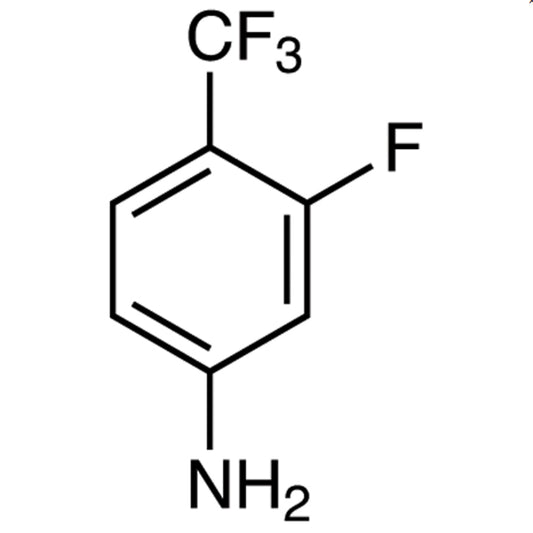
3-Amino-4-fluorobenzotrifluoride is a chemical compound widely used as a building block in the synthesis of complex organic molecules. Its unique molecular structure, featuring both an amino group and a fluorine atom on the benzene ring, makes it a versatile reagent in chemical reactions. This compound plays a crucial role in laboratory settings where the construction of intricate molecular frameworks is required. It is particularly valuable in research areas that demand precise chemical modifications and controlled reactivity.
The compound's chemical stability and predictable reactivity make it a preferred choice for various synthetic pathways. Its fluorinated structure contributes to enhanced solubility and reactivity in specific reaction conditions, allowing for greater control over chemical transformations. These properties make it ideal for substitution and electrophilic reactions, where the introduction of functional groups is essential. The combination of amino and fluorine functionalities also enables the compound to participate in a wide range of chemical processes, enhancing its utility in organic synthesis.
In Indonesian laboratories, 3-Amino-4-fluorobenzotrifluoride is commonly used in research focused on the development of bioactive compounds. It is a key reagent in pharmaceutical and functional chemical studies, supporting experiments that require high accuracy and consistency. Its availability ensures that researchers can conduct experiments with reliable results, contributing to advancements in scientific knowledge and innovation.
TCI brochures (PDF)
- Fluorination Reagents, Fluorinated Building Blocks 2026-03-18 · p. 17
Related TCI products
- TCI A2469 69411-68-3 4-Amino-2-fluorobenzotrifluoride
- TCI A1164 2357-47-3 5-Amino-2-fluorobenzotrifluoride
- TCI A1158 393-39-5 2-Amino-5-fluorobenzotrifluoride
- TCI B5333 630125-49-4 3-Bromo-5-nitrobenzotrifluoride
- TCI A0376 400-98-6 4-Amino-3-nitrobenzotrifluoride
- TCI T1042 394-25-2 4-Methoxy-3-nitrobenzotrifluoride
- Organic synthesis of bioactive compounds where fluorinated and amino functionalities are required for molecular design.
- Pharmaceutical research involving the development of new drugs with enhanced pharmacological properties.
- Functional chemical studies that require precise modification of aromatic rings through substitution reactions.
- Academic research in Indonesian universities focusing on advanced chemical transformations and molecular engineering.
- Industrial applications in chemical manufacturing processes that demand controlled reactivity and stability.
| Brand | TCI |
|---|---|
| CAS number | 535-52-4 |
| Molecular formula | — |
| Purity | — |
| Category | Chemistry > Building Blocks > Fluorinated Building Blocks |
| Pack sizes | Available in various quantities as per standard laboratory supply |
| Physical form | Solid (exact form may vary based on supplier packaging) |
| Storage | Store in a cool, dry place away from direct sunlight and moisture |
This compound should be stored in a cool, dry environment to maintain its chemical stability. It is recommended to keep it in airtight containers to prevent exposure to moisture and air. Due to its chemical nature, it should be handled in a well-ventilated area, and appropriate personal protective equipment should be worn when handling. Avoid contact with incompatible materials such as strong oxidizing agents. Regular inspection of storage conditions ensures the integrity of the compound remains unaffected. Proper labeling and secure storage are essential to prevent accidental exposure and ensure safe laboratory practices.
—
Produk Terkait
-
4-Amino-2-fluorobenzotrifluoride TCI A2469
Regular price From Rp 1.856.400,00Regular priceRp 1.297.800,00Sale price From Rp 1.856.400,00 -
5-Amino-2-fluorobenzotrifluoride TCI A1164
Regular price From Rp 477.750,00Regular priceRp 333.900,00Sale price From Rp 477.750,00 -
2-Amino-5-fluorobenzotrifluoride TCI A1158
Regular price From Rp 1.140.300,00Regular priceRp 796.950,00Sale price From Rp 1.140.300,00 -
3-Bromo-5-nitrobenzotrifluoride TCI B5333
Regular price From Rp 584.850,00Regular priceRp 408.450,00Sale price From Rp 584.850,00 -
4-Amino-3-nitrobenzotrifluoride TCI A0376
Regular price Rp 2.782.500,00Regular priceRp 1.945.650,00Sale price Rp 2.782.500,00 -
4-Methoxy-3-nitrobenzotrifluoride TCI T1042
Regular price From Rp 664.650,00Regular priceRp 464.100,00Sale price From Rp 664.650,00 -
4-Nitrobenzotrifluoride TCI N0902
Regular price Rp 2.491.650,00Regular priceRp 1.741.950,00Sale price Rp 2.491.650,00 -
3-Nitrobenzotrifluoride TCI N0280
Regular price From Rp 980.700,00Regular priceRp 685.650,00Sale price From Rp 980.700,00