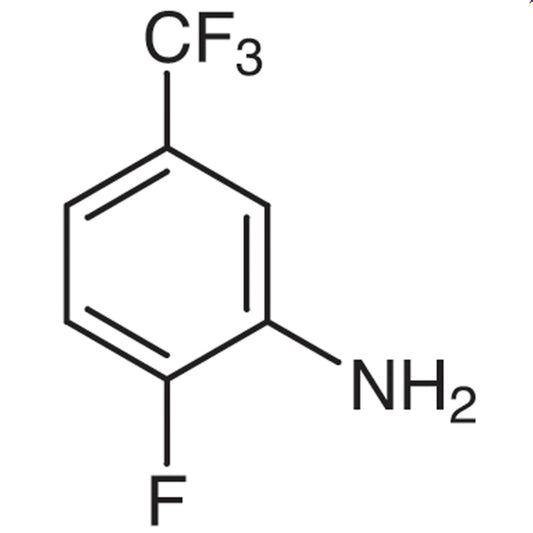
4-Amino-2-fluorobenzotrifluoride is a fluorinated building block widely used in the synthesis of organofluorine compounds. As a key intermediate in chemical reactions, it plays a vital role in laboratories where fluorine substitution is required. Its unique molecular structure enables it to participate in various chemical transformations, making it an essential component in the development of compounds with specific chemical and biological properties. This compound is particularly valuable in research settings where the introduction of fluorine atoms is necessary for achieving desired functional characteristics.
The compound’s chemical properties, including its reactivity and stability under controlled conditions, make it a preferred choice for synthetic chemists. It is capable of undergoing substitution, reduction, and other complex reactions, which allows for the creation of a wide range of fluorinated derivatives. These characteristics make it suitable for use in both academic and industrial research. Its ability to react with various reagents ensures its versatility in different synthetic pathways, contributing to its widespread application in chemical synthesis.
In Indonesian laboratories, 4-Amino-2-fluorobenzotrifluoride is commonly used in chemical research, especially in the field of organofluorine chemistry. It is a key reagent in the development of new compounds with specific properties, such as enhanced stability or biological activity. Its availability in the local market supports ongoing research efforts, enabling scientists to explore the potential of fluorinated compounds in various scientific and industrial applications.
TCI brochures (PDF)
- Fluorination Reagents, Fluorinated Building Blocks 2026-03-18 · p. 20
Related TCI products
- TCI A1582 535-52-4 3-Amino-4-fluorobenzotrifluoride
- TCI A1164 2357-47-3 5-Amino-2-fluorobenzotrifluoride
- TCI A1158 393-39-5 2-Amino-5-fluorobenzotrifluoride
- TCI B5333 630125-49-4 3-Bromo-5-nitrobenzotrifluoride
- TCI A0376 400-98-6 4-Amino-3-nitrobenzotrifluoride
- TCI T1042 394-25-2 4-Methoxy-3-nitrobenzotrifluoride
- Fluorinated Compound Synthesis: This compound is ideal for creating fluorinated derivatives due to its reactivity and compatibility with various synthetic pathways.
- Medicinal Chemistry Research: It is frequently used in the development of pharmaceuticals where fluorine substitution enhances drug efficacy and stability.
- Organic Reaction Studies: Its ability to undergo substitution and reduction reactions makes it a valuable tool for studying reaction mechanisms and chemical transformations.
- Material Science Investigations: It supports the synthesis of advanced materials with unique chemical and physical properties.
- Environmental Chemistry Research: It is used to study the behavior and degradation of fluorinated compounds in environmental systems.
| Brand | TCI |
|---|---|
| CAS number | 69411-68-3 |
| Molecular formula | — |
| Purity | — |
| Category | Chemistry > Building Blocks > Fluorinated Building Blocks |
| Pack sizes | Available in various quantities as per standard laboratory requirements |
| Physical form | Solid, crystalline appearance |
| Storage | Store in a cool, dry place away from light and moisture |
This compound should be stored in a cool, dry environment, away from direct light and moisture to maintain its stability. It is recommended to use airtight containers made of materials that are chemically inert to prevent any unwanted reactions. Due to its reactivity, it should be handled with care, using appropriate personal protective equipment such as gloves and safety goggles. Proper ventilation is essential when working with this compound to minimize exposure. It is important to keep it away from incompatible substances to ensure safe storage and handling in the laboratory.
—
Produk Terkait
-
3-Amino-4-fluorobenzotrifluoride TCI A1582
Regular price From Rp 477.750,00Regular priceRp 333.900,00Sale price From Rp 477.750,00 -
5-Amino-2-fluorobenzotrifluoride TCI A1164
Regular price From Rp 477.750,00Regular priceRp 333.900,00Sale price From Rp 477.750,00 -
2-Amino-5-fluorobenzotrifluoride TCI A1158
Regular price From Rp 1.140.300,00Regular priceRp 796.950,00Sale price From Rp 1.140.300,00 -
3-Bromo-5-nitrobenzotrifluoride TCI B5333
Regular price From Rp 584.850,00Regular priceRp 408.450,00Sale price From Rp 584.850,00 -
4-Amino-3-nitrobenzotrifluoride TCI A0376
Regular price Rp 2.782.500,00Regular priceRp 1.945.650,00Sale price Rp 2.782.500,00 -
4-Methoxy-3-nitrobenzotrifluoride TCI T1042
Regular price From Rp 664.650,00Regular priceRp 464.100,00Sale price From Rp 664.650,00 -
4-Nitrobenzotrifluoride TCI N0902
Regular price Rp 2.491.650,00Regular priceRp 1.741.950,00Sale price Rp 2.491.650,00 -
3-Nitrobenzotrifluoride TCI N0280
Regular price From Rp 980.700,00Regular priceRp 685.650,00Sale price From Rp 980.700,00