


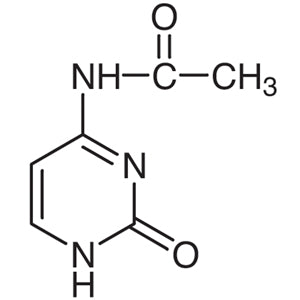
N4-Acetylcytosine is a chemical compound classified under the category of heterocyclic building blocks, commonly used in organic chemistry and biochemical research. As a derivative of cytosine, it plays a crucial role in the synthesis of complex organic compounds, particularly those related to nucleotide structures. In laboratory settings, this compound serves as a foundational element for the development of various molecules, including pharmaceuticals, biochemical reagents, and synthetic compounds. Its structural versatility makes it an essential tool for researchers aiming to explore molecular modifications and functional group transformations.
N4-Acetylcytosine is valued for its chemical stability and reactivity, which allow it to participate effectively in substitution, coupling, and modification reactions. Its solubility in organic solvents such as ethyl acetate and acetone enhances its usability in diverse experimental conditions. These properties make it a preferred choice for synthetic chemists and biochemists who require reliable and consistent performance in their experiments. The compound’s predictable behavior under various reaction conditions ensures reproducibility and accuracy in laboratory procedures.
In Indonesian laboratories, N4-Acetylcytosine is frequently utilized in organic chemistry research, especially in projects involving the synthesis of biomedically relevant compounds or the development of new chemical materials. It supports studies focused on nucleotide-related structures and their applications in drug discovery and biochemical analysis. Its availability and performance make it a key component in both academic and industrial research environments.
TCI brochures (PDF)
- Nucleosides, Nucleotides, Nucleic Acids and Related Reagents 2026-03-23 · p. 8
- Organic synthesis of nucleotide derivatives due to its structural similarity to cytosine and its reactivity in functional group modifications.
- Development of pharmaceutical compounds as a building block for nucleoside analogs used in drug design and therapeutic research.
- Biochemical research involving nucleic acid analogs for studying DNA and RNA interactions and modifications.
- Synthesis of synthetic polymers and biocompatible materials through controlled chemical reactions and molecular assembly.
- Analytical chemistry applications for standardization and calibration in nucleotide-related assays and spectroscopic studies.
| Brand | TCI |
|---|---|
| CAS number | 14631-20-0 |
| Molecular formula | — |
| Purity | — |
| Category | Chemistry > Building Blocks > Heterocyclic Building Blocks |
| Pack sizes | Available in various quantities as per supplier specifications |
| Physical form | Solid (as per standard chemical product form) |
| Storage | Store in a cool, dry place away from light and moisture |
N4-Acetylcytosine should be stored in a cool, dry environment, away from direct light and moisture to maintain its chemical stability. It is recommended to use airtight containers to prevent exposure to humidity and contaminants. Proper labeling of storage containers is essential for safe handling and identification. In laboratory settings, it is important to follow standard chemical safety protocols, including the use of personal protective equipment such as gloves and goggles. The compound is generally non-hazardous under normal conditions but should be handled with care to avoid any potential chemical interactions. Regular monitoring of storage conditions ensures the integrity of the material for research applications.
—
Produk Terkait
-
N4-Benzoylcytosine TCI B3169
Regular price Rp 875.700,00Regular priceRp 627.900,00Sale price Rp 875.700,00 -
AdenineHydrochlorideHemihydrate TCI A0150
Regular price From Rp 717.150,00Regular priceRp 516.600,00Sale price From Rp 717.150,00 -
Uracil TCI U0013
Regular price From Rp 742.350,00Regular priceRp 534.450,00Sale price From Rp 742.350,00 -
4-Thiouracil TCI T2757
Regular price Rp 2.835.000,00Regular priceRp 1.998.150,00Sale price Rp 2.835.000,00 -
8-Bromo-7-(2-butyn-1-yl)-3-methylxanthine TCI B4454
Regular price Rp 1.458.450,00Regular priceRp 1.035.300,00Sale price Rp 1.458.450,00 -
O~6~-Benzylguanine TCI B4208
Regular price From Rp 1.220.100,00Regular priceRp 868.350,00Sale price From Rp 1.220.100,00 -
6-Benzyloxypurine TCI B3355
Regular price Rp 2.650.200,00Regular priceRp 1.869.000,00Sale price Rp 2.650.200,00 -
N6-Benzyladenine TCI B1088
Regular price From Rp 955.500,00Regular priceRp 683.550,00Sale price From Rp 955.500,00


