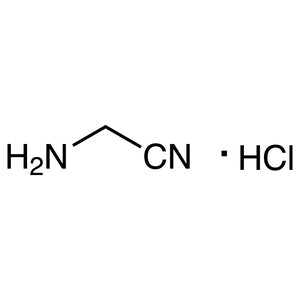
Aminoacetonitrile Hydrochloride is a chemical compound widely used in laboratory settings for its versatility in chemical reactions and organic synthesis. As a fundamental building block, it plays a crucial role in the development of more complex molecular structures. Its simple yet essential structure makes it a valuable tool for researchers aiming to create new compounds with specific functional groups. This compound is particularly important in the field of synthetic chemistry, where it serves as a starting point for various chemical transformations. Its reactivity and stability make it a reliable choice for a wide range of experimental applications.
The compound is known for its chemical stability and high reactivity, which are key factors in its popularity among chemists. It dissolves well in organic solvents such as ethyl acetate and acetone, making it easy to handle and incorporate into different reaction systems. These properties ensure that it remains a preferred choice in both academic and industrial research environments. Its consistent performance and predictable behavior under various conditions contribute to its reliability in laboratory settings, especially when precision and reproducibility are required.
In Indonesian laboratories, Aminoacetonitrile Hydrochloride is commonly used in both educational and research contexts. It is a staple in university chemistry departments and research institutions, where it supports basic chemical experiments as well as advanced synthetic projects. Its availability in the local market ensures that it is accessible to a wide range of users, making it an essential component of many laboratory workflows.
Related TCI products
- TCI A0912 5466-22-8 Aminoacetonitrile Sulfate
- TCI D4145 70591-20-7 N-(Diphenylmethylene)aminoacetonitrile
- TCI C1439 3589-41-1 N-(Benzyloxycarbonyl)aminoacetonitrile
- TCI M0140 5616-32-0 Methylaminoacetonitrile
- TCI D1104 3010-02-4 Diethylaminoacetonitrile
- TCI A0252 41784-08-1 4'-Aminoacetophenone Hydrochloride
- Organic synthesis applications benefit from its reactivity and ability to form complex molecules through various chemical reactions.
- It is ideal for academic research due to its simplicity and reliability in producing consistent results in laboratory experiments.
- Pharmaceutical research often utilizes this compound as a building block for the development of new drug molecules and therapeutic agents.
- Material science experiments leverage its chemical properties to create new compounds with specific functional characteristics.
- Educational institutions use it for teaching fundamental chemical reactions and synthetic techniques to students at all levels.
| Brand | TCI |
|---|---|
| CAS number | 6011-14-9 |
| Molecular formula | — |
| Purity | — |
| Category | Chemistry > Building Blocks > Non-Heterocyclic Building Blocks |
| Pack sizes | Available in various quantities to suit different laboratory needs |
| Physical form | Solid powder |
| Storage | Store in a cool, dry place away from moisture and direct sunlight |
Aminoacetonitrile Hydrochloride should be stored in a cool, dry environment to maintain its chemical integrity. It is recommended to keep the compound in a tightly sealed container to prevent exposure to moisture and air. Due to its reactivity, it should be handled with care, using appropriate personal protective equipment such as gloves and safety goggles. It is important to store it away from incompatible substances to avoid any potential chemical interactions. In laboratory settings, proper ventilation should be maintained when handling this compound to ensure a safe working environment. Regular inspection of storage conditions is advised to ensure long-term stability and usability of the material.
—
Produk Terkait
-
AminoacetonitrileSulfate TCI A0912
Regular price Rp 1.749.300,00Regular priceRp 1.239.000,00Sale price Rp 1.749.300,00 -
N-(Diphenylmethylene)aminoacetonitrile TCI D4145
Regular price Rp 1.431.150,00Regular priceRp 1.016.400,00Sale price Rp 1.431.150,00 -
N-(Benzyloxycarbonyl)aminoacetonitrile TCI C1439
Regular price Rp 4.954.950,00Regular priceRp 3.480.750,00Sale price Rp 4.954.950,00 -
Methylaminoacetonitrile TCI M0140
Regular price Rp 3.603.600,00Regular priceRp 2.535.750,00Sale price Rp 3.603.600,00 -
Diethylaminoacetonitrile TCI D1104
Regular price Rp 3.180.450,00Regular priceRp 2.239.650,00Sale price Rp 3.180.450,00 -
4'-AminoacetophenoneHydrochloride TCI A0252
Regular price Rp 2.411.850,00Regular priceRp 1.702.050,00Sale price Rp 2.411.850,00 -
4'-Dimethylaminoacetophenone TCI D1575
Regular price Rp 875.700,00Regular priceRp 627.900,00Sale price Rp 875.700,00 -
3'-Dimethylaminoacetophenone TCI D1446
Regular price Rp 3.100.650,00Regular priceRp 2.184.000,00Sale price Rp 3.100.650,00