

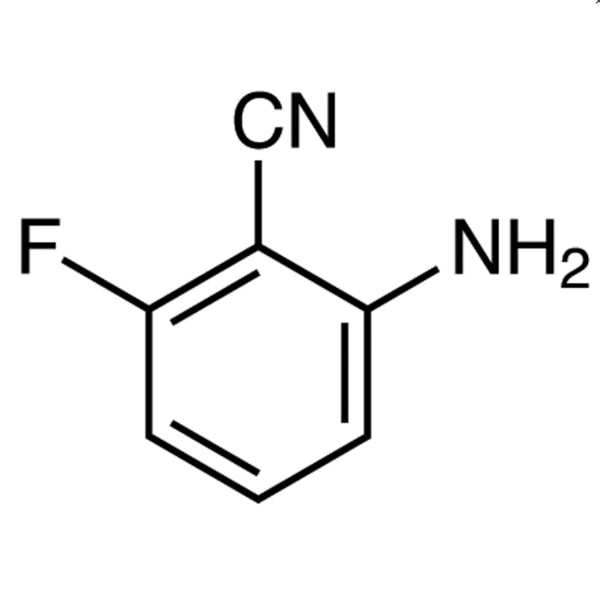
2-Amino-6-fluorobenzonitrile is a chemical compound widely used as a building block in the synthesis of complex organic molecules. It plays a crucial role in laboratory settings by enabling the creation of structurally diverse compounds through various chemical reactions, including substitution and electrophilic reactions. This compound is particularly valuable in the field of organic chemistry due to its versatile functional groups, which allow for further modification and functionalization. Its presence in fluorinated building blocks makes it an essential tool for researchers aiming to develop new compounds with specific properties.
The compound's reactivity is enhanced by the presence of both an amino group and a nitrile group, which contribute to its high chemical reactivity. The inclusion of a fluorine atom further influences its polarity and stability, making it suitable for precise chemical reactions. These characteristics make it a preferred choice for applications requiring controlled and predictable chemical behavior. Its stability under certain conditions also ensures that it remains a reliable reagent in various synthetic processes.
In Indonesian laboratories, 2-Amino-6-fluorobenzonitrile is commonly used in research related to organic chemistry, pharmacology, and materials science. Its availability in solid form and ease of handling make it practical for use in both small-scale and larger experimental setups. This compound supports the development of new materials and pharmaceuticals, contributing to the advancement of scientific research in Indonesia.
TCI brochures (PDF)
- Fluorination Reagents, Fluorinated Building Blocks 2026-03-18 · p. 16
Related TCI products
- TCI A1965 63069-50-1 4-Amino-3-fluorobenzonitrile
- TCI B4988 421552-12-7 2-(Bromomethyl)-4-fluorobenzonitrile
- TCI B4600 179898-34-1 3-Bromo-5-fluorobenzonitrile
- TCI B4022 133059-44-6 4-Bromo-3-fluorobenzonitrile
- TCI B3204 105942-09-4 4-(Bromomethyl)-3-fluorobenzonitrile
- TCI B3183 79544-27-7 2-Bromo-6-fluorobenzonitrile
- Organic synthesis applications benefit from its reactivity and functional groups, enabling the creation of complex molecules.
- Pharmaceutical research utilizes its structure for designing new drug compounds with desired biological activity.
- Material science studies leverage its fluorinated structure for developing advanced polymer and coating materials.
- Analytical chemistry experiments use it as a standard compound for calibration and reference purposes.
- Environmental research incorporates it to study the behavior of fluorinated compounds in different chemical environments.
| Brand | TCI |
|---|---|
| CAS number | 77326-36-4 |
| Molecular formula | — |
| Purity | — |
| Category | Chemistry > Building Blocks > Fluorinated Building Blocks |
| Pack sizes | Available in various quantities as per standard laboratory supply |
| Physical form | Solid |
| Storage | Store in a cool, dry place away from light and moisture |
This compound should be stored in a cool, dry environment, away from direct light and moisture to maintain its stability and reactivity. It is recommended to use airtight containers to prevent exposure to air and humidity, which could affect its chemical integrity. Due to its reactive nature, it should be handled in a well-ventilated area, and appropriate personal protective equipment should be worn when working with it. Proper labeling and storage conditions are essential to ensure safety and maintain the compound's effectiveness in laboratory applications. Always follow standard laboratory safety protocols when handling this material to minimize risks associated with chemical exposure.
—
Produk Terkait
-
4-Amino-3-fluorobenzonitrile TCI A1965
Regular price From Rp 4.133.850,00Regular priceRp 2.906.400,00Sale price From Rp 4.133.850,00 -
2-(Bromomethyl)-4-fluorobenzonitrile TCI B4988
Regular price From Rp 1.033.200,00Regular priceRp 738.150,00Sale price From Rp 1.033.200,00 -
3-Bromo-5-fluorobenzonitrile TCI B4600
Regular price From Rp 822.150,00Regular priceRp 590.100,00Sale price From Rp 822.150,00 -
4-Bromo-3-fluorobenzonitrile TCI B4022
Regular price From Rp 2.782.500,00Regular priceRp 1.961.400,00Sale price From Rp 2.782.500,00 -
4-(Bromomethyl)-3-fluorobenzonitrile TCI B3204
Regular price From Rp 1.272.600,00Regular priceRp 905.100,00Sale price From Rp 1.272.600,00 -
2-Bromo-6-fluorobenzonitrile TCI B3183
Regular price Rp 795.900,00Regular priceRp 572.250,00Sale price Rp 795.900,00 -
2-Bromo-5-fluorobenzonitrile TCI B3010
Regular price From Rp 1.326.150,00Regular priceRp 942.900,00Sale price From Rp 1.326.150,00 -
4-Bromo-2-fluorobenzonitrile TCI B2745
Regular price From Rp 1.881.600,00Regular priceRp 1.331.400,00Sale price From Rp 1.881.600,00


