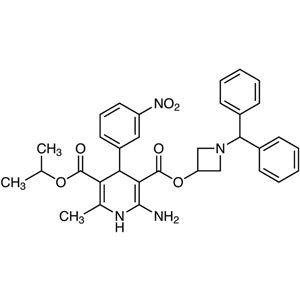
Azelnidipine is a pharmacological compound widely used in pharmacological and clinical pharmacology research. As a derivative of a calcium antagonist, it plays a significant role in studies examining the pharmacological effects on the cardiovascular system. This compound is essential for investigating the pharmacological activity, mechanism of action, and side effects of specific drugs. In laboratory settings, Azelnidipine is used to explore molecular interactions and biological responses to pharmaceutical agents. Its stability under controlled conditions ensures reliable results in various experimental procedures.
Azelnidipine is preferred due to its chemical stability and ability to maintain pharmacological activity throughout the research process. Its complex chemical structure allows for use in multiple analytical methods, including spectroscopy, chromatography, and biological activity testing. The compound’s consistent performance makes it a reliable choice for experiments requiring accuracy and reproducibility. Researchers appreciate its role in enabling detailed studies of drug interactions and physiological responses.
In Indonesian laboratories, Azelnidipine is commonly used by researchers at universities and research institutions. It is integral to studies related to drug development, pharmacodynamics, and toxicology. Its application supports both basic and applied research, contributing to advancements in pharmaceutical science. The compound’s versatility and reliability make it a valuable tool for scientists working in various research fields.
TCI brochures (PDF)
- Calcium Signaling Research Reagents 2025-05-26 · p. 1
- Pharmaceutical Ingredients for Research and Experimental Use 2026-03-09 · p. 20
- Reagents for Biological Research 2025-03-11 · p. 45
- Pharmacological research for studying drug mechanisms and physiological responses.
- Clinical pharmacology studies to evaluate drug efficacy and side effects in controlled environments.
- Biochemical analysis to investigate molecular interactions and drug metabolism pathways.
- Toxicology experiments to assess the safety and long-term effects of pharmaceutical compounds.
- Drug development projects requiring accurate and consistent pharmacological activity testing.
| Brand | TCI |
|---|---|
| CAS number | 123524-52-7 |
| Molecular formula | — |
| Purity | — |
| Category | Life Science > Biochemicals and Reagents > Pharmaceutical Research Reagents |
| Pack sizes | Available in standard laboratory quantities as per supplier specifications |
| Physical form | Solid, crystalline powder |
| Storage | Store in a cool, dry place away from light and moisture |
Azelnidipine should be stored in a cool, dry environment, away from direct light and moisture to maintain its chemical stability. It is recommended to use sealed containers to prevent exposure to air and humidity. Due to its pharmaceutical nature, it should be handled with appropriate personal protective equipment, such as gloves and safety goggles, to ensure laboratory safety. The compound is not flammable or corrosive, but standard laboratory precautions should still be observed when working with it. Proper labeling and storage conditions are essential to maintain its integrity and ensure safe handling during experiments.
—
Product Categories
- Biochemicals and ReagentsPharmaceutical Research Reagents (for Experimental Use)Antihypertensive Ingredients (for Research and Experimental Use)
- Cell BiologyCell Signaling and NeuroscienceCalcium Signaling
- Cell BiologyCell Signaling and Neuroscience
- Pharmaceutical Development and Drug Discovery ResearchPharmaceutical Research Reagents (for Experimental Use)Antihypertensive Ingredients (for Research and Experimental Use)
Produk Terkait
-
ManidipineDihydrochloride TCI M2225
Regular price Rp 5.830.650,00Regular price -
VerapamilHydrochloride TCI V0118
Regular price From Rp 1.565.550,00Regular price -
Isradipine TCI I0876
Regular price Rp 7.659.750,00Regular price -
(+)-cis-DiltiazemHydrochloride TCI D3662
Regular price From Rp 2.359.350,00Regular price -
Zonisamide TCI Z0026
Regular price From Rp 2.147.250,00Regular price -
SodiumValproate TCI S0894
Regular price From Rp 2.016.000,00Regular price -
2-PropylvalericAcid TCI P0823
Regular price From Rp 1.749.300,00Regular price -
Ethosuximide TCI E0746
Regular price From Rp 1.961.400,00Regular price