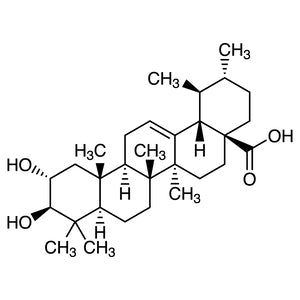
Asiatic Acid, with CAS number 464-92-6, is a natural compound derived from specific plant sources and widely utilized in life science research. This compound plays a crucial role in biochemical and pharmacological studies due to its diverse biological activities. It is commonly used as a research reagent in laboratories for investigating the mechanisms of various diseases and for developing therapeutic agents. Its presence in experimental settings enables scientists to explore its potential in both traditional and modern medicine.
Asiatic Acid is valued for its complex chemical structure, which contributes to its reactivity and stability in laboratory conditions. It exhibits excellent solubility in organic solvents, making it versatile for a wide range of chemical reactions. Additionally, its strong antioxidant properties make it suitable for applications in biomedical and health-related research. These characteristics, combined with its biological activity, make it a preferred choice for researchers seeking compounds with therapeutic potential.
In Indonesian laboratories, Asiatic Acid is frequently used in studies related to chronic diseases, herbal medicine development, and the investigation of biological effects of natural compounds. Its availability and reliability as a research material have made it a staple in many scientific investigations. Researchers rely on its consistent performance and well-documented properties to support their experimental work.
Advantages (TCI brochure)
- Pentacyclic triterpene extracted from Centella asiatica, a tropical medicinal plant
- Possesses wide pharmacological activities
TCI brochures (PDF)
- Crude Medicine Ingredients for Cancer Research 2025-02-17 · p. 1
- Traditional Medicine/Crude Medicine Research Reagents 2024-09-11 · p. 1
- Terpenes 2025-09-22 · p. 9
- Plant Research Reagents 2026-02-24 · p. 8
- Phytochemicals 2025-12-17 · p. 2
- Pharmaceutical Ingredients for Research and Experimental Use 2026-03-09 · p. 49
- Anti-inflammatory Research: Asiatic Acid is ideal for studying inflammatory responses due to its known anti-inflammatory properties.
- Drug Development: It serves as a key reagent in the formulation of herbal and synthetic drugs, supporting pharmacological studies.
- Biochemical Analysis: Its solubility and reactivity make it suitable for various biochemical assays and reaction protocols.
- Oxidative Stress Studies: The compound’s strong antioxidant activity makes it valuable in research on oxidative stress and cellular damage.
- Chronic Disease Research: It is used to investigate the mechanisms of chronic diseases and potential therapeutic interventions.
| Brand | TCI |
|---|---|
| CAS number | 464-92-6 |
| Molecular formula | — |
| Purity | — |
| Category | Life Science > Biochemicals and Reagents > Crude Medicine Ingredients for Research and Experimental Use |
| Pack sizes | Available in various quantities as per standard laboratory requirements |
| Physical form | Solid, crystalline appearance |
| Storage | — |
Asiatic Acid should be stored in a cool, dry, and well-ventilated area away from direct sunlight. It is recommended to keep it in a sealed container to prevent moisture absorption. Due to its chemical nature, it should be handled with appropriate personal protective equipment, such as gloves and safety goggles. Avoid exposure to incompatible substances and ensure proper ventilation when working with it. Storage conditions should maintain its stability and prevent degradation. Regular inspection of the container is advised to ensure it remains intact and free from contamination.
—
Product Categories
- Biochemicals and ReagentsCrude Medicine Ingredients for Research and Experimental Use
- Biochemicals and ReagentsPharmaceutical Research Reagents (for Experimental Use)Cosmetic Research Reagents (for Experimental Use)
- Biochemicals and ReagentsTerpenesTriterpenes
- Cell BiologyNutrition ResearchPhytochemicals
- Pharmaceutical Development and Drug Discovery ResearchPharmaceutical Research Reagents (for Experimental Use)Cosmetic Research Reagents (for Experimental Use)
- Pharmaceutical Development and Drug Discovery ResearchCrude Medicine Ingredients for Research and Experimental Use
Produk Terkait
-
MoronicAcid TCI M2610
Regular price From Rp 4.559.100,00Regular priceRp 3.203.550,00Sale price From Rp 4.559.100,00 -
20(R)-GinsenosideRh2 TCI G0567
Regular price From Rp 4.293.450,00Regular priceRp 3.017.700,00Sale price From Rp 4.293.450,00 -
CorosolicAcid TCI C3921
Regular price Rp 8.770.650,00Regular priceRp 6.148.800,00Sale price Rp 8.770.650,00 -
Arbutin TCI A0522
Regular price From Rp 505.050,00Regular priceRp 368.550,00Sale price From Rp 505.050,00 -
Allantoin TCI A0211
Regular price Rp 795.900,00Regular priceRp 572.250,00Sale price Rp 795.900,00 -
UrsolicAcid TCI U0065
Regular price From Rp 1.908.900,00Regular priceRp 1.350.300,00Sale price From Rp 1.908.900,00 -
BetulinicAcid TCI B2836
Regular price From Rp 1.723.050,00Regular priceRp 1.220.100,00Sale price From Rp 1.723.050,00 -
Betulinol TCI B0803
Regular price Rp 1.881.600,00Regular priceRp 1.331.400,00Sale price Rp 1.881.600,00