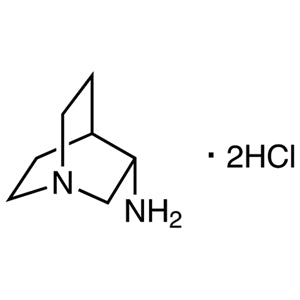
(R)-(+)-3-Aminoquinuclidine Dihydrochloride is a chiral compound widely used in asymmetric synthesis, playing a crucial role in the development of chiral molecules with specific biological activity. This compound is essential in organic chemistry research, particularly in pharmaceutical and medicinal chemistry applications. Its unique stereochemical properties make it a valuable tool for creating enantiomerically pure compounds, which are critical in drug development and other advanced chemical processes. As a chiral building block, it provides a foundation for synthesizing complex molecules with precise stereochemistry.
The compound is known for its stability under standard laboratory conditions and its solubility in organic solvents, which simplifies handling and manipulation during chemical reactions. These properties make it a preferred choice for researchers working on asymmetric synthesis and chiral compound development. Its ability to participate in controlled stereoselective reactions enhances its utility in creating compounds with desired biological effects. The compound's reliability and consistent performance contribute to its popularity in both academic and industrial research settings.
In Indonesian laboratories, (R)-(+)-3-Aminoquinuclidine Dihydrochloride is commonly used in pharmaceutical and organic chemistry research. Researchers in universities and research institutions rely on this compound for experiments requiring precise stereochemical control. Its application is widespread in drug discovery and development, where the synthesis of chiral molecules is essential for creating effective and safe pharmaceutical products.
TCI brochures (PDF)
- Chiral Building Blocks 2025-04-14 · p. 5
Related TCI products
- TCI A2434 119904-90-4 (S)-(-)-3-Aminoquinuclidine Dihydrochloride
- TCI A1054 116183-83-6 (3S)-(+)-3-Aminopyrrolidine Dihydrochloride
- TCI A1236 6530-09-2 3-Aminoquinuclidine Dihydrochloride
- TCI D2828 19777-66-3 (S)-1,2-Diaminopropane Dihydrochloride
- TCI D2827 19777-67-4 (R)-1,2-Diaminopropane Dihydrochloride
- TCI B6393 212611-88-6 (1R,2R)-N1,N2-Dibenzylcyclohexane-1,2-diamine Dihydrochloride
- Asymmetric synthesis in pharmaceutical research due to its chiral structure and stereoselective properties.
- Development of enantiomerically pure compounds for drug discovery and medicinal chemistry applications.
- Organic chemistry experiments requiring controlled stereochemistry in complex molecule synthesis.
- Research in pharmacology where chiral compounds are essential for biological activity studies.
- Creation of chiral building blocks for the synthesis of biologically active molecules in academic and industrial settings.
| Brand | TCI |
|---|---|
| CAS number | 123536-14-1 |
| Molecular formula | — |
| Purity | — |
| Category | Chemistry > Asymmetric Synthesis > Chiral Building Blocks |
| Pack sizes | Available in various quantities as per supplier specifications |
| Physical form | Solid powder |
| Storage | Store in a cool, dry place away from light and moisture |
This compound should be stored in a cool, dry environment, away from direct light and moisture to maintain its stability and purity. It is recommended to use airtight containers to prevent exposure to humidity and contaminants. Due to its chemical nature, it should be handled with appropriate personal protective equipment, such as gloves and safety goggles, to ensure laboratory safety. While it is generally stable under standard conditions, it should be kept in a secure location to prevent accidental exposure. Proper storage and handling are essential to maintain its effectiveness in research applications.
—
Produk Terkait
-
(S)-(-)-3-AminoquinuclidineDihydrochloride TCI A2434
Regular price Rp 1.431.150,00Regular price -
(3S)-(+)-3-AminopyrrolidineDihydrochloride TCI A1054
Regular price From Rp 4.347.000,00Regular price -
3-AminoquinuclidineDihydrochloride TCI A1236
Regular price From Rp 1.829.100,00Regular price -
(S)-1,2-DiaminopropaneDihydrochloride TCI D2828
Regular price Rp 1.431.150,00Regular price -
(R)-1,2-DiaminopropaneDihydrochloride TCI D2827
Regular price Rp 2.306.850,00Regular price -
(1R,2R)-N1,N2-Dibenzylcyclohexane-1,2-diamineDihydrochloride TCI B6393
Regular price From Rp 3.605.700,00Regular price -
(1S,2S)-N~1~,N~2~-Dibenzylcyclohexane-1,2-diamineDihydrochloride TCI B6390
Regular price From Rp 3.605.700,00Regular price -
XyleminDihydrochloride TCI X0080
Regular price From Rp 2.518.950,00Regular price