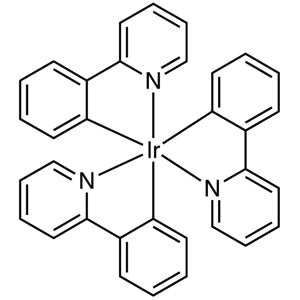
TCI A3149 1173886-71-9, also known as (Acetylacetonato)bis(2-phenylquinoline-C2,N')iridium(III), is a metal-based complex compound widely used in catalytic reactions and chemical synthesis. This iridium(III) complex is designed to facilitate various organic reactions, particularly those requiring high electronic activation. Its unique structure, featuring acetylacetonato and 2-phenylquinoline ligands, makes it an effective catalyst in laboratory settings. The compound is especially valuable in applications where precise control over reaction pathways is essential.
The compound's high reactivity and ability to accelerate chemical reactions without being consumed make it a preferred choice for researchers. Its stability under a range of reaction conditions ensures reliable performance, while its optical properties open up possibilities in photonic and optical material applications. These characteristics make it a versatile tool for both fundamental and applied research in chemistry and catalysis.
In Indonesian laboratories, this compound is commonly used in catalytic and synthetic research. It is particularly favored for its efficiency in organic reactions, such as hydroformylation and C–C bond formation. Its role in advancing chemical processes and supporting scientific innovation is well recognized among researchers in the region.
TCI brochures (PDF)
- Organic Light-Emitting Diode (OLED) Materials 2026-08-18 · p. 8
- Transition Metal Catalysts 2026-04-10 · p. 11
Related TCI products
- TCI T3716 94928-86-6 Tris(2-phenylpyridinato)iridium(III)
- TCI T2685 435293-93-9 Tris[1-phenylisoquinoline-C2,N]iridium(III) (purified by sublimation)
- TCI T1946 94928-86-6 Tris(2-phenylpyridinato)iridium(III) (purified by sublimation)
- TCI B4944 864163-80-4 (2,2'-Bipyridine)bis[2-(2,4-difluorophenyl)pyridine]iridium(III) Hexafluorophosphate
- TCI B4893 106294-60-4 (2,2'-Bipyridine)bis(2-phenylpyridinato)iridium(III) Hexafluorophosphate
- TCI P2637 337526-85-9 (2,4-Pentanedionato)bis(2-phenylpyridine)iridium(III)
- Organic catalysis: This compound is ideal for organic reactions requiring high electronic activation, such as hydroformylation and C–C bond formation, due to its efficient catalytic properties.
- Photocatalytic reactions: Its unique optical properties make it suitable for applications in photocatalysis, where light-induced reactions are essential.
- Synthetic chemistry research: It is widely used in synthetic chemistry to facilitate complex molecule synthesis, offering high selectivity and yield.
- Material science applications: The compound's optical characteristics make it valuable in the development of advanced optical materials and devices.
- Transition metal catalysis studies: Its structure and reactivity make it a key component in studies involving transition metal-based catalysts and their mechanisms.
| Brand | TCI |
|---|---|
| CAS number | 1173886-71-9 |
| Molecular formula | — |
| Purity | — |
| Category | Chemistry > Catalysis and Inorganic Chemistry > Transition Elements [Catalysis and Inorganic Chemistry] |
| Pack sizes | Available in various quantities as per standard laboratory supply |
| Physical form | Solid powder |
| Storage | Store in a cool, dry place away from moisture and direct sunlight |
This compound should be stored in a cool, dry environment, away from moisture and direct sunlight to maintain its stability and effectiveness. It is recommended to use airtight containers to prevent exposure to air and humidity, which could affect its performance. Due to its reactivity, it should be handled with care, using appropriate personal protective equipment such as gloves and safety goggles. It is important to ensure that the storage area is well-ventilated to minimize any potential risks associated with its chemical nature. Proper labeling and storage practices are essential to maintain the integrity of the compound and ensure safe laboratory operations.
—
Product Categories
Produk Terkait
-
Tris(2-phenylpyridinato)iridium(III) TCI T3716
Regular price From Rp 5.114.550,00Regular priceRp 3.592.050,00Sale price From Rp 5.114.550,00 -
Tris[1-phenylisoquinoline-C2,N]iridium(III)(purifiedbysublimation) TCI T2685
Regular price Rp 10.785.600,00Regular priceRp 7.557.900,00Sale price Rp 10.785.600,00 -
Tris(2-phenylpyridinato)iridium(III)(purifiedbysublimation) TCI T1946
Regular price Rp 8.240.400,00Regular priceRp 5.778.150,00Sale price Rp 8.240.400,00 -
(2,2'-Bipyridine)bis[2-(2,4-difluorophenyl)pyridine]iridium(III)Hexafluorophosphate TCI B4944
Regular price Rp 8.983.800,00Regular priceRp 6.297.900,00Sale price Rp 8.983.800,00 -
(2,2'-Bipyridine)bis(2-phenylpyridinato)iridium(III)Hexafluorophosphate TCI B4893
Regular price Rp 6.360.900,00Regular priceRp 4.463.550,00Sale price Rp 6.360.900,00 -
(2,4-Pentanedionato)bis(2-phenylpyridine)iridium(III) TCI P2637
Regular price Rp 4.849.950,00Regular priceRp 3.407.250,00Sale price Rp 4.849.950,00 -
(4,4'-Di-tert-butyl-2,2'-bipyridine)bis[(2-pyridinyl)phenyl]iridium(III)Hexafluorophosphate TCI D4887
Regular price Rp 6.518.400,00Regular priceRp 4.573.800,00Sale price Rp 6.518.400,00 -
(Acetylacetonato)(1,5-cyclooctadiene)iridium(I) TCI A2981
Regular price From Rp 1.988.700,00Regular priceRp 1.405.950,00Sale price From Rp 1.988.700,00