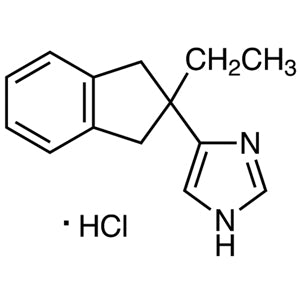
Atipamezole is a chemical compound widely used in pharmacological and biochemical research, particularly in studies related to drugs that interact with the central nervous system. As an antagonist to drugs acting through alpha-2 adrenergic receptors, such as xylazine, it plays a crucial role in experimental settings where the effects of such compounds need to be studied or reversed. In the laboratory, Atipamezole serves as a valuable tool for investigating the mechanisms and effects of various pharmaceutical agents. Its application extends to experiments involving the modulation of neural activity and physiological responses in test animals. Due to its specific and reliable properties, Atipamezole is a preferred choice in scientific research requiring precise control and accurate testing.
Atipamezole is known for its chemical stability, which allows it to be used under a variety of laboratory conditions. It exhibits good solubility in organic solvents, making it convenient for preparation and use in experimental procedures. This solubility characteristic ensures that it can be effectively incorporated into different types of chemical reactions and laboratory tests. Additionally, the high purity of Atipamezole guarantees consistent and reliable results in experiments, enhancing the accuracy of scientific findings. These properties collectively make it a dependable and versatile reagent for researchers.
In Indonesian laboratories, Atipamezole is commonly used in pharmacological and biochemical experiments. It is particularly relevant in studies involving the central nervous system, where its antagonistic properties are essential for understanding drug interactions. Researchers in Indonesia rely on Atipamezole for its reliability and effectiveness in experimental setups, especially in academic and industrial research environments. Its use is widespread in both basic and applied research, contributing to the advancement of scientific knowledge in the region.
TCI brochures (PDF)
- Pharmaceutical Ingredients for Research and Experimental Use 2026-03-09 · p. 25
- Pharmacological research involving alpha-2 adrenergic receptor antagonism, as Atipamezole is used to counteract the effects of drugs like xylazine in experimental models.
- Neuropharmacological studies where modulation of central nervous system activity is required, due to its ability to influence neural responses in test animals.
- Biochemical experiments requiring precise control over receptor interactions, as its specificity allows for accurate testing of drug mechanisms.
- Animal behavior studies where physiological responses to various stimuli need to be measured and manipulated, benefiting from its role in reversing sedative effects.
- Drug development programs focusing on the identification and testing of compounds with potential therapeutic applications in neurological disorders.
| Brand | TCI |
|---|---|
| CAS number | 104054-27-5 |
| Molecular formula | — |
| Purity | — |
| Category | Life Science > Biochemicals and Reagents > Pharmaceutical Research Reagents |
| Pack sizes | As per manufacturer specifications |
| Physical form | Solid (as per standard product description) |
| Storage | Store in a cool, dry place away from light and moisture |
Atipamezole should be stored in a cool, dry place, away from direct light and moisture to maintain its chemical stability. It is recommended to keep it in a tightly sealed container to prevent contamination and degradation. Due to its chemical nature, it should be handled with appropriate personal protective equipment, such as gloves and safety goggles, to ensure laboratory safety. The compound is not flammable, but it should be stored separately from incompatible substances to avoid any potential chemical interactions. Regular inspection of storage conditions is advised to ensure the integrity of the material remains unaffected. Proper labeling and documentation of storage locations are essential for safe and efficient laboratory management.
—
Product Categories
- Biochemicals and ReagentsPharmaceutical Research Reagents (for Experimental Use)Neurotransmitter Agent Ingredients (for Research and Experimental Use)
- Cell BiologyBioactive Small Molecules
- Cell BiologyCell Signaling and NeuroscienceNeuroscience
- Pharmaceutical Development and Drug Discovery ResearchPharmaceutical Research Reagents (for Experimental Use)Neurotransmitter Agent Ingredients (for Research and Experimental Use)
Produk Terkait
-
AtipamezoleHydrochloride TCI A2956
Regular price From Rp 5.855.850,00Regular priceRp 4.110.750,00Sale price From Rp 5.855.850,00 -
WAY-100635Maleate TCI W0016
Regular price From Rp 5.300.400,00Regular priceRp 3.722.250,00Sale price From Rp 5.300.400,00 -
TolazolineHydrochloride TCI T3791
Regular price Rp 1.696.800,00Regular priceRp 1.202.250,00Sale price Rp 1.696.800,00 -
MecamylamineHydrochloride TCI M3503
Regular price Rp 5.352.900,00Regular priceRp 3.759.000,00Sale price Rp 5.352.900,00 -
SalmeterolXinafoate TCI A3190
Regular price From Rp 7.949.550,00Regular priceRp 5.574.450,00Sale price From Rp 7.949.550,00 -
EVP-6124Hydrochloride TCI E1453
Regular price Rp 3.498.600,00Regular priceRp 2.462.250,00Sale price Rp 3.498.600,00 -
4-AminobutyricAcid TCI A0282
Regular price From Rp 505.050,00Regular priceRp 352.800,00Sale price From Rp 505.050,00 -
AtropineSulfateMonohydrate TCI A0550
Regular price From Rp 1.908.900,00Regular priceRp 1.350.300,00Sale price From Rp 1.908.900,00