


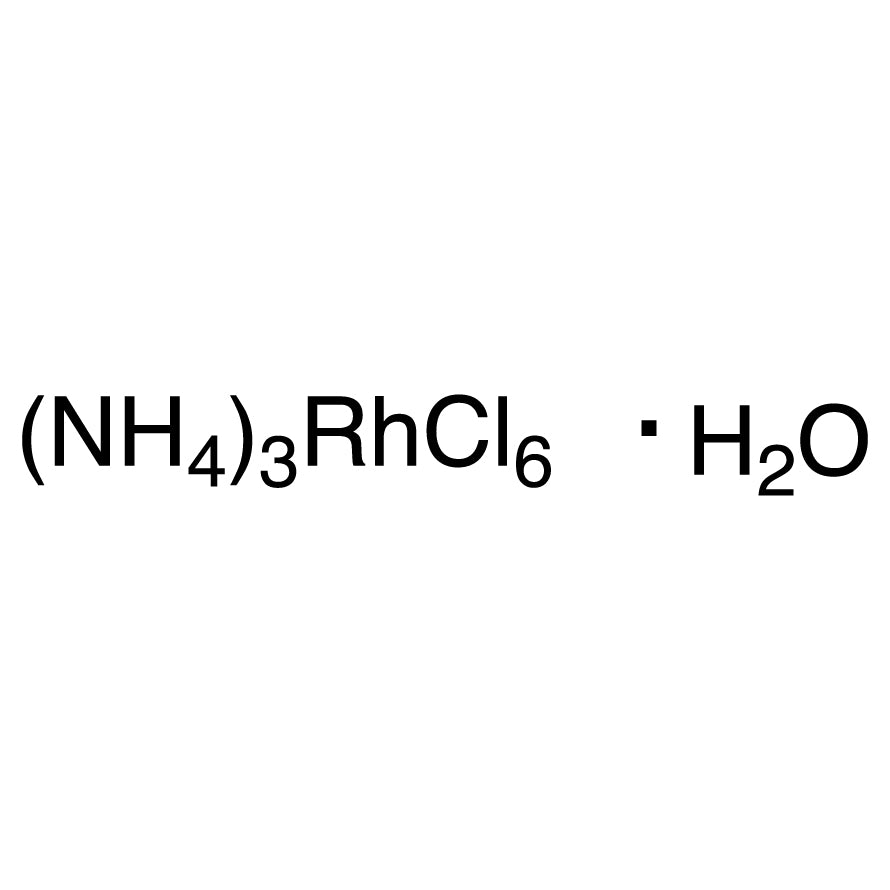
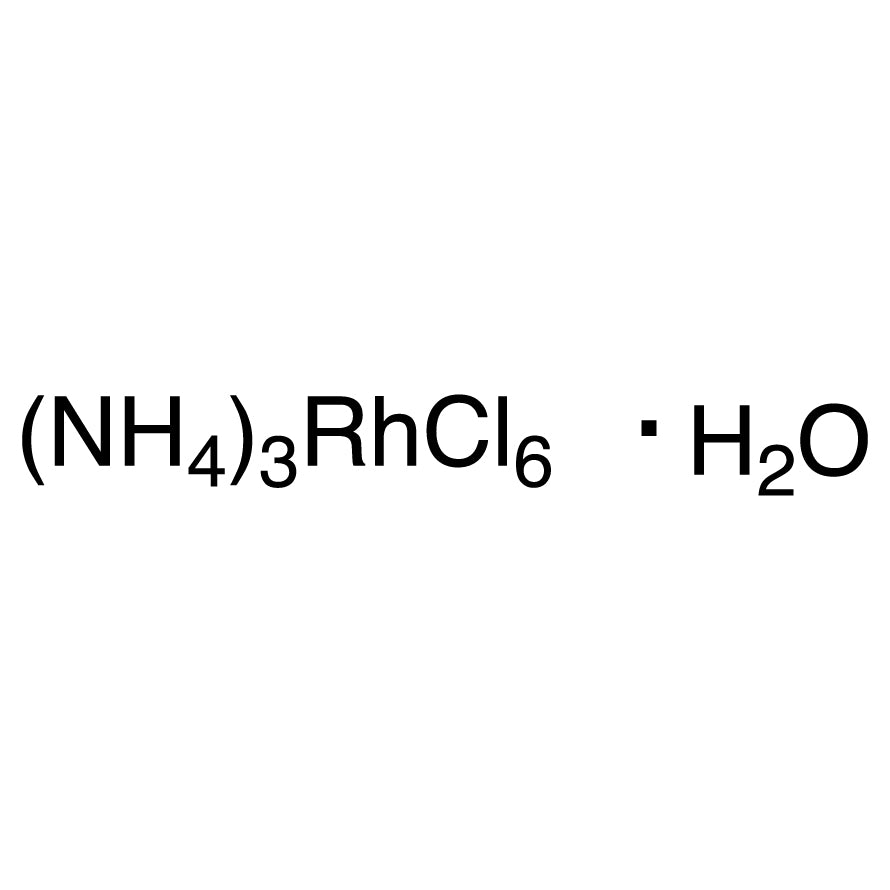
Ammonium Hexachlororhodate(III) Monohydrate is a chemical compound widely used in laboratory settings, particularly in catalysis and inorganic chemistry. This compound plays a crucial role in various chemical reactions, especially those involving transition metals. Its unique structure, featuring rhodate(III) ions coordinated with chloride and ammonium ions, makes it an essential reagent for synthesizing complex compounds. Due to its reactivity, it is often employed in redox reactions and the formation of both organic and inorganic substances. Its versatility in chemical applications makes it a valuable tool for researchers and students alike.
The compound is known for its high reactivity and solubility in organic solvents such as ethanol and acetone. These properties make it a preferred choice for applications requiring efficient dissolution and rapid reaction kinetics. Its ability to act as a catalyst in various synthetic processes enhances its utility in both academic and industrial research. Additionally, its chemical stability under controlled conditions ensures consistent performance in laboratory experiments. The combination of reactivity and solubility makes it ideal for a wide range of chemical investigations.
In Indonesian laboratories, Ammonium Hexachlororhodate(III) Monohydrate is commonly used in inorganic chemistry and catalysis research. It is frequently found in academic institutions and research centers where chemical synthesis and reaction studies are conducted. Its role in facilitating complex reactions and its availability through suppliers like AMI Scientific make it a staple in the chemical laboratories of Indonesia. Researchers and students rely on its properties to achieve reliable and reproducible results in their experiments.
TCI brochures (PDF)
- Transition Metal Catalysts 2026-04-10 · p. 10
Related TCI products
- TCI T2661 2635339-90-9 Tetrakis[N-tetrafluorophthaloyl-(S)-tert-leucinato]dirhodium Bis(ethyl Acetate) Adduct
- TCI T2659 1816286-21-1 Tetrakis[N-tetrachlorophthaloyl-(S)-tert-leucinato]dirhodium Bis(ethyl Acetate) Adduct
- TCI T2658 2001054-66-4 Tetrakis[N-tetrachlorophthaloyl-(R)-tert-leucinato]dirhodium Bis(ethyl Acetate) Adduct
- TCI T2055 Tetrakis[N-phthaloyl-(S)-tert-leucinato]dirhodium Bis(ethyl Acetate) Adduct
- TCI T2054 Tetrakis[N-phthaloyl-(R)-tert-leucinato]dirhodium Bis(ethyl Acetate) Adduct
- TCI T1551 131219-55-1 Tetrakis[N-phthaloyl-(S)-phenylalaninato]dirhodium Ethyl Acetate Adduct
- Inorganic synthesis reactions benefit from its ability to act as a catalyst, enabling the formation of complex coordination compounds.
- Redox reactions often utilize this compound due to its reactivity and capacity to participate in electron transfer processes.
- Organic synthesis applications leverage its solubility and reactivity for the preparation of organic compounds under controlled conditions.
- Catalytic processes in industrial and academic settings rely on its efficiency in promoting chemical transformations.
- Research in transition metal chemistry frequently incorporates this compound to study coordination and reaction mechanisms.
| Brand | TCI |
|---|---|
| CAS number | 63771-38-0 |
| Molecular formula | — |
| Purity | — |
| Category | Chemistry > Catalysis and Inorganic Chemistry > Transition Elements |
| Pack sizes | Available in various quantities as per supplier specifications |
| Physical form | Solid, monohydrate form |
| Storage | Store in a cool, dry place away from moisture and heat |
Ammonium Hexachlororhodate(III) Monohydrate should be stored in a cool, dry environment to prevent degradation due to moisture and high temperatures. It is recommended to use airtight containers to minimize exposure to humidity. Due to its reactivity, it should be handled with care, and appropriate personal protective equipment should be worn when working with it. Avoid contact with incompatible substances to ensure safety in the laboratory. Proper storage conditions help maintain its chemical stability and effectiveness in experimental applications.
—
Produk Terkait
-
Tetrakis[N-tetrafluorophthaloyl-(S)-tert-leucinato]dirhodiumBis(ethylAcetate)Adduct TCI T2661
Regular price Rp 8.506.050,00Regular priceRp 5.964.000,00Sale price Rp 8.506.050,00 -
Tetrakis[N-tetrachlorophthaloyl-(S)-tert-leucinato]dirhodiumBis(ethylAcetate)Adduct TCI T2659
Regular price Rp 8.240.400,00Regular priceRp 5.778.150,00Sale price Rp 8.240.400,00 -
Tetrakis[N-tetrachlorophthaloyl-(R)-tert-leucinato]dirhodiumBis(ethylAcetate)Adduct TCI T2658
Regular price Rp 6.333.600,00Regular priceRp 4.444.650,00Sale price Rp 6.333.600,00 -
Tetrakis[N-phthaloyl-(S)-tert-leucinato]dirhodiumBis(ethylAcetate)Adduct TCI T2055
Regular price Rp 6.095.250,00Regular priceRp 4.277.700,00Sale price Rp 6.095.250,00 -
Tetrakis[N-phthaloyl-(R)-tert-leucinato]dirhodiumBis(ethylAcetate)Adduct TCI T2054
Regular price Rp 6.095.250,00Regular priceRp 4.277.700,00Sale price Rp 6.095.250,00 -
Tetrakis[N-phthaloyl-(S)-phenylalaninato]dirhodiumEthylAcetateAdduct TCI T1551
Regular price Rp 6.518.400,00Regular priceRp 4.573.800,00Sale price Rp 6.518.400,00 -
Tetrakis(triphenylacetato)dirhodium(II)DichloromethaneAdduct TCI T1544
Regular price Rp 4.133.850,00Regular priceRp 2.906.400,00Sale price Rp 4.133.850,00 -
Bis[rhodium(alpha,alpha,alpha',alpha'-tetramethyl-1,3-benzenedipropionicAcid)] TCI B4549
Regular price Rp 2.464.350,00Regular priceRp 1.738.800,00Sale price Rp 2.464.350,00


