

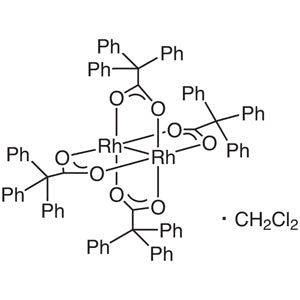
Tetrakis(triphenylacetato)dirhodium(II) Dichloromethane Adduct is a transition metal complex based on rhodium(II) that plays a key role as a catalyst in modern organic synthesis. In the chemistry laboratory, this compound is used primarily for C-H bond activation, a process that converts relatively inert carbon-hydrogen bonds into reactive centers that can be further functionalized. As a catalyst, it enables reactions to proceed with greater selectivity and efficiency than conventional pathways. This product is supplied in a 100 mg package by TCI, a reagent supplier widely recognized in the research community. The compound is generally employed in organic chemistry, inorganic chemistry, and materials chemistry research to construct complex molecules with high stereoselectivity and reproducible results.
The distinctive "paddlewheel" structure featuring two rhodium atoms and four triphenylacetate ligands provides good thermal stability as well as an electronic environment that supports controlled carbene and nitrene transfer. These structural characteristics make the complex a preferred choice for researchers who require reliable and predictable catalytic behavior in demanding transformations. The dichloromethane adduct form indicates that the compound is frequently used under reaction conditions involving dichloromethane as a solvent, allowing it to be handled conveniently in standard laboratory setups. Its well-defined architecture and consistent performance underpin its reputation as a dependable tool for selective C-H functionalization chemistry.
In Indonesian laboratories, this catalyst is typically applied in academic and institutional research settings focused on organic synthesis, catalysis, and materials science. Researchers commonly use it when designing synthetic routes that demand high stereocontrol and reproducibility, such as the construction of complex molecular frameworks. It is also relevant to projects exploring new catalytic methods for C-H activation and related transformations. Given its specialized nature, the compound is usually handled by experienced chemists in advanced research facilities, and its 100 mg packaging is well suited to the scale of typical investigative experiments conducted in university and research institute laboratories across Indonesia.
Related TCI products
- TCI T2661 2635339-90-9 Tetrakis[N-tetrafluorophthaloyl-(S)-tert-leucinato]dirhodium Bis(ethyl Acetate) Adduct
- TCI T2659 1816286-21-1 Tetrakis[N-tetrachlorophthaloyl-(S)-tert-leucinato]dirhodium Bis(ethyl Acetate) Adduct
- TCI T2658 2001054-66-4 Tetrakis[N-tetrachlorophthaloyl-(R)-tert-leucinato]dirhodium Bis(ethyl Acetate) Adduct
- TCI T2055 Tetrakis[N-phthaloyl-(S)-tert-leucinato]dirhodium Bis(ethyl Acetate) Adduct
- TCI T2054 Tetrakis[N-phthaloyl-(R)-tert-leucinato]dirhodium Bis(ethyl Acetate) Adduct
- TCI T1551 131219-55-1 Tetrakis[N-phthaloyl-(S)-phenylalaninato]dirhodium Ethyl Acetate Adduct
- C-H Activation Studies: This catalyst enables the direct functionalization of unreactive carbon-hydrogen bonds, allowing researchers to convert inert positions into useful reactive centers for building more complex molecules.
- Stereoselective Synthesis: The paddlewheel rhodium structure provides a controlled electronic environment that supports highly selective reactions, making it ideal for constructing molecules with precise three-dimensional arrangements.
- Carbene and Nitrene Transfer Reactions: The compound's electronic configuration facilitates controlled transfer of carbene and nitrene units, enabling efficient insertion chemistry that is difficult to achieve with conventional reagents.
- Organometallic and Inorganic Research: As a well-defined rhodium(II) complex, it serves as a model catalyst in fundamental studies of metal-mediated transformations and coordination chemistry.
- Materials Chemistry Development: Researchers use this catalyst to prepare structurally complex organic frameworks with high reproducibility, supporting the design of advanced molecular materials for further study.
| Brand | TCI |
|---|---|
| CAS number | 142214-04-8 |
| Molecular formula | — |
| Purity | — |
| Category | Chemistry > Catalysis and Inorganic Chemistry > C-H Activation [Catalysis] |
| Pack sizes | 100 mg |
| Physical form | Solid complex (dichloromethane adduct form) |
| Storage | Store under conditions that preserve the dichloromethane adduct integrity, away from moisture and heat |
The compound should be stored in a cool, dry place in its original tightly sealed container, protected from moisture, direct sunlight, and excessive heat to preserve the integrity of the dichloromethane adduct. Suitable containers include the original manufacturer's vial or any chemically compatible, airtight glass vessel. When handling, wear appropriate personal protective equipment such as laboratory gloves and safety goggles, and work in a well-ventilated area or fume hood. Avoid inhaling dust or vapors, prevent contact with skin and eyes, and keep the material away from open flames and strong oxidizing agents. Always follow standard laboratory safety procedures and consult the supplier's safety documentation before use.
—
Produk Terkait
-
Tetrakis[N-tetrafluorophthaloyl-(S)-tert-leucinato]dirhodiumBis(ethylAcetate)Adduct TCI T2661
Regular price Rp 8.453.550,00Regular price -
Tetrakis[N-tetrachlorophthaloyl-(S)-tert-leucinato]dirhodiumBis(ethylAcetate)Adduct TCI T2659
Regular price Rp 8.187.900,00Regular price -
Tetrakis[N-tetrachlorophthaloyl-(R)-tert-leucinato]dirhodiumBis(ethylAcetate)Adduct TCI T2658
Regular price Rp 6.281.100,00Regular price -
Tetrakis[N-phthaloyl-(S)-tert-leucinato]dirhodiumBis(ethylAcetate)Adduct TCI T2055
Regular price Rp 6.042.750,00Regular price -
Tetrakis[N-phthaloyl-(R)-tert-leucinato]dirhodiumBis(ethylAcetate)Adduct TCI T2054
Regular price Rp 6.042.750,00Regular price -
Tetrakis[N-phthaloyl-(S)-phenylalaninato]dirhodiumEthylAcetateAdduct TCI T1551
Regular price Rp 6.465.900,00Regular price -
[1,1'-Bis(diphenylphosphino)ferrocene]palladium(II)DichlorideDichloromethaneAdduct TCI B2064
Regular price From Rp 2.068.500,00Regular price -
Bis[rhodium(alpha,alpha,alpha',alpha'-tetramethyl-1,3-benzenedipropionicAcid)] TCI B4549
Regular price Rp 2.411.850,00Regular price
![2635339-90-9 Tetrakis[N-tetrafluorophthaloyl-(S)-tert-leucinato]dirhodium Bis(ethyl Acetate) Adduct - AMI Scientific](http://amiscientific.com/cdn/shop/files/TCI2510T2661.jpg?v=1767143212&width=533)
![1816286-21-1 Tetrakis[N-tetrachlorophthaloyl-(S)-tert-leucinato]dirhodium Bis(ethyl Acetate) Adduct - AMI Scientific](http://amiscientific.com/cdn/shop/files/TCI2510T2659.jpg?v=1767143207&width=533)
![2001054-66-4 Tetrakis[N-tetrachlorophthaloyl-(R)-tert-leucinato]dirhodium Bis(ethyl Acetate) Adduct - AMI Scientific](http://amiscientific.com/cdn/shop/files/TCI2510T2658.jpg?v=1767143203&width=533)
![Tetrakis[N-phthaloyl-(S)-tert-leucinato]dirhodium Bis(ethyl Acetate) Adduct - AMI Scientific](http://amiscientific.com/cdn/shop/files/TCI2510T2055.jpg?v=1767142579&width=533)
![Tetrakis[N-phthaloyl-(R)-tert-leucinato]dirhodium Bis(ethyl Acetate) Adduct - AMI Scientific](http://amiscientific.com/cdn/shop/files/TCI2510T2054.jpg?v=1767142575&width=533)
![131219-55-1 Tetrakis[N-phthaloyl-(S)-phenylalaninato]dirhodium Ethyl Acetate Adduct - AMI Scientific](http://amiscientific.com/cdn/shop/files/TCI2510T1551.jpg?v=1767141820&width=533)
![95464-05-4 [1,1'-Bis(diphenylphosphino)ferrocene]palladium(II) Dichloride Dichloromethane Adduct - AMI Scientific](http://amiscientific.com/cdn/shop/files/TCI2510B2064_55725750-1d93-4607-a5e5-5c490594863a.jpg?v=1767330765&width=533)
![819050-89-0 Bis[rhodium(alpha,alpha,alpha',alpha'-tetramethyl-1,3-benzenedipropionic Acid)] - AMI Scientific](http://amiscientific.com/cdn/shop/files/TCI2510B4549.jpg?v=1767091344&width=533)