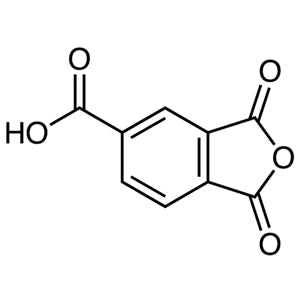
Trimellitic Acid (TCI B0042), with CAS number 528-44-9, is a versatile chemical compound widely used in laboratory settings for various chemical reactions. As a non-heterocyclic building block in organic chemistry, it serves as a fundamental component in the synthesis of complex molecules. Its unique structure, featuring three carboxylic acid groups, allows it to participate in multiple chemical reactions, making it an essential tool for chemists. This compound is commonly employed in the development of polymers, pharmaceuticals, and industrial chemicals due to its reactivity and functional versatility.
One of the key properties that make Trimellitic Acid a preferred choice is its ability to act as a cross-linking agent in chemical reactions. The presence of three carboxylic acid groups enables it to form ester, amide, or amine linkages with a variety of functional groups. This reactivity makes it suitable for applications such as esterification, amidation, and condensation reactions. Additionally, its chemical stability under controlled conditions ensures consistent performance in laboratory experiments. These characteristics contribute to its widespread use in both academic and industrial research environments.
In Indonesian laboratories, Trimellitic Acid is highly relevant for organic chemistry research, compound synthesis, and the development of new chemical materials. It is frequently used by researchers and students in higher education institutions and research centers for experimental purposes. Its role in creating complex molecular structures supports advancements in pharmaceutical and polymer science, making it an essential reagent in the Indonesian scientific community.
TCI brochures (PDF)
- Organic Linker Molecules for Metal Organic Frameworks (MOFs) 2026-05-11 · p. 4
- Organic synthesis applications benefit from Trimellitic Acid due to its reactivity and ability to form multiple functional groups, enabling the creation of complex molecules.
- Polymer development relies on Trimellitic Acid as a cross-linking agent, enhancing the structural integrity and properties of synthetic polymers.
- Pharmaceutical research utilizes this compound for the synthesis of drug molecules, where its functional groups can be modified to achieve desired therapeutic effects.
- Industrial chemical production uses Trimellitic Acid as a building block for the manufacture of various chemical products, including coatings and adhesives.
- Educational laboratories incorporate Trimellitic Acid in teaching experiments to demonstrate carboxylic acid reactions and molecular synthesis techniques.
| Brand | TCI |
|---|---|
| CAS number | 528-44-9 |
| Molecular formula | — |
| Purity | — |
| Category | Chemistry > Building Blocks > Non-Heterocyclic Building Blocks |
| Pack sizes | Available in various quantities as per standard laboratory supply |
| Physical form | Solid, typically in crystalline or powder form |
| Storage | Store in a cool, dry place away from moisture and direct sunlight |
Trimellitic Acid should be stored in a cool, dry environment to maintain its chemical stability and prevent degradation. It is recommended to keep it in airtight containers to minimize exposure to moisture and air, which can affect its reactivity. Due to its acidic nature, it should be handled with appropriate personal protective equipment, such as gloves and safety goggles, to ensure laboratory safety. Avoid contact with skin and eyes, and ensure proper ventilation when working with this compound. It is important to store it away from incompatible materials, such as strong bases or oxidizing agents, to prevent unwanted chemical reactions. Proper storage and handling practices help maintain the compound's effectiveness and ensure safe laboratory operations.
—
Product Categories
- Organic-Inorganic Hybrid MaterialsMetal Organic Frameworks (MOF) and Their Raw MaterialsOrganic Linker Molecules [Metal Organic Frameworks (MOFs) Precursors]
- Polymer/Macromolecule ReagentsMetal Organic Frameworks (MOF) and Their Raw MaterialsOrganic Linker Molecules [Metal Organic Frameworks (MOFs) Precursors]
Produk Terkait
-
HemimelliticAcid TCI H1592
Regular price Rp 5.300.400,00Regular priceRp 3.706.500,00Sale price Rp 5.300.400,00 -
TrimelliticAnhydride TCI C0959
Regular price From Rp 505.050,00Regular priceRp 352.800,00Sale price From Rp 505.050,00 -
TrimelliticAnhydride TCI C0046
Regular price From Rp 505.050,00Regular priceRp 352.800,00Sale price From Rp 505.050,00 -
AcetylenedicarboxylicAcid TCI A0088
Regular price From Rp 1.220.100,00Regular priceRp 868.350,00Sale price From Rp 1.220.100,00 -
Tetrakis(4-carboxyphenyl)methane TCI T3896
Regular price Rp 6.863.850,00Regular priceRp 4.799.550,00Sale price Rp 6.863.850,00 -
1,2,4,5-Tetrakis(4-carboxyphenyl)benzene TCI T3894
Regular price From Rp 2.837.100,00Regular priceRp 1.983.450,00Sale price From Rp 2.837.100,00 -
1,3,5-Tris(4-carboxyphenyl)benzene TCI T2647
Regular price From Rp 3.683.400,00Regular priceRp 2.575.650,00Sale price From Rp 3.683.400,00 -
5-BromoisophthalicAcid TCI B4232
Regular price From Rp 1.193.850,00Regular priceRp 834.750,00Sale price From Rp 1.193.850,00