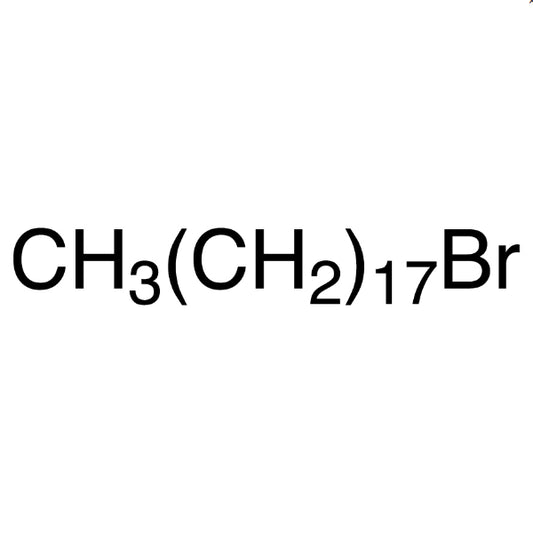
1-Bromoeicosane is a chemical compound belonging to the category of saturated hydrocarbon chains with a bromine substitution at the terminal end. This compound plays a crucial role in organic chemistry laboratories, where it serves as a foundational building block for the synthesis of more complex molecules. Its unique structure allows it to participate in various chemical reactions, making it an essential reagent for researchers aiming to create customized organic compounds. Due to its chemical versatility, it is widely used in both academic and industrial research settings.
The compound's chemical properties, including its limited solubility in polar solvents and its reactivity in specific chemical environments, make it a preferred choice for controlled synthetic processes. Its stability under certain conditions ensures that it can be safely stored and used in a variety of experimental setups. Additionally, its long carbon chain and bromine substitution contribute to its reactivity in nucleophilic substitution and elimination reactions, which are fundamental in organic synthesis.
In Indonesian laboratories, 1-Bromoeicosane is commonly used in organic chemistry research, particularly in academic settings. It is a key component in the development of new compounds and is often utilized in experiments that require precise chemical reactions. Its role in creating structured and reactive compounds makes it an indispensable tool for chemists working in both research and development environments.
TCI brochures (PDF)
- Building Blocks for Organic Semiconductor 2026-03-24 · p. 43
- Organic synthesis experiments require 1-Bromoeicosane as a versatile building block for creating complex molecular structures.
- It is ideal for nucleophilic substitution reactions due to its bromine substitution, allowing for targeted chemical modifications.
- In elimination reactions, this compound can be used to generate alkenes, making it useful in synthetic pathways.
- Its limited solubility in polar solvents makes it suitable for reactions in non-polar environments, enhancing reaction specificity.
- Indonesian academic labs use it extensively in teaching and research to demonstrate fundamental organic chemistry concepts.
| Brand | TCI |
|---|---|
| CAS number | 4276-49-7 |
| Molecular formula | — |
| Purity | — |
| Category | Chemistry > Building Blocks > Non-Heterocyclic Building Blocks |
| Pack sizes | Available in standard laboratory quantities |
| Physical form | Liquid |
| Storage | Store in a cool, dry place away from light and incompatible materials |
1-Bromoeicosane should be stored in a cool, dry location away from direct sunlight and sources of heat. It is recommended to use airtight containers made of materials compatible with organic solvents to prevent evaporation and contamination. Due to its reactivity, it should be kept away from strong bases, oxidizing agents, and other reactive substances. Proper ventilation is essential when handling this compound to minimize exposure. In laboratory settings, it is important to follow standard safety protocols, including the use of personal protective equipment such as gloves and goggles. Regular monitoring of storage conditions ensures the compound remains stable and safe for use in chemical experiments.
—
Product Categories
Produk Terkait
-
1-Bromoheptadecane TCI B0937
Regular price From Rp 3.340.050,00Regular priceRp 2.335.200,00Sale price From Rp 3.340.050,00 -
1-Bromopentadecane TCI B0936
Regular price From Rp 3.949.050,00Regular priceRp 2.761.500,00Sale price From Rp 3.949.050,00 -
1-Bromotridecane TCI B0935
Regular price From Rp 2.518.950,00Regular priceRp 1.760.850,00Sale price From Rp 2.518.950,00 -
1-Bromoundecane TCI B0934
Regular price From Rp 1.035.300,00Regular priceRp 723.450,00Sale price From Rp 1.035.300,00 -
1-Bromononane TCI B0933
Regular price From Rp 1.485.750,00Regular priceRp 1.038.450,00Sale price From Rp 1.485.750,00 -
1-Bromopentane TCI B0628
Regular price From Rp 530.250,00Regular priceRp 370.650,00Sale price From Rp 530.250,00 -
1-Bromooctane TCI B0626
Regular price From Rp 452.550,00Regular priceRp 316.050,00Sale price From Rp 452.550,00 -
1-Bromooctadecane TCI B0625
Regular price From Rp 452.550,00Regular priceRp 316.050,00Sale price From Rp 452.550,00