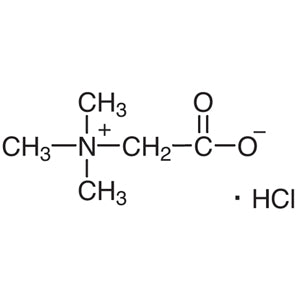
Betaine Anhydrous from TCI (product code B0455) is the water-free form of betaine, also known as trimethylglycine. It is a derivative of the amino acid glycine in which the nitrogen atom carries three methyl groups. The molecule is therefore a zwitterion, with a permanent positive charge on the quaternary nitrogen and a negative charge on the carboxylate group. In the laboratory, betaine is used as a synthetic building block, an additive in molecular biology, a protective osmolyte, and a reference compound in nutrition and metabolism studies.
Researchers choose betaine for its stable zwitterionic character, its high solubility in water, and its relatively low tendency to interfere with biomolecules. As an osmolyte, betaine helps cells and proteins withstand osmotic stress. In PCR, betaine is known to reduce the formation of DNA secondary structures and to help amplify GC-rich templates. The anhydrous form provides a more precise amount of active compound per gram than hydrated forms, which makes it easier to prepare solutions at a measured concentration and supports consistent results between batches of experiments.
In Indonesia, anhydrous betaine is relevant to laboratories working in molecular biology, biotechnology, nutrition, animal feed, agriculture, and chemistry. University research groups, government research institutes, and industrial quality control laboratories can use it to optimise PCR, study osmotic stress responses, prepare standards for feed and nutrition analysis, and support organic synthesis. A consistent, well-documented TCI reagent helps these laboratories keep their methods reproducible.
TCI brochures (PDF)
- Quaternary Ammonium Salts 2025-11-10 · p. 9
- PCR enhancement: betaine reduces the formation of DNA secondary structures, which helps amplify difficult GC-rich templates that often give weak or nonspecific products in standard reactions.
- Osmolyte and protein stabilisation studies: as a compatible osmolyte, betaine helps cells and proteins withstand osmotic stress, so it suits experiments on stress tolerance and protein stability.
- Organic synthesis building block: its quaternary ammonium and carboxylate groups make betaine a useful non-heterocyclic building block for preparing derivatives in synthetic chemistry research.
- Nutrition and metabolism research: betaine is a common reference compound in studies of methyl-group metabolism, and the anhydrous form allows accurate weighing for standard preparation.
- Animal feed and agricultural analysis: laboratories testing feed formulations and plant stress responses can use anhydrous betaine as a well-defined standard for measured-concentration solutions.
| Brand | TCI (product code B0455) |
|---|---|
| CAS number | 107-43-7 |
| Molecular formula | — |
| Purity | — |
| Category | Chemistry > Building Blocks > Non-Heterocyclic Building Blocks |
| Pack sizes | available in the pack sizes listed on the product page |
| Physical form | anhydrous (water-free) solid |
| Storage | keep tightly closed in a cool, dry place, protected from moisture |
Store Betaine Anhydrous in its original, tightly sealed container in a cool, dry, well-ventilated area, away from moisture and incompatible materials such as strong oxidising agents. Because the anhydrous form is valued for its precise content per gram, reseal the container promptly after each use so that it does not take up moisture from the air. Desiccator storage is a good option once the container has been opened. Handle the material in line with good laboratory practice: wear gloves, safety glasses, and a lab coat, avoid creating or breathing in dust, and wash your hands after handling. Label any prepared solutions clearly with the concentration and preparation date. Always check the Safety Data Sheet supplied with the product for specific hazard and disposal information.
—
Produk Terkait
-
BetaineHydrochloride TCI B0458
Regular price From Rp 530.250,00Regular priceRp 386.400,00Sale price From Rp 530.250,00 -
BetaineAnhydrous[forBiochemicalResearch] TCI B6796
Regular price From Rp 662.550,00Regular priceRp 478.800,00Sale price From Rp 662.550,00