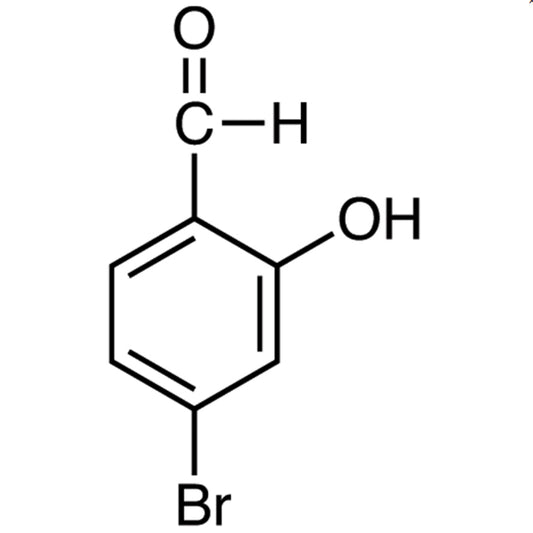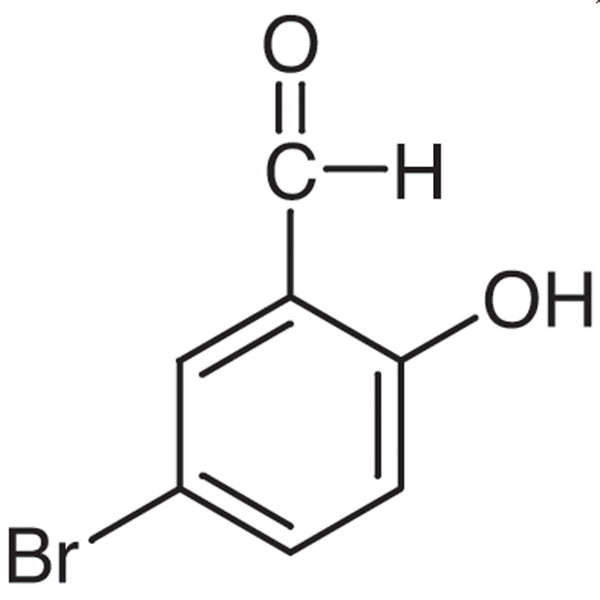
5-Bromosalicylaldehyde is a chemical compound widely used as a building block in various chemical reactions. It is a versatile reagent that plays a crucial role in synthetic chemistry, particularly in the formation of complex molecules. This compound contains both an aldehyde group and a bromo group, which contribute to its high reactivity and make it suitable for a wide range of chemical transformations. Its structural features allow it to participate in multiple reaction mechanisms, making it an essential component in the development of new chemical compounds.
The compound is known for its chemical stability and reactivity, which are key factors in its popularity among researchers. It is capable of undergoing nucleophilic substitution, condensation, and other important reactions, making it a preferred choice in laboratory settings. Its ability to react under different conditions enhances its utility in both academic and industrial research. Additionally, its solubility in organic solvents such as ethyl acetate and acetone further simplifies its application in experimental procedures.
In Indonesian laboratories, 5-Bromosalicylaldehyde is commonly used in organic chemistry research and the synthesis of new compounds. It is particularly valuable in the study of heterocyclic compounds and other organic derivatives. Due to its reactivity and versatility, it is a sought-after material for researchers and educational institutions in Indonesia. Its consistent performance and reliability make it a trusted reagent in various chemical processes.
- Organic synthesis applications benefit from 5-Bromosalicylaldehyde due to its reactivity and ability to form complex molecules through various reaction mechanisms.
- Heterocyclic compound development often utilizes this reagent because of its structural versatility and participation in nucleophilic substitution reactions.
- Chemical research projects require this compound for its stability and capacity to engage in multiple synthetic pathways, enhancing experimental outcomes.
- Educational institutions use it as a teaching tool to demonstrate chemical reactivity and synthetic strategies in undergraduate and graduate courses.
- Industrial laboratories incorporate it into their processes for the production of specialty chemicals and pharmaceutical intermediates.
| Brand | TCI |
|---|---|
| CAS number | 1761-61-1 |
| Molecular formula | — |
| Purity | — |
| Category | Chemistry > Building Blocks > Non-Heterocyclic Building Blocks |
| Pack sizes | Available in various quantities as per supplier specifications |
| Physical form | Solid |
| Storage | Store in a cool, dry place away from light and moisture |
5-Bromosalicylaldehyde should be stored in a cool, dry environment, away from direct light and moisture to maintain its chemical stability. It is recommended to use airtight containers to prevent exposure to air and humidity, which could affect its reactivity. Proper labeling of storage containers is essential for safety and identification. In laboratory settings, it should be handled with appropriate personal protective equipment, including gloves and safety goggles, to minimize direct contact. It is important to ensure that the compound is kept away from incompatible substances to avoid any potential chemical reactions. Regular inspection of storage conditions is advised to ensure the compound remains in optimal condition for use.
—
Produk Terkait
-
3-Bromosalicylaldehyde TCI B3922
Regular price From Rp 1.273.650,00Regular priceRp 890.400,00Sale price From Rp 1.273.650,00 -
4-Bromosalicylaldehyde TCI B3637
Regular price From Rp 1.936.200,00Regular priceRp 1.353.450,00Sale price From Rp 1.936.200,00 -
Salicylaldehyde TCI S0275
Regular price From Rp 584.850,00Regular priceRp 408.450,00Sale price From Rp 584.850,00 -
Salicylaldehyde TCI S0004
Regular price From Rp 689.850,00Regular priceRp 481.950,00Sale price From Rp 689.850,00 -
3,5-Dibromosalicylaldehyde TCI D0188
Regular price From Rp 1.035.300,00Regular priceRp 723.450,00Sale price From Rp 1.035.300,00 -
4-(Diethylamino)salicylaldehyde TCI D1752
Regular price From Rp 1.538.250,00Regular priceRp 1.090.950,00Sale price From Rp 1.538.250,00 -
5-BromosalicylicAcid TCI B0895
Regular price Rp 1.405.950,00Regular priceRp 998.550,00Sale price Rp 1.405.950,00 -
3-Bromo-5-nitrosalicylaldehyde TCI B3198
Regular price From Rp 1.167.600,00Regular priceRp 815.850,00Sale price From Rp 1.167.600,00