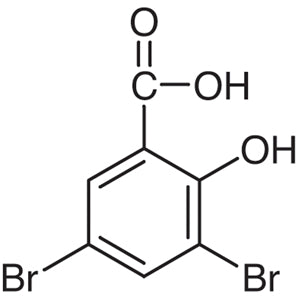
3,5-Dibromosalicylaldehyde from TCI is a salicylaldehyde derivative that carries two bromine atoms at positions 3 and 5 of the aromatic ring. It has an aldehyde group and a phenolic hydroxyl group next to each other on the ring, which makes it a useful building block in both organic synthesis and coordination chemistry. In the laboratory, its main use is making Schiff bases, which form when the aldehyde condenses with a primary amine. These Schiff base ligands can then form complexes with a wide range of transition metal ions.
Researchers choose this compound because its functional groups make condensation with amines straightforward, and the ortho hydroxyl group can also coordinate to the metal center. Both bromine atoms withdraw electrons, which changes the acidity of the phenol and the electronic properties of the resulting ligand. As a result, the metal complexes made from it differ in stability, color, and catalytic activity. The bromine atoms can also be used for further reactions, such as cross-coupling, which opens up more ways to modify the structure.
In inorganic and organic chemistry laboratories in Indonesia, 3,5-Dibromosalicylaldehyde is in steady demand among researchers who develop Schiff base ligands and their metal complexes. University research groups, graduate students working on synthesis theses, and institutional laboratories that study coordination compounds use it as a dependable starting material. Supplied under the TCI brand, it gives Indonesian researchers a consistent source of this halogenated aldehyde for repeated synthesis work and comparative studies.
- Schiff base synthesis: the aldehyde group condenses readily with primary amines, so this compound is a convenient starting material for preparing imine ligands in organic and coordination chemistry work.
- Transition metal complex preparation: Schiff base ligands made from this aldehyde can coordinate to many transition metal ions through the imine nitrogen and the neighboring phenolic oxygen.
- Tuning ligand electronic properties: the two electron-withdrawing bromine atoms change phenol acidity and ligand electronics, so researchers can compare how substituents affect complex stability and color.
- Catalysis research: because the bromine substituents change the electronic environment of the metal center, complexes built from this ligand are useful for studying how structure relates to catalytic activity.
- Further structural modification: the bromine atoms can serve as reactive sites, for example in cross-coupling reactions, which lets chemists extend the molecule into more elaborate building blocks.
| Brand | TCI (product code D0188) |
|---|---|
| CAS number | 90-59-5 |
| Molecular formula | — |
| Purity | — |
| Category | Chemistry > Building Blocks > Non-Heterocyclic Building Blocks |
| Pack sizes | available in the pack sizes listed on this product page |
| Physical form | refer to the manufacturer's label and safety data sheet |
| Storage | keep tightly closed in a cool, dry place as directed on the label |
Store 3,5-Dibromosalicylaldehyde in its original, tightly sealed container in a cool, dry, well-ventilated area. Keep it away from direct sunlight, heat sources, and incompatible materials such as strong oxidizing agents. Because aldehydes can degrade when exposed to air and moisture over time, close the container promptly after each use. Handle the compound in a fume hood or another well-ventilated area, and wear standard personal protective equipment, including gloves, safety glasses, and a laboratory coat. Avoid breathing in dust or vapors and avoid contact with skin and eyes. Before use, read the manufacturer's safety data sheet for full hazard, first-aid, and disposal information, and dispose of waste according to local regulations.
—
Produk Terkait
-
3-Bromosalicylaldehyde TCI B3922
Regular price From Rp 1.273.650,00Regular priceRp 890.400,00Sale price From Rp 1.273.650,00 -
4-Bromosalicylaldehyde TCI B3637
Regular price From Rp 1.936.200,00Regular priceRp 1.353.450,00Sale price From Rp 1.936.200,00 -
5-Bromosalicylaldehyde TCI B0893
Regular price Rp 2.837.100,00Regular priceRp 1.983.450,00Sale price Rp 2.837.100,00 -
Salicylaldehyde TCI S0275
Regular price From Rp 584.850,00Regular priceRp 408.450,00Sale price From Rp 584.850,00 -
Salicylaldehyde TCI S0004
Regular price From Rp 689.850,00Regular priceRp 481.950,00Sale price From Rp 689.850,00 -
3,5-DibromosalicylicAcid TCI D1087
Regular price From Rp 1.458.450,00Regular priceRp 1.035.300,00Sale price From Rp 1.458.450,00 -
4-(Diethylamino)salicylaldehyde TCI D1752
Regular price From Rp 1.538.250,00Regular priceRp 1.090.950,00Sale price From Rp 1.538.250,00 -
5-BromosalicylicAcid TCI B0895
Regular price Rp 1.405.950,00Regular priceRp 998.550,00Sale price Rp 1.405.950,00