


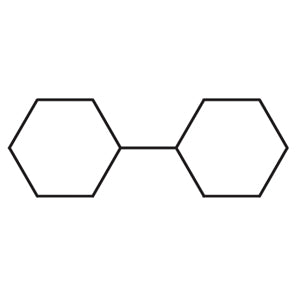
Bicyclohexyl is a chemical compound widely used as a foundational material in various laboratory applications, particularly in the synthesis of complex organic compounds. Its unique molecular structure, consisting of two interconnected hexagonal rings, provides a stable yet reactive framework that supports a wide range of chemical transformations. This compound is essential in organic chemistry research, enabling scientists to build more intricate molecules through controlled chemical reactions. Its role as a building block is critical in both academic and industrial settings, where precision and reliability are paramount.
Bicyclohexyl is valued for its relatively low reactivity, which simplifies handling and storage while maintaining chemical stability under standard laboratory conditions. Its high boiling point ensures that it remains in liquid form during high-temperature reactions, reducing the risk of evaporation and improving process efficiency. These properties make it a preferred choice for researchers seeking a reliable and versatile reagent. Additionally, its inert nature allows for compatibility with a variety of other chemicals, enhancing its utility in multi-step synthesis protocols.
In Indonesian laboratories, Bicyclohexyl is commonly used in organic chemistry research and the development of new compounds. It is particularly relevant for academic institutions and research organizations focused on complex molecule synthesis. Its availability through trusted suppliers like AMI Scientific ensures that it remains a key component in both teaching and applied research settings. The compound's consistent performance and predictable behavior make it an essential tool for chemists working in Indonesia.
Related TCI products
- TCI B2405 23391-99-3 4,4'-Bicyclohexanone
- TCI B1621 20601-38-1 4,4'-Bicyclohexanol (mixture of isomers)
- TCI T3756 132123-45-6 3,4,5-Trifluorophenyl trans,trans-4'-Propylbicyclohexyl-4-carboxylate
- TCI B5317 89111-63-7 trans,trans-4'-Butylbicyclohexyl-4-carboxylic Acid
- TCI B5123 153429-47-1 trans,trans-4-Butyl-4'-vinylbicyclohexyl
- TCI B4915 129738-42-7 trans,trans-4'-(3-Butenyl)-4-(p-tolyl)bicyclohexyl
- Organic synthesis is a primary application where Bicyclohexyl serves as a building block for creating complex molecules due to its stable structure and predictable reactivity.
- Research in pharmaceutical development benefits from Bicyclohexyl's ability to participate in controlled reactions, aiding in the design of new drug compounds.
- Teaching laboratories use Bicyclohexyl to demonstrate fundamental chemical reactions and molecular structure concepts in undergraduate and graduate courses.
- Industrial chemical processes incorporate Bicyclohexyl for its reliability in high-temperature reactions, ensuring consistent results in large-scale production.
- Analytical chemistry applications utilize Bicyclohexyl as a standard reference material for calibrating instruments and verifying reaction outcomes.
| Brand | TCI |
|---|---|
| CAS number | 92-51-3 |
| Molecular formula | — |
| Purity | — |
| Category | Chemistry > Building Blocks > Non-Heterocyclic Building Blocks |
| Pack sizes | Available in 25g, 100g, and 500g |
| Physical form | Colorless liquid |
| Storage | Store in a cool, dark place away from heat and direct sunlight |
Bicyclohexyl should be stored in a cool, dark environment to maintain its chemical stability and prevent degradation. It is recommended to keep it in a tightly sealed container made of glass or high-density polyethylene to minimize exposure to air and moisture. Due to its low reactivity, it does not require special handling beyond standard laboratory safety protocols. However, it is important to ensure that the storage area is well-ventilated to avoid the accumulation of vapors. Avoid contact with incompatible materials, and always use appropriate personal protective equipment when handling the compound. Proper storage conditions help preserve its effectiveness and ensure safe use in laboratory settings.
—
Produk Terkait
-
4,4'-Bicyclohexanone TCI B2405
Regular price Rp 5.352.900,00Regular priceRp 3.759.000,00Sale price Rp 5.352.900,00 -
4,4'-Bicyclohexanol(mixtureofisomers) TCI B1621
Regular price From Rp 1.618.050,00Regular priceRp 1.146.600,00Sale price From Rp 1.618.050,00 -
3,4,5-Trifluorophenyltrans,trans-4'-Propylbicyclohexyl-4-carboxylate TCI T3756
Regular price From Rp 1.483.650,00Regular priceRp 1.053.150,00Sale price From Rp 1.483.650,00 -
trans,trans-4'-Butylbicyclohexyl-4-carboxylicAcid TCI B5317
Regular price From Rp 2.013.900,00Regular priceRp 1.423.800,00Sale price From Rp 2.013.900,00 -
trans,trans-4-Butyl-4'-vinylbicyclohexyl TCI B5123
Regular price From Rp 769.650,00Regular priceRp 537.600,00Sale price From Rp 769.650,00 -
trans,trans-4'-(3-Butenyl)-4-(p-tolyl)bicyclohexyl TCI B4915
Regular price From Rp 1.378.650,00Regular priceRp 963.900,00Sale price From Rp 1.378.650,00 -
trans,trans-4'-Propyl-4-(4-trifluoromethoxyphenyl)bicyclohexyl TCI P2464
Regular price Rp 823.200,00Regular priceRp 575.400,00Sale price Rp 823.200,00


