

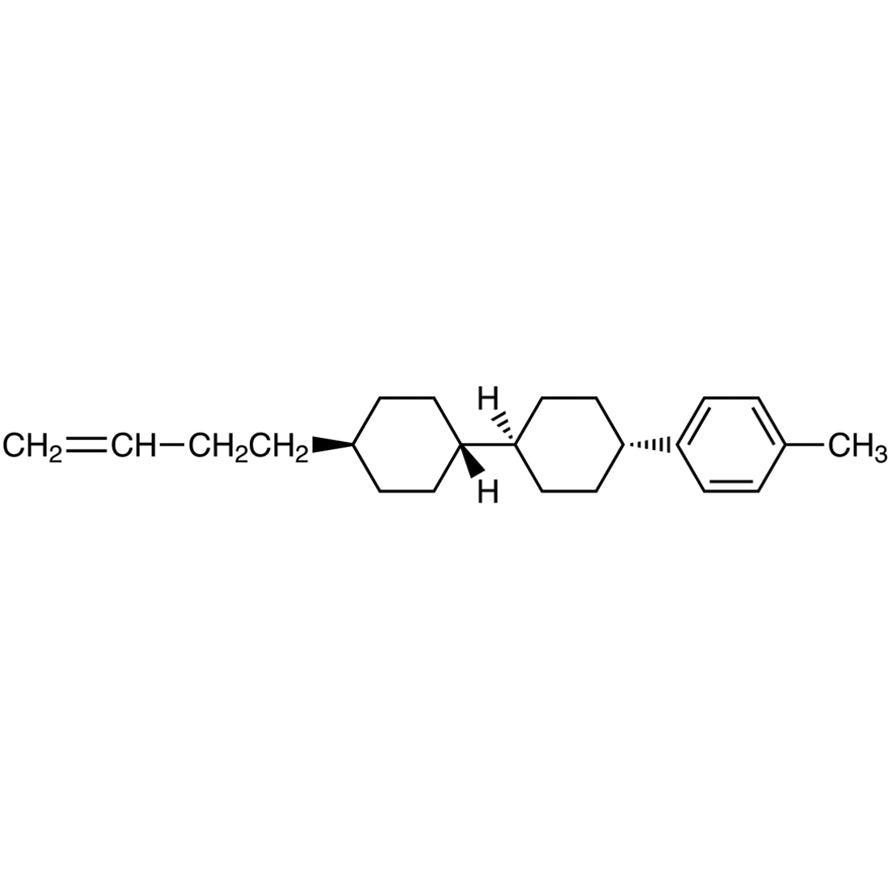
Trans,trans-4'-(3-Butenyl)-4-(p-tolyl)bicyclohexyl is a specialized chemical compound used in materials science, particularly in the study and development of liquid crystal (LC) materials. This compound plays a crucial role in laboratories where researchers are exploring the properties of materials that can change their molecular orientation in response to external stimuli such as electric or magnetic fields. Its unique molecular structure enables it to be a key component in the formulation of advanced electronic materials. Due to its ability to respond dynamically to environmental changes, it is highly valued in the field of optoelectronics and material science.
The compound’s properties make it a preferred choice for researchers working on innovative electronic materials. It exhibits excellent optical and electronic characteristics, including the ability to align its molecules in a controlled manner. This responsiveness to external stimuli allows for precise control over material behavior, which is essential in the development of high-performance liquid crystal displays and optical sensors. Additionally, its thermal stability ensures that it maintains its structural integrity under varying temperature conditions, making it suitable for use in a wide range of experimental setups.
In Indonesian laboratories, this compound is commonly used in research related to liquid crystal materials and electronic devices. Scientists and researchers in academic institutions and research centers rely on it for developing new technologies in the field of optoelectronics. Its versatility and performance make it a valuable resource in the pursuit of advanced material science applications.
TCI brochures (PDF)
- Liquid Crystal Materials 2026-04-01 · p. 7
Related TCI products
- TCI P2464 133937-72-1 trans,trans-4'-Propyl-4-(4-trifluoromethoxyphenyl)bicyclohexyl
- TCI P2404 84656-75-7 trans,trans-4'-Propyl-4-(p-tolyl)bicyclohexyl
- TCI M3140 97398-80-6 trans,trans-4-Methoxy-4'-propyl-1,1'-bicyclohexyl
- TCI E1465 96624-41-8 (trans,trans)-4-Ethyl-4'-propyl-1,1'-bicyclohexyl
- TCI D6019 473257-14-6 trans,trans-4-Propyl-4'-(4-propoxy-2,3-difluorophenyl)bicyclohexyl
- TCI T3756 132123-45-6 3,4,5-Trifluorophenyl trans,trans-4'-Propylbicyclohexyl-4-carboxylate
- Liquid Crystal Display (LCD) Development: This compound is ideal for creating LC materials that can change their orientation in response to electric fields, enabling the production of high-quality displays.
- Optical Sensor Fabrication: Its ability to respond to external stimuli makes it suitable for use in optical sensors that detect changes in light or electromagnetic fields.
- Electronic Material Research: Researchers use it to study the behavior of materials under different conditions, aiding in the development of new electronic components.
- Advanced Optoelectronic Devices: Its optical and electronic properties make it a key ingredient in the development of next-generation optoelectronic systems.
- Thermal Stability Testing: The compound’s thermal stability allows it to be used in experiments that require consistent performance across a range of temperatures.
| Brand | TCI |
|---|---|
| CAS number | 129738-42-7 |
| Molecular formula | — |
| Purity | — |
| Category | Materials Science > Electronic Materials > Liquid Crystal (LC) Materials |
| Pack sizes | Available in various quantities as per standard laboratory supply |
| Physical form | Liquid |
| Storage | Store in a cool, dry place away from direct sunlight |
This compound should be stored in a cool, dry environment, away from direct sunlight and sources of heat. It is recommended to keep it in a sealed container to prevent exposure to air and moisture. Due to its chemical nature, it should be handled with appropriate personal protective equipment, including gloves and safety goggles. Storage conditions should maintain a stable temperature to preserve its properties and ensure long-term usability. Proper labeling and storage practices are essential to maintain safety and prevent contamination in the laboratory setting.
—
Product Categories
- Electronic MaterialsLiquid Crystal (LC) MaterialsNematic Liquid Crystals, Smectic Liquid Crystals [Liquid Crystal (LC) Materials]
- Material Building BlocksLiquid Crystal (LC) Building BlocksAlkenylcylohexanes [Liquid Crystal (LC) Building Blocks]
- Material Building BlocksLiquid Crystal (LC) Building BlocksOther Liquid Crystal (LC) Building Blocks
Produk Terkait
-
trans,trans-4'-Propyl-4-(4-trifluoromethoxyphenyl)bicyclohexyl TCI P2464
Regular price Rp 823.200,00Regular priceRp 575.400,00Sale price Rp 823.200,00 -
trans,trans-4'-Propyl-4-(p-tolyl)bicyclohexyl TCI P2404
Regular price From Rp 637.350,00Regular priceRp 445.200,00Sale price From Rp 637.350,00 -
trans,trans-4-Methoxy-4'-propyl-1,1'-bicyclohexyl TCI M3140
Regular price Rp 3.763.200,00Regular priceRp 2.631.300,00Sale price Rp 3.763.200,00 -
(trans,trans)-4-Ethyl-4'-propyl-1,1'-bicyclohexyl TCI E1465
Regular price Rp 743.400,00Regular priceRp 519.750,00Sale price Rp 743.400,00 -
trans,trans-4-Propyl-4'-(4-propoxy-2,3-difluorophenyl)bicyclohexyl TCI D6019
Regular price Rp 1.140.300,00Regular priceRp 796.950,00Sale price Rp 1.140.300,00 -
3,4,5-Trifluorophenyltrans,trans-4'-Propylbicyclohexyl-4-carboxylate TCI T3756
Regular price From Rp 1.483.650,00Regular priceRp 1.053.150,00Sale price From Rp 1.483.650,00 -
trans,trans-4-Butyl-4'-vinylbicyclohexyl TCI B5123
Regular price From Rp 769.650,00Regular priceRp 537.600,00Sale price From Rp 769.650,00 -
trans,trans-4'-Pentyl-4-bicyclohexylmethanol TCI P2433
Regular price From Rp 848.400,00Regular priceRp 609.000,00Sale price From Rp 848.400,00


