

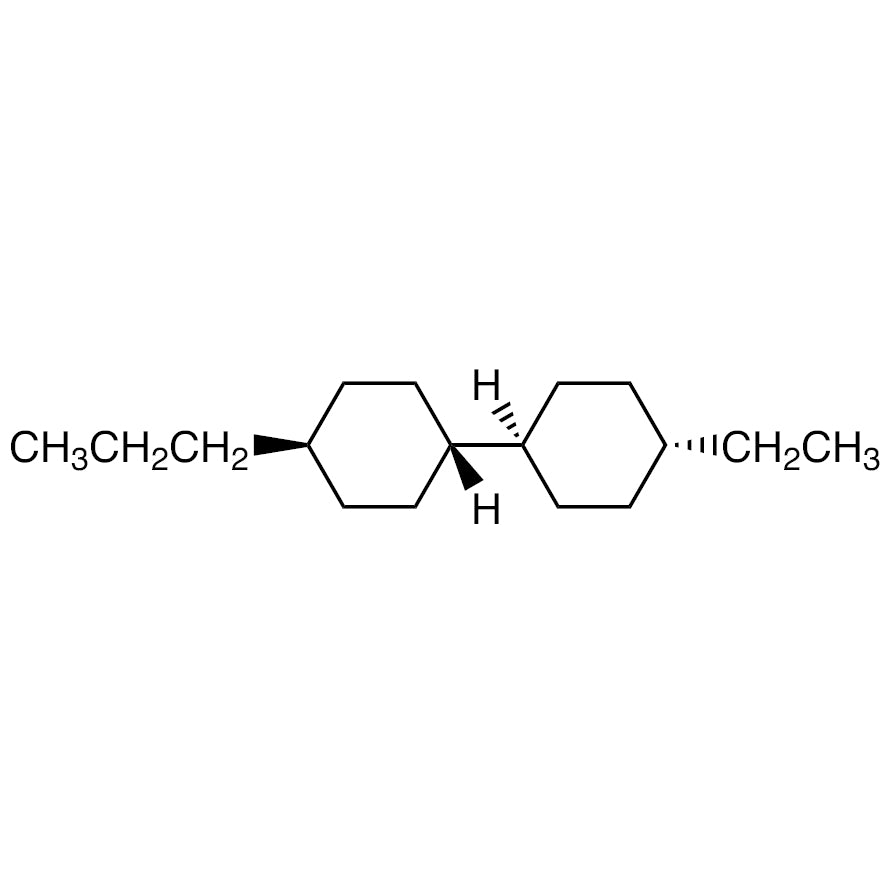
(Trans,trans)-4-Ethyl-4'-propyl-1,1'-bicyclohexyl is an organic compound widely used in materials science research. As a key component in the development of advanced materials, it plays a vital role in laboratories focused on liquid crystal technology and molecular engineering. This compound is essential for creating materials with tailored optical, mechanical, and thermal properties. Its unique molecular structure allows for precise control over molecular alignment, making it a valuable tool in the synthesis of complex compounds and the modification of molecular frameworks.
The compound's stability and polar characteristics make it a preferred choice for researchers seeking to manipulate molecular interactions. Its cyclic structure ensures chemical stability, while its polar nature enables interactions with other molecules under specific conditions. These properties are particularly useful in studies involving phase transitions, conductivity, and responses to external stimuli. The compound's ability to respond to heat and light further enhances its utility in the development of smart materials and optoelectronic devices.
In Indonesian laboratories, this compound is commonly used in materials science research, especially in the fields of liquid crystals and composite materials. It is a key ingredient in the synthesis of advanced materials and is often employed in academic and industrial research settings. Its versatility and reliability make it a standard component in the chemical inventory of many research institutions in Indonesia.
Related TCI products
- TCI B4915 129738-42-7 trans,trans-4'-(3-Butenyl)-4-(p-tolyl)bicyclohexyl
- TCI P2433 82598-08-1 trans,trans-4'-Pentyl-4-bicyclohexylmethanol
- TCI P2432 82562-85-4 (trans,trans)-4'-Propyl-4-bicyclohexylmethanol
- TCI D4911 147622-85-3 trans-4'-(3,4-Difluorophenyl)bicyclohexyl-4-one
- TCI P2464 133937-72-1 trans,trans-4'-Propyl-4-(4-trifluoromethoxyphenyl)bicyclohexyl
- TCI P2404 84656-75-7 trans,trans-4'-Propyl-4-(p-tolyl)bicyclohexyl
- Liquid Crystal Research - This compound is ideal for studying the behavior of liquid crystals due to its unique molecular structure and ability to align under specific conditions.
- Material Synthesis - Its cyclic and polar properties make it a valuable building block for synthesizing complex organic compounds with tailored properties.
- Composite Material Development - The compound's stability and interaction potential support the creation of advanced composite materials with enhanced mechanical and optical characteristics.
- Optical Material Investigation - Its response to light and heat makes it suitable for research into optoelectronic and photonic materials.
- Thermal Response Studies - The compound's ability to respond to temperature changes is useful in studies involving phase transitions and thermal conductivity.
| Brand | TCI |
|---|---|
| CAS number | 96624-41-8 |
| Molecular formula | — |
| Purity | — |
| Category | Materials Science > Material Building Blocks > Liquid Crystal (LC) Building Blocks |
| Pack sizes | Available in various quantities as per standard laboratory supply |
| Physical form | Liquid |
| Storage | Store in a cool, dark place away from direct sunlight and moisture |
This compound should be stored in a cool, dark environment to maintain its stability and prevent degradation. It is recommended to use airtight containers to protect it from moisture and air exposure. Due to its polar nature, it is important to handle it with care to avoid contamination. Proper labeling of containers is essential for safety and traceability. In a laboratory setting, it should be kept in a well-ventilated area, and personal protective equipment such as gloves and safety goggles should be worn during handling. Regular monitoring of storage conditions ensures the compound remains in optimal condition for research use.
—
Produk Terkait
-
trans,trans-4'-(3-Butenyl)-4-(p-tolyl)bicyclohexyl TCI B4915
Regular price From Rp 1.378.650,00Regular price -
trans,trans-4'-Pentyl-4-bicyclohexylmethanol TCI P2433
Regular price From Rp 795.900,00Regular price -
(trans,trans)-4'-Propyl-4-bicyclohexylmethanol TCI P2432
Regular price Rp 1.696.800,00Regular price -
trans-4'-(3,4-Difluorophenyl)bicyclohexyl-4-one TCI D4911
Regular price From Rp 769.650,00Regular price -
trans,trans-4'-Propyl-4-(4-trifluoromethoxyphenyl)bicyclohexyl TCI P2464
Regular price Rp 823.200,00Regular price -
trans,trans-4'-Propyl-4-(p-tolyl)bicyclohexyl TCI P2404
Regular price From Rp 637.350,00Regular price -
trans,trans-4-Methoxy-4'-propyl-1,1'-bicyclohexyl TCI M3140
Regular price Rp 3.763.200,00Regular price -
trans,trans-4-Propyl-4'-(4-propoxy-2,3-difluorophenyl)bicyclohexyl TCI D6019
Regular price Rp 1.140.300,00Regular price


