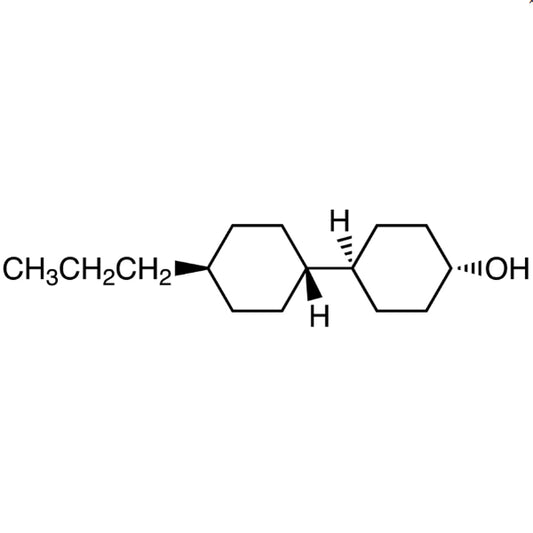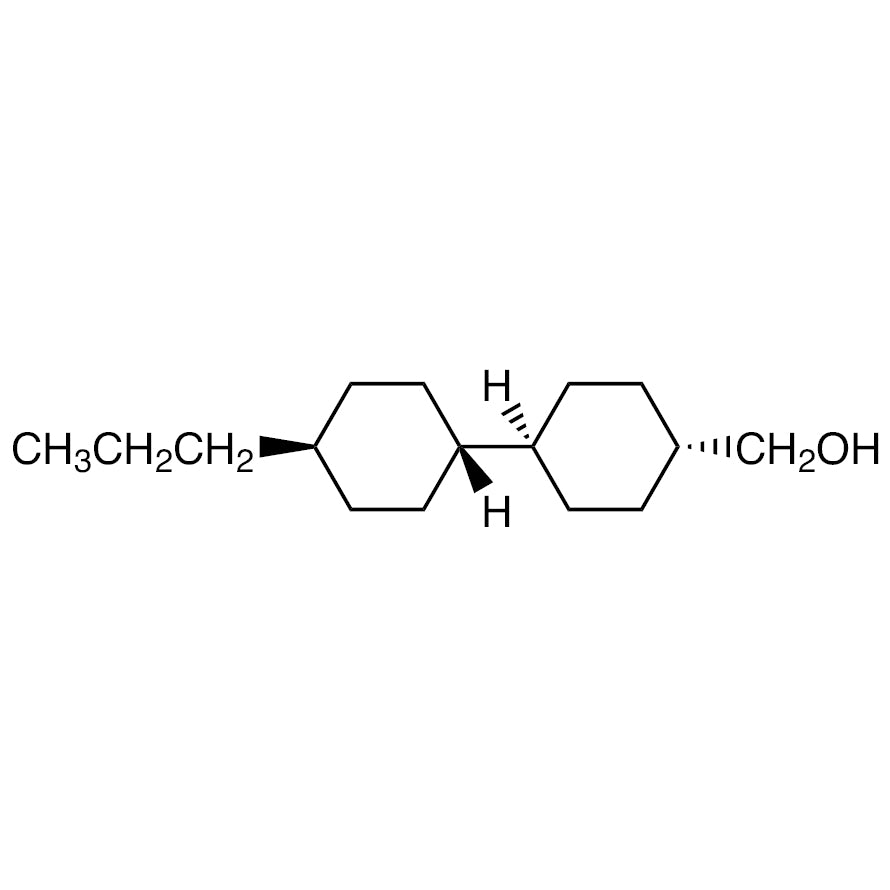
(trans,trans)-4'-Propyl-4-bicyclohexylmethanol from TCI is a liquid crystal (LC) building block. Its structure is two cyclohexane rings in the trans,trans configuration, with a propyl group at one end and a hydroxymethyl group at the other. Bicyclohexyl frameworks like this one are common in the mesogenic molecules used in liquid crystal mixtures. In the laboratory, the compound is an intermediate for building liquid crystal molecules through esterification, etherification, or conversion of the alcohol group into other functional groups.
Researchers choose this compound because its geometry suits liquid crystal materials. The trans,trans configuration makes the molecule elongated and fairly straight. This rod-like shape supports the formation of mesomorphic phases. Saturated cyclohexane rings generally give lower viscosity and better light stability than aromatic rings, and display formulations need both. The propyl group serves as the terminal alkyl chain. The -CH2OH group provides a reactive attachment point for adding other cores or polar groups, so chemists can extend the molecule in a controlled way.
In Indonesia, this material is relevant to materials chemistry laboratories, physics and chemistry research groups at universities, and research institutions working on functional organic materials. Typical work includes synthesizing new mesogens, studying how molecular structure relates to phase behavior, and preparing model compounds for optical and electro-optical studies. Teams working on display materials, organic electronics, or advanced coursework in organic synthesis can use it as a well-defined starting material for multi-step synthetic routes.
- Liquid crystal mesogen synthesis: the rigid trans,trans bicyclohexyl core and the reactive hydroxymethyl end let researchers build rod-like molecules suited to mesomorphic phases.
- Esterification reactions: the primary alcohol group reacts readily with carboxylic acids or acid chlorides, linking the bicyclohexyl unit to aromatic cores or polar terminal groups.
- Etherification and functional group conversion: the -CH2OH group can be converted into ethers, halides, or other functionalities, which widens the range of possible liquid crystal target structures.
- Structure-property relationship studies: the defined propyl chain and saturated ring system help researchers compare how cyclohexane-based cores change viscosity, stability, and phase behavior relative to aromatic analogues.
- Display and optical materials research: saturated cyclohexane rings generally give lower viscosity and better light stability, so this building block suits experimental formulations for display-related liquid crystal mixtures.
| Brand | TCI (product code P2432) |
|---|---|
| CAS number | 82562-85-4 |
| Molecular formula | — |
| Purity | — |
| Category | Materials Science > Material Building Blocks > Liquid Crystal (LC) Building Blocks |
| Pack sizes | see the current TCI product listing for available pack sizes |
| Physical form | see the TCI product documentation and certificate of analysis |
| Storage | follow the storage conditions on the product label and in the TCI safety data sheet |
Keep this compound in its original, tightly closed container in a cool, dry, well-ventilated area, away from direct sunlight, heat sources, and incompatible materials such as strong oxidizing agents. Glass or other chemically resistant containers with secure closures are suitable if the material is repackaged, and the new containers should be clearly labeled. Before use, read the TCI safety data sheet for specific hazard and storage guidance. Follow standard laboratory precautions: wear safety glasses, gloves, and a lab coat, work in a fume hood when handling powders or solutions, avoid inhalation and skin contact, and dispose of waste in line with local regulations and institutional chemical safety procedures.
—
Produk Terkait
-
trans,trans-4'-Pentyl-4-bicyclohexylmethanol TCI P2433
Regular price From Rp 795.900,00Regular price -
trans,trans-4'-(3-Butenyl)-4-(p-tolyl)bicyclohexyl TCI B4915
Regular price From Rp 1.378.650,00Regular price -
(trans,trans)-4-Ethyl-4'-propyl-1,1'-bicyclohexyl TCI E1465
Regular price Rp 743.400,00Regular price -
trans-4-(trans-4-Pentylcyclohexyl)cyclohexanol TCI P2690
Regular price From Rp 3.155.250,00Regular price -
trans-4-(trans-4-Propylcyclohexyl)cyclohexanol TCI P2434
Regular price From Rp 1.087.800,00Regular price -
trans-4-MethoxycinnamicAcid TCI M0576
Regular price Rp 1.724.100,00Regular price -
Bicyclohexyl TCI B0902
Regular price From Rp 1.565.550,00Regular price -
Azetidin-3-ylmethanolHydrochloride TCI A3231
Regular price From Rp 2.730.000,00Regular price