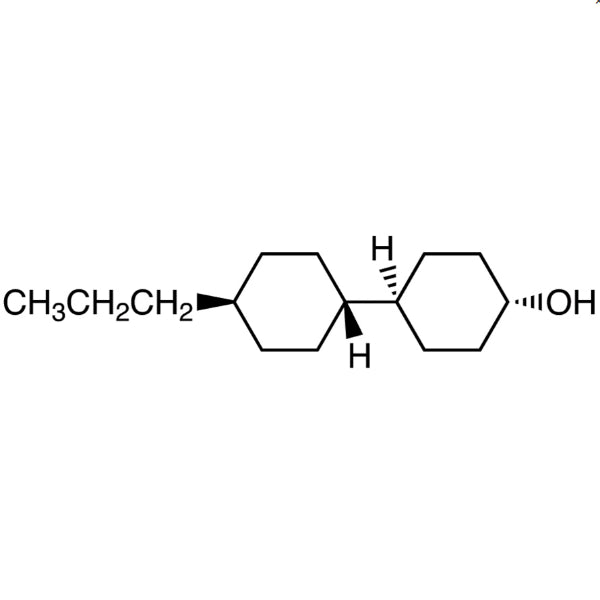
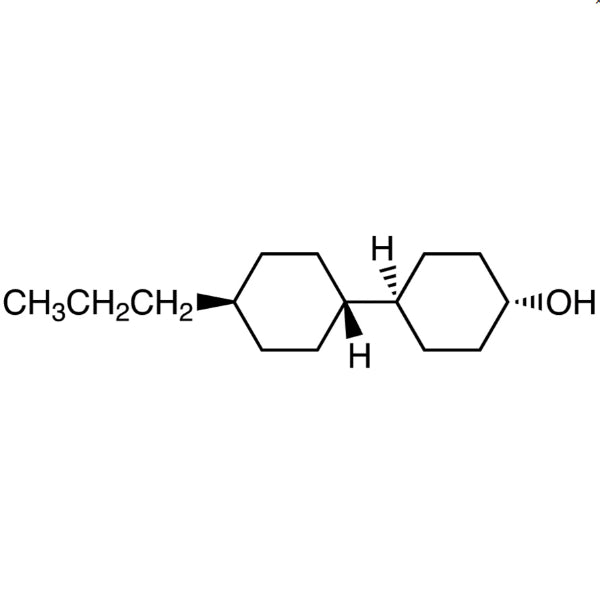
trans-4-(trans-4-Propylcyclohexyl)cyclohexanol from TCI is a liquid crystal building block made of two linked trans-cyclohexane rings. One end of the molecule carries a propyl chain. At the other end, a secondary hydroxyl group is bonded directly to the ring. The compound is an important intermediate in the synthesis of mesogens with a bicyclohexyl core. In the laboratory, chemists use the hydroxyl group to form esters or ethers. They can also oxidize it to a ketone, which can then be developed into a wide range of liquid crystal molecules.
Researchers choose this material because the trans configuration of both rings gives a straight, elongated molecule. That shape is a key requirement for the rod-like molecules that form liquid crystal phases. Unlike the related methanol derivatives, this compound has its OH group attached directly to the ring. As a result, the linking group in the final product sits closer to the core, which produces a different molecular geometry. Saturated rings are also a common choice because they tend to give materials with low viscosity and good resistance to light. Both properties are valued in liquid crystal research for display applications.
In Indonesia, this compound suits university chemistry and materials science laboratories, research institutions, and research and development groups working on organic synthesis and functional materials. Typical users include postgraduate researchers making new mesogenic compounds, groups studying how molecular structure relates to liquid crystal phase behaviour, and teams exploring materials for display technology. Because the molecule has a reactive hydroxyl group and a rigid bicyclohexyl core, one starting material can support a whole series of derivatives. That makes it practical for systematic structure–property studies.
Related TCI products
- TCI P2690 82575-70-0 trans-4-(trans-4-Pentylcyclohexyl)cyclohexanol
- TCI P2372 117923-32-7 4-[2-(trans-4-Propylcyclohexyl)ethyl]cyclohexanone
- TCI P2108 82832-73-3 4-(trans-4-Propylcyclohexyl)cyclohexanone
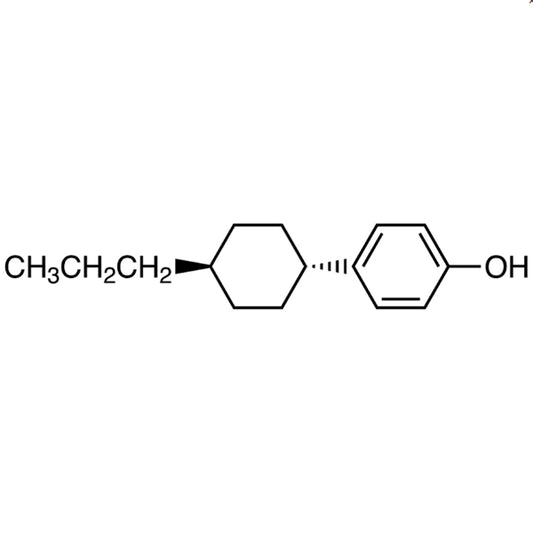
- TCI P1616 81936-33-6 4-(trans-4-Propylcyclohexyl)phenol
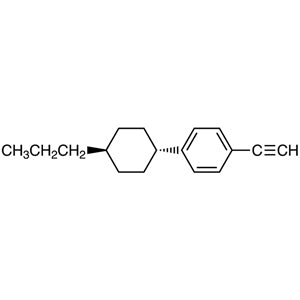
- TCI E1232 88074-73-1 1-Ethynyl-4-(trans-4-propylcyclohexyl)benzene
- TCI T2706 30129-18-1 4-(Trifluoromethyl)cyclohexanol (cis- and trans- mixture)
- Esterification to form liquid crystal esters: the secondary hydroxyl group reacts with carboxylic acids or acid chlorides, giving rod-shaped esters with a rigid bicyclohexyl core for mesogen research.
- Ether synthesis for mesogenic compounds: the hydroxyl group bonded directly to the ring can be converted to ethers, giving linking groups that sit closer to the core than those made from methanol derivatives.
- Oxidation to the corresponding ketone: the secondary alcohol can be oxidized to a ketone, which then serves as a versatile intermediate for building many different liquid crystal molecules.
- Structure–property relationship studies: the straight, elongated trans,trans geometry lets researchers see how changes in linking groups and terminal chains affect the formation and behaviour of liquid crystal phases.
- Display-oriented liquid crystal material research: the saturated bicyclohexyl core tends to give low viscosity and good light resistance, both desirable for liquid crystal materials studied for display applications.
| Brand | TCI (product code P2434) |
|---|---|
| CAS number | 82832-72-2 |
| Molecular formula | — |
| Purity | — |
| Category | Materials Science > Material Building Blocks > Liquid Crystal (LC) Building Blocks |
| Pack sizes | available in the pack sizes offered by TCI; please ask us for current options |
| Physical form | refer to the TCI product label and Certificate of Analysis |
| Storage | follow the storage conditions on the TCI label and Safety Data Sheet |
Store this compound in its original, tightly closed container in a cool, dry, well-ventilated place, away from direct sunlight, heat sources, and strong oxidizing agents. Always follow the specific storage temperature on the TCI label and Safety Data Sheet. If you transfer it to another container, use clean, dry, chemically compatible glass bottles with secure caps and clear labels. Handle the material in a fume hood or a well-ventilated area. Wear standard personal protective equipment, including a lab coat, safety glasses, and chemical-resistant gloves. Avoid inhaling dust or vapour, and avoid contact with skin and eyes. Read the Safety Data Sheet before use, and dispose of waste according to your institution's procedures and local regulations.
—
Produk Terkait
-
trans-4-(trans-4-Pentylcyclohexyl)cyclohexanol TCI P2690
Regular price From Rp 3.155.250,00Regular price -
4-[2-(trans-4-Propylcyclohexyl)ethyl]cyclohexanone TCI P2372
Regular price Rp 1.670.550,00Regular price -
4-(trans-4-Propylcyclohexyl)cyclohexanone TCI P2108
Regular price From Rp 848.400,00Regular price -
4-(trans-4-Propylcyclohexyl)phenol TCI P1616
Regular price From Rp 980.700,00Regular price -
1-Ethynyl-4-(trans-4-propylcyclohexyl)benzene TCI E1232
Regular price Rp 2.199.750,00Regular price -
4-(Trifluoromethyl)cyclohexanol(cis-andtrans-mixture) TCI T2706
Regular price Rp 4.347.000,00Regular price -
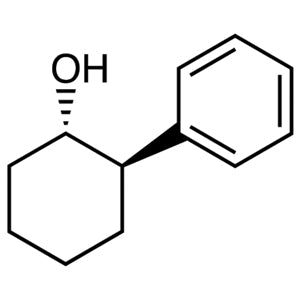
(1S,2R)-(+)-trans-2-Phenyl-1-cyclohexanol TCI T1491
Regular price Rp 1.510.950,00Regular price -
(1R,2S)-(-)-trans-2-Phenyl-1-cyclohexanol TCI T1490
Regular price From Rp 903.000,00Regular price

![117923-32-7 4-[2-(trans-4-Propylcyclohexyl)ethyl]cyclohexanone - AMI Scientific](http://amiscientific.com/cdn/shop/files/TCI2510P2372.jpg?v=1768362745&width=533)