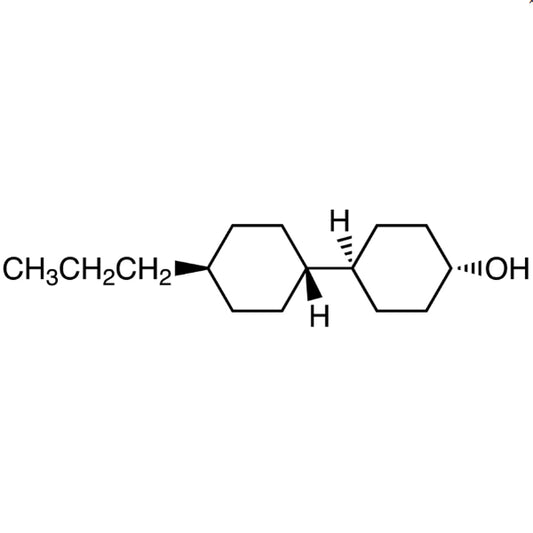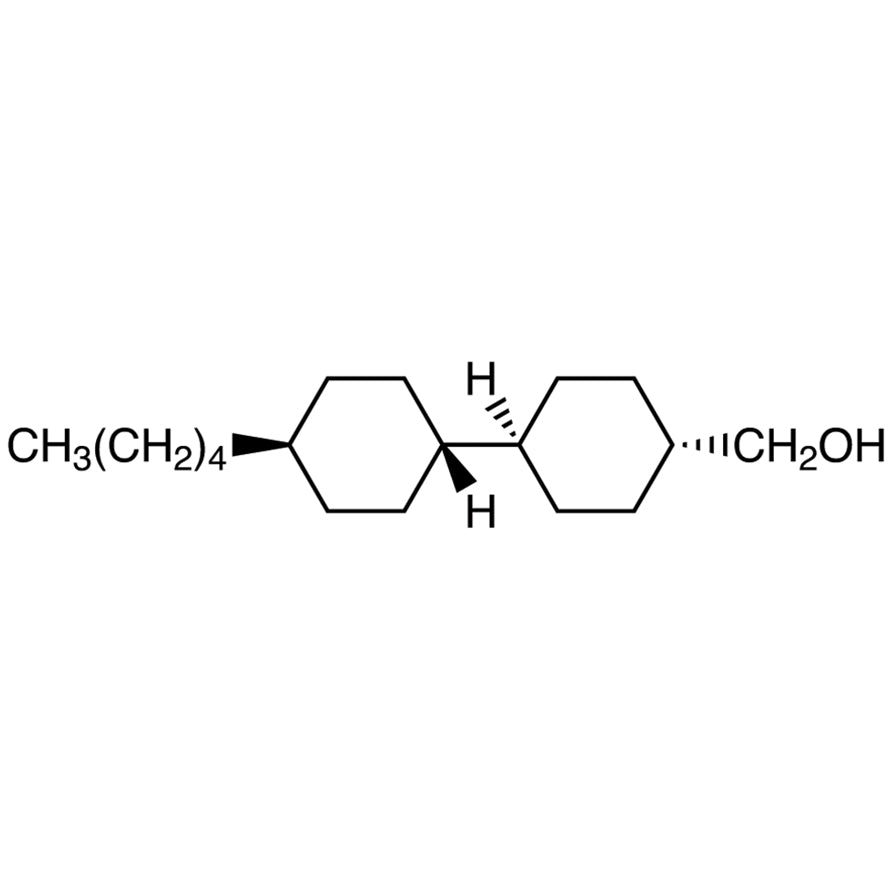
trans,trans-4'-Pentyl-4-bicyclohexylmethanol from TCI is a liquid crystal building block. Its trans,trans-configured bicyclohexyl core carries a pentyl chain at one end and a hydroxymethyl group at the other. It is the pentyl homologue of a similar propyl derivative. In materials laboratories, it serves as an intermediate for synthesising mesogens, which are molecules that can form liquid crystal phases. Synthesis typically goes through its primary alcohol group, for example by esterification, etherification or oxidation, to build more complex target structures.
Two structural features make this compound a preferred choice. First, the trans,trans bicyclohexyl core gives the molecule an elongated, rigid shape, which suits the formation of nematic and smectic phases in derived products. Second, the pentyl chain is longer than a propyl chain, so it generally shifts the balance between the rigid and flexible parts of the molecule. This can affect the phase temperature range and the tendency to form smectic phases. Pentyl chains are common in commercial liquid crystal molecules, so this building block is useful for research that aims to model real-world systems closely.
In Indonesia, this compound is useful for research groups in materials chemistry and physics that study liquid crystals and functional organic materials. University laboratories and research institutes can use it to prepare new mesogenic compounds, compare homologous series, and study how alkyl chain length affects phase behaviour. It also supports thesis and dissertation projects in organic synthesis that need a defined, structurally rigid alcohol intermediate as a starting point for multi-step syntheses.
Related TCI products
- TCI P2432 82562-85-4 (trans,trans)-4'-Propyl-4-bicyclohexylmethanol
- TCI B4915 129738-42-7 trans,trans-4'-(3-Butenyl)-4-(p-tolyl)bicyclohexyl
- TCI E1465 96624-41-8 (trans,trans)-4-Ethyl-4'-propyl-1,1'-bicyclohexyl
- TCI P2318 129738-34-7 trans,trans-4-Pentyl-4'-vinylbicyclohexyl
- TCI E1487 124728-81-0 (trans,trans)-4-(4-Ethoxy-2,3-difluorophenyl)-4'-pentyl-1,1'-bi(cyclohexane)
- TCI P2690 82575-70-0 trans-4-(trans-4-Pentylcyclohexyl)cyclohexanol
- Mesogen synthesis: the primary alcohol group allows esterification or etherification to attach other molecular fragments and build liquid crystal molecules with a rigid bicyclohexyl core.
- Oxidation to aldehyde or acid derivatives: the hydroxymethyl group can be oxidised, giving access to further functional intermediates for designing liquid crystal materials.
- Homologous series studies: as the pentyl homologue of a related propyl derivative, it lets researchers compare systematically how alkyl chain length influences phase temperature ranges and smectic tendencies.
- Nematic and smectic phase research: the elongated, rigid trans,trans bicyclohexyl core makes derived products suitable for investigating how nematic and smectic phases form.
- Modelling commercial liquid crystal systems: pentyl chains are common in commercial liquid crystal molecules, so this compound helps laboratory studies reflect the structures used in practical liquid crystal materials.
| Brand | TCI (product code P2433) |
|---|---|
| CAS number | 82598-08-1 |
| Molecular formula | — |
| Purity | — |
| Category | Materials Science > Material Building Blocks > Liquid Crystal (LC) Building Blocks |
| Pack sizes | as offered in the TCI catalogue for this product code |
| Physical form | refer to the TCI product specification and Certificate of Analysis |
| Storage | follow the storage conditions on the TCI label and Safety Data Sheet |
Store this compound in its original, tightly closed container, in a cool, dry and well-ventilated place away from direct sunlight, heat sources and strong oxidising agents. Always check the TCI label and Safety Data Sheet for the recommended storage temperature. When handling, wear standard laboratory protective equipment: safety glasses, chemical-resistant gloves and a lab coat. Work in a fume hood or well-ventilated area, and avoid creating dust or breathing in vapours. Reseal the container promptly after use to protect the material from moisture and contamination. Dispose of waste according to local regulations and your institution's chemical waste procedures.
—
Produk Terkait
-
(trans,trans)-4'-Propyl-4-bicyclohexylmethanol TCI P2432
Regular price Rp 1.749.300,00Regular priceRp 1.239.000,00Sale price Rp 1.749.300,00 -
trans,trans-4'-(3-Butenyl)-4-(p-tolyl)bicyclohexyl TCI B4915
Regular price From Rp 1.378.650,00Regular priceRp 963.900,00Sale price From Rp 1.378.650,00 -
(trans,trans)-4-Ethyl-4'-propyl-1,1'-bicyclohexyl TCI E1465
Regular price Rp 743.400,00Regular priceRp 519.750,00Sale price Rp 743.400,00 -
trans,trans-4-Pentyl-4'-vinylbicyclohexyl TCI P2318
Regular price From Rp 1.405.950,00Regular priceRp 982.800,00Sale price From Rp 1.405.950,00 -
(trans,trans)-4-(4-Ethoxy-2,3-difluorophenyl)-4'-pentyl-1,1'-bi(cyclohexane) TCI E1487
Regular price From Rp 795.900,00Regular priceRp 556.500,00Sale price From Rp 795.900,00 -
trans-4-(trans-4-Pentylcyclohexyl)cyclohexanol TCI P2690
Regular price From Rp 3.207.750,00Regular priceRp 2.258.550,00Sale price From Rp 3.207.750,00 -
trans-4-(trans-4-Propylcyclohexyl)cyclohexanol TCI P2434
Regular price From Rp 1.140.300,00Regular priceRp 812.700,00Sale price From Rp 1.140.300,00 -
trans-4-MethoxycinnamicAcid TCI M0576
Regular price Rp 1.776.600,00Regular priceRp 1.257.900,00Sale price Rp 1.776.600,00