

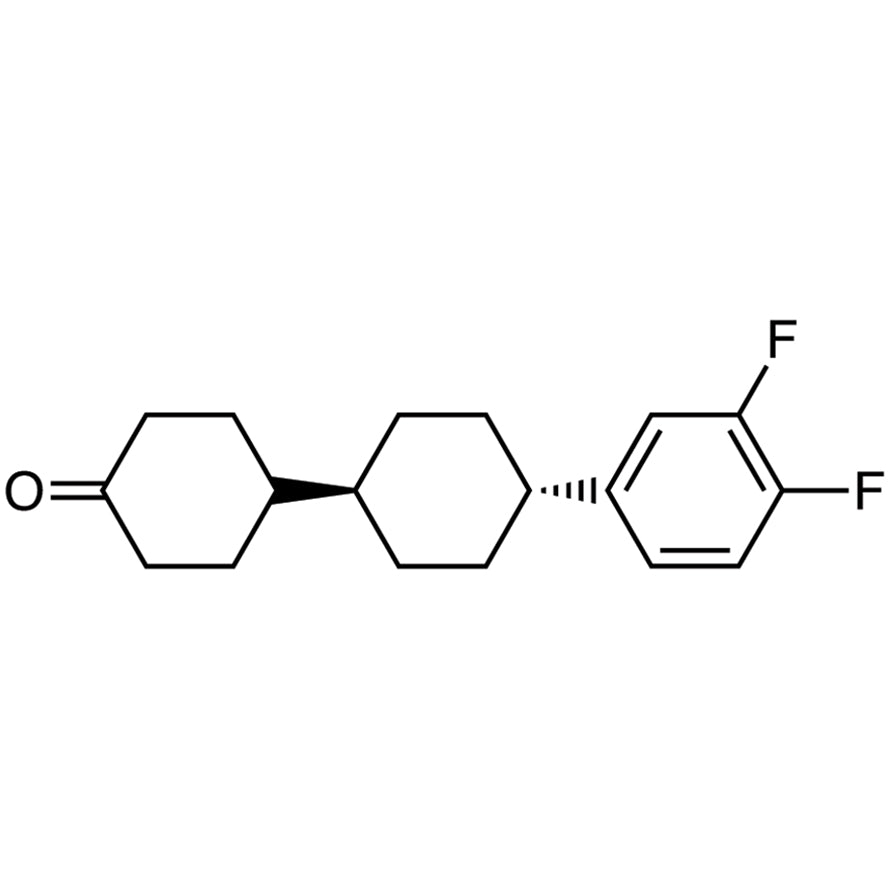
Trans-4'-(3,4-Difluorophenyl)bicyclohexyl-4-one is a specialized chemical compound used in scientific research, particularly in the development of materials with anisotropic properties. This compound is a key component in the field of liquid crystal (LC) building blocks, which are essential for creating materials with ordered molecular structures. In the laboratory, it serves as a foundational material for synthesizing complex compounds that find applications in advanced electronics, optical devices, and innovative material technologies. Its unique molecular structure enables it to interact effectively with other molecules, making it a versatile tool for researchers.
The compound's molecular structure features a difluoro group on the phenyl ring, which imparts both polarity and reactivity. These characteristics make it ideal for chemical reactions requiring high specificity and precise control. Additionally, the presence of the bicyclohexyl core enhances its structural stability, allowing it to maintain its integrity under various experimental conditions. This combination of reactivity and stability ensures that it remains a reliable choice for a wide range of chemical processes.
In Indonesian laboratories, this compound is commonly used in experiments related to liquid crystals and advanced material development. It plays a crucial role in the study of anisotropic materials, contributing to the advancement of research in materials science. Its application supports both academic and industrial efforts in creating new materials with tailored properties.
Related TCI products
- TCI B4915 129738-42-7 trans,trans-4'-(3-Butenyl)-4-(p-tolyl)bicyclohexyl
- TCI E1465 96624-41-8 (trans,trans)-4-Ethyl-4'-propyl-1,1'-bicyclohexyl
- TCI P2464 133937-72-1 trans,trans-4'-Propyl-4-(4-trifluoromethoxyphenyl)bicyclohexyl
- TCI P2404 84656-75-7 trans,trans-4'-Propyl-4-(p-tolyl)bicyclohexyl
- TCI M3140 97398-80-6 trans,trans-4-Methoxy-4'-propyl-1,1'-bicyclohexyl
- TCI E1487 124728-81-0 (trans,trans)-4-(4-Ethoxy-2,3-difluorophenyl)-4'-pentyl-1,1'-bi(cyclohexane)
- Liquid Crystal Research – This compound is ideal for studying anisotropic materials due to its molecular structure that aligns with liquid crystal properties.
- Organic Synthesis – Its reactivity and structural versatility make it a valuable building block for synthesizing complex organic compounds.
- Optical Material Development – The compound's polar and reactive nature supports the creation of materials with unique optical properties.
- Electronic Material Innovation – Its stability and molecular structure enable its use in developing advanced electronic components.
- Material Characterization Studies – It is frequently used in experiments that require precise molecular interactions and structural analysis.
| Brand | TCI |
|---|---|
| CAS number | 147622-85-3 |
| Molecular formula | — |
| Purity | — |
| Category | Materials Science > Material Building Blocks > Liquid Crystal (LC) Building Blocks |
| Pack sizes | Available in various quantities as per supplier specifications |
| Physical form | Liquid |
| Storage | Store in a cool, dry place away from light and incompatible substances |
This compound should be stored in a cool, dry environment, away from direct sunlight and sources of heat. It is recommended to use airtight containers made of materials that are chemically inert, such as glass or high-density polyethylene, to prevent contamination and degradation. Due to its reactivity, it should be handled with care, using appropriate personal protective equipment like gloves and safety goggles. It is important to ensure that it is kept separate from incompatible substances, such as strong oxidizers or acids, to avoid any potential chemical reactions. Proper labeling and storage conditions will help maintain its stability and effectiveness for use in laboratory research.
—
Produk Terkait
-
trans,trans-4'-(3-Butenyl)-4-(p-tolyl)bicyclohexyl TCI B4915
Regular price From Rp 1.378.650,00Regular price -
(trans,trans)-4-Ethyl-4'-propyl-1,1'-bicyclohexyl TCI E1465
Regular price Rp 743.400,00Regular price -
trans,trans-4'-Propyl-4-(4-trifluoromethoxyphenyl)bicyclohexyl TCI P2464
Regular price Rp 823.200,00Regular price -
trans,trans-4'-Propyl-4-(p-tolyl)bicyclohexyl TCI P2404
Regular price From Rp 637.350,00Regular price -
trans,trans-4-Methoxy-4'-propyl-1,1'-bicyclohexyl TCI M3140
Regular price Rp 3.763.200,00Regular price -
(trans,trans)-4-(4-Ethoxy-2,3-difluorophenyl)-4'-pentyl-1,1'-bi(cyclohexane) TCI E1487
Regular price From Rp 795.900,00Regular price -
trans,trans-4-(4-Ethoxy-2,3-difluorophenyl)-4'-ethyl-1,1'-bi(cyclohexyl) TCI E1477
Regular price Rp 717.150,00Regular price -
trans,trans-4-(4-Ethoxy-2,3-difluorophenyl)-4'-propylbicyclohexyl TCI E1157
Regular price From Rp 2.121.000,00Regular price


