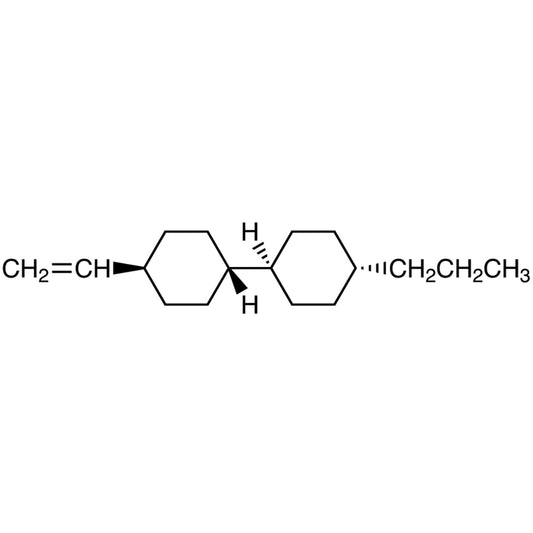
Trans,trans-4-Butyl-4'-vinylbicyclohexyl is a specialized chemical compound used in material science research, particularly in the development of liquid crystal materials. As a building block for liquid crystals, it plays a crucial role in creating materials with unique optical and thermal properties. This compound is essential for scientists working on advanced materials that require precise molecular structures and specific physical characteristics. Its presence in laboratory settings enables the exploration of new material properties and the design of innovative applications in various scientific fields.
The compound's unique molecular structure and stability make it a preferred choice for researchers. Its symmetrical and rigid molecular framework contributes to excellent thermal and mechanical properties, which are vital for the performance of liquid crystal materials. Additionally, its good solubility in organic solvents simplifies synthesis and processing procedures, making it a versatile tool in material development. These characteristics ensure that it remains a key component in the creation of advanced materials with tailored properties.
In Indonesian laboratories, this compound is widely used in material science and technology research. It is commonly found in academic and industrial research settings where scientists are developing new materials for display technologies, sensors, and other advanced applications. Its role in supporting scientific innovation makes it an essential resource for researchers in Indonesia.
Related TCI products
- TCI P2318 129738-34-7 trans,trans-4-Pentyl-4'-vinylbicyclohexyl
- TCI P2317 116020-44-1 trans,trans-4-Propyl-4'-vinylbicyclohexyl
- TCI M2638 155041-85-3 trans,trans-4-(4-Methylphenyl)-4'-vinylbicyclohexyl
- TCI B4915 129738-42-7 trans,trans-4'-(3-Butenyl)-4-(p-tolyl)bicyclohexyl
- TCI P2371 279246-65-0 trans,trans-4-[(E)-1-Propenyl]-4'-propylbicyclohexyl
- TCI E1465 96624-41-8 (trans,trans)-4-Ethyl-4'-propyl-1,1'-bicyclohexyl
- Liquid Crystal Material Development: This compound is ideal for creating liquid crystal materials due to its unique molecular structure and thermal stability, enabling the design of materials with specific optical and mechanical properties.
- Optical Sensor Fabrication: Its stable molecular framework and solubility in organic solvents make it suitable for use in optical sensors, where precise molecular alignment is critical for performance.
- Advanced Display Technology Research: The compound's role in liquid crystal materials makes it a key component in research aimed at developing next-generation display technologies.
- Thermal Material Innovation: Its thermal stability and molecular rigidity are beneficial in the development of materials that require controlled thermal behavior.
- Material Science Education: It is frequently used in teaching and research settings to demonstrate the properties and applications of liquid crystal building blocks.
| Brand | TCI |
|---|---|
| CAS number | 153429-47-1 |
| Molecular formula | — |
| Purity | — |
| Category | Materials Science > Material Building Blocks > Liquid Crystal (LC) Building Blocks |
| Pack sizes | Available in standard laboratory quantities |
| Physical form | Liquid |
| Storage | Store in a cool, dry place away from light |
This compound should be stored in a cool, dry environment, away from direct sunlight and sources of heat. It is recommended to use sealed, airtight containers to prevent exposure to moisture and air. Due to its chemical nature, it should be handled in a well-ventilated area, and appropriate personal protective equipment, such as gloves and safety goggles, should be worn. Avoid contact with skin and eyes, and ensure proper disposal according to local regulations. Regular monitoring of storage conditions is essential to maintain the compound's integrity and ensure safe laboratory practices.
—
Produk Terkait
-
trans,trans-4-Pentyl-4'-vinylbicyclohexyl TCI P2318
Regular price From Rp 1.405.950,00Regular priceRp 982.800,00Sale price From Rp 1.405.950,00 -
trans,trans-4-Propyl-4'-vinylbicyclohexyl TCI P2317
Regular price From Rp 2.704.800,00Regular priceRp 1.891.050,00Sale price From Rp 2.704.800,00 -
trans,trans-4-(4-Methylphenyl)-4'-vinylbicyclohexyl TCI M2638
Regular price Rp 2.227.050,00Regular priceRp 1.557.150,00Sale price Rp 2.227.050,00 -
trans,trans-4'-(3-Butenyl)-4-(p-tolyl)bicyclohexyl TCI B4915
Regular price From Rp 1.378.650,00Regular priceRp 963.900,00Sale price From Rp 1.378.650,00 -
trans,trans-4-[(E)-1-Propenyl]-4'-propylbicyclohexyl TCI P2371
Regular price From Rp 1.485.750,00Regular priceRp 1.038.450,00Sale price From Rp 1.485.750,00 -
(trans,trans)-4-Ethyl-4'-propyl-1,1'-bicyclohexyl TCI E1465
Regular price Rp 743.400,00Regular priceRp 519.750,00Sale price Rp 743.400,00 -
4-(trans-4-Vinylcyclohexyl)benzonitrile TCI V0135
Regular price From Rp 1.618.050,00Regular priceRp 1.146.600,00Sale price From Rp 1.618.050,00 -
5-Vinylbicyclo[221]hept-2-ene(stabilizedwithBHT) TCI V0062
Regular price From Rp 769.650,00Regular priceRp 537.600,00Sale price From Rp 769.650,00