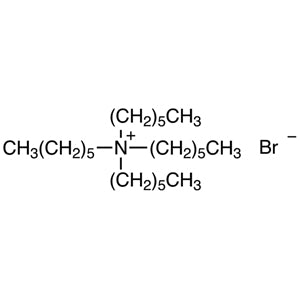
Benzyltributylammonium Bromide is a chemical compound widely used as a phase transfer catalyst in various chemical reactions. It plays a crucial role in facilitating reactions that involve electron or proton transfer between different phases, such as between organic and aqueous phases. This compound is particularly valuable in synthetic chemistry, where it helps overcome the challenges of immiscibility between reactants. Its ability to enhance reaction efficiency under non-standard conditions makes it a key reagent in the development of complex chemical structures.
The compound’s chemical properties make it a preferred choice for laboratory applications. Its stable molecular structure and ionic groups enable effective ion transfer across phases, significantly accelerating chemical processes. This efficiency is especially beneficial in heterogeneous reactions where traditional catalysts may not perform optimally. The compound’s versatility allows it to be used in a wide range of reaction environments, making it a reliable option for both academic and industrial research.
In Indonesian laboratories, Benzyltributylammonium Bromide is extensively used in chemical research, particularly in organic synthesis and catalytic processes. It is a common component in studies aimed at improving reaction yields and reducing synthesis times. Its widespread use in local research institutions and chemical industries highlights its importance in advancing chemical innovation in the region.
TCI brochures (PDF)
- Quaternary Ammonium Salts 2025-11-10 · p. 6
Related TCI products
- Organic synthesis reactions benefit from this catalyst due to its ability to enhance interfacial reactions between organic and aqueous phases.
- Heterogeneous catalytic processes utilize this compound to improve reaction efficiency and reduce energy consumption.
- Phase transfer reactions in aqueous-organic systems rely on its ionic structure to facilitate ion transfer across different phases.
- Industrial chemical production processes incorporate it to accelerate complex synthesis steps and improve product purity.
- Research laboratories use it to explore new catalytic mechanisms and optimize reaction conditions for various chemical transformations.
| Brand | TCI |
|---|---|
| CAS number | 25316-59-0 |
| Molecular formula | — |
| Purity | — |
| Category | Chemistry > Synthetic Reagents > Phase Transfer Catalysts |
| Pack sizes | Available in various quantities as per standard supplier offerings |
| Physical form | Solid powder |
| Storage | Store in a cool, dry place away from moisture and direct sunlight |
This compound should be stored in a cool, dry environment to maintain its chemical stability. It is recommended to keep it in airtight containers to prevent moisture absorption, which could affect its performance. Due to its ionic nature, it should be handled with care to avoid contamination. Laboratory personnel should wear appropriate personal protective equipment when handling this material. It is best stored in a well-ventilated area, away from incompatible substances. Regular inspection of storage conditions ensures the compound remains effective for its intended applications.
—
Produk Terkait
-
BenzyltributylammoniumChloride TCI B1384
Regular price From Rp 557.550,00Regular priceRp 405.300,00Sale price From Rp 557.550,00 -
TrimethylpropylammoniumBromide TCI T2762
Regular price Rp 6.704.250,00Regular priceRp 4.704.000,00Sale price Rp 6.704.250,00 -
TrimethylnonylammoniumBromide TCI T2734
Regular price Rp 1.801.800,00Regular priceRp 1.275.750,00Sale price Rp 1.801.800,00 -
Tetra-n-octylammoniumBromide TCI T1603
Regular price From Rp 1.618.050,00Regular priceRp 1.146.600,00Sale price From Rp 1.618.050,00 -
TetraheptylammoniumBromide TCI T1602
Regular price From Rp 1.298.850,00Regular priceRp 924.000,00Sale price From Rp 1.298.850,00 -
TetrahexylammoniumBromide TCI T1599
Regular price Rp 2.889.600,00Regular priceRp 2.035.950,00Sale price Rp 2.889.600,00 -
TetraamylammoniumBromide TCI T1432
Regular price From Rp 1.326.150,00Regular priceRp 942.900,00Sale price From Rp 1.326.150,00 -
BenzyldodecyldimethylammoniumBromide TCI B3748
Regular price From Rp 1.167.600,00Regular priceRp 831.600,00Sale price From Rp 1.167.600,00