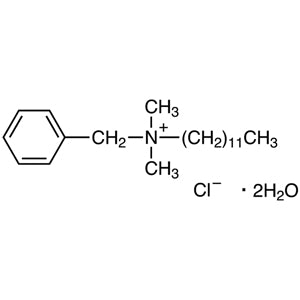
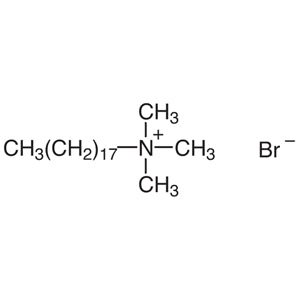
Benzyldodecyldimethylammonium Bromide (BDDB), with the CAS number 7281-04-1, is a chemical compound widely used as a phase transfer catalyst in laboratory settings. It plays a crucial role in facilitating reactions between immiscible phases, such as aqueous and organic solvents, by enabling the transfer of ions or molecules across these boundaries. This compound is particularly valuable in synthetic chemistry where efficient phase transfer is essential for reaction success. Its ability to bridge different phases without being consumed in the reaction makes it an indispensable tool for chemists working on complex synthesis processes.
BDDB is favored for its high purity, stability, and consistent performance across various experimental conditions. Its cationic structure allows it to interact effectively with both polar and non-polar molecules, enhancing its versatility in different chemical reactions. The compound remains stable under typical laboratory conditions, which ensures reliable results in repeated experiments. These properties make BDDB a preferred choice for researchers seeking a dependable and efficient catalyst in their synthetic workflows.
In Indonesian laboratories, BDDB is commonly used in organic synthesis and catalytic research. Its application is widespread in both academic and industrial settings, where it supports the development of new chemical processes. The compound's reliability and effectiveness have made it a staple in many chemical laboratories across Indonesia, contributing to the advancement of chemical research and innovation.
TCI brochures (PDF)
- Quaternary Ammonium Salts 2025-11-10 · p. 6
- Polymer Additives 2026-04-16 · p. 12
Related TCI products
- TCI B2171 147228-80-6 Benzyldodecyldimethylammonium Chloride Dihydrate
- TCI D6051 7173-51-5 Didecyldimethylammonium Chloride
- TCI T2734 1943-11-9 Trimethylnonylammonium Bromide
- TCI T0906 1119-97-7 Tetradecyltrimethylammonium Bromide
- TCI S0364 1120-02-1 Trimethylstearylammonium Bromide
- TCI O0163 2083-68-3 n-Octyltrimethylammonium Bromide
- Organic synthesis reactions benefit from BDDB's ability to enhance phase transfer, improving reaction efficiency and yield.
- Catalytic processes in aqueous-organic systems rely on BDDB to facilitate ion and molecule transfer between immiscible phases.
- Polymerization reactions often use BDDB to promote interactions between different reaction components, ensuring uniform reaction progression.
- Extraction and separation techniques in analytical chemistry utilize BDDB to improve the transfer of analytes between phases.
- Biochemical assays benefit from BDDB’s role in enabling the movement of charged molecules across phase boundaries, enhancing detection accuracy.
| Brand | TCI |
|---|---|
| CAS number | 7281-04-1 |
| Molecular formula | — |
| Purity | — |
| Category | Chemistry > Synthetic Reagents > Phase Transfer Catalysts |
| Pack sizes | Available in various quantities as per supplier specifications |
| Physical form | Solid powder |
| Storage | Store in a cool, dry place away from moisture and direct sunlight |
BDDB should be stored in a cool, dry environment to maintain its chemical integrity and prevent degradation. It is recommended to use airtight containers to protect it from moisture and humidity, which can affect its performance. Since it is a solid powder, it should be handled with care to avoid inhalation or skin contact. In laboratory settings, personal protective equipment such as gloves and safety goggles should be worn when handling the compound. Proper ventilation is essential to minimize exposure to airborne particles. Regular inspection of storage conditions ensures that the material remains stable and suitable for use in chemical experiments.
—
Produk Terkait
-
BenzyldodecyldimethylammoniumChlorideDihydrate TCI B2171
Regular price Rp 1.881.600,00Regular priceRp 1.331.400,00Sale price Rp 1.881.600,00 -
DidecyldimethylammoniumChloride TCI D6051
Regular price Rp 2.359.350,00Regular priceRp 1.665.300,00Sale price Rp 2.359.350,00 -
TrimethylnonylammoniumBromide TCI T2734
Regular price Rp 1.801.800,00Regular priceRp 1.275.750,00Sale price Rp 1.801.800,00 -
TetradecyltrimethylammoniumBromide TCI T0906
Regular price From Rp 582.750,00Regular priceRp 423.150,00Sale price From Rp 582.750,00 -
TrimethylstearylammoniumBromide TCI S0364
Regular price Rp 2.013.900,00Regular priceRp 1.423.800,00Sale price Rp 2.013.900,00 -
n-OctyltrimethylammoniumBromide TCI O0163
Regular price From Rp 1.351.350,00Regular priceRp 960.750,00Sale price From Rp 1.351.350,00 -
HexyltrimethylammoniumBromide TCI H0534
Regular price From Rp 2.411.850,00Regular priceRp 1.702.050,00Sale price From Rp 2.411.850,00 -
HexadecyltrimethylammoniumBromide TCI H0081
Regular price From Rp 530.250,00Regular priceRp 386.400,00Sale price From Rp 530.250,00