

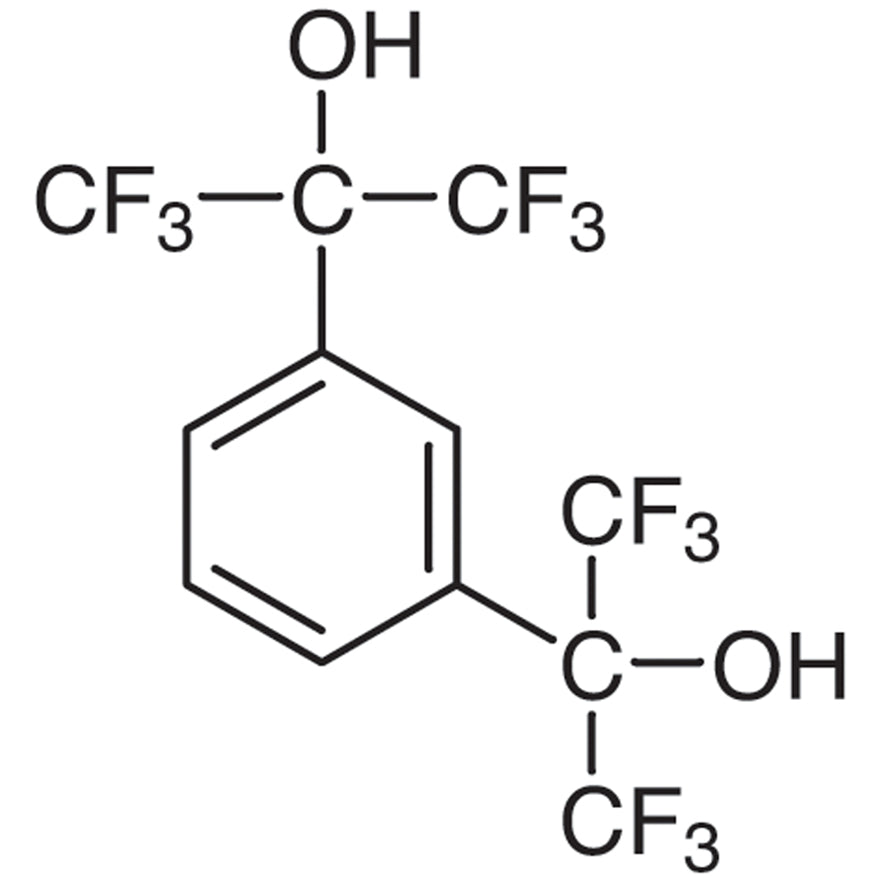
1,3-Bis(hexafluoro-alpha-hydroxyisopropyl)benzene is a specialized chemical compound used in scientific and industrial applications, particularly within the fields of materials science and polymer chemistry. As a monomer, it plays a crucial role in the synthesis of polymers with unique properties, such as high thermal and chemical resistance. This compound is widely utilized in laboratory settings as a building block for creating advanced polymer materials. Its structural complexity and functional groups make it an essential component in the development of high-performance materials.
The compound's unique properties, including its stable molecular structure and controlled reactivity, make it a preferred choice for polymer synthesis. The presence of fluorine and hydroxyl groups contributes to its exceptional chemical stability and physical characteristics. These features enable the production of materials with enhanced durability and resistance to environmental factors. Its ability to maintain structural integrity under various conditions ensures reliable performance in both research and industrial applications.
In Indonesian laboratories, 1,3-Bis(hexafluoro-alpha-hydroxyisopropyl)benzene is commonly used in material science and polymer chemistry research. It is a key reagent in the development of specialized polymers for applications such as insulation materials, coatings, and electronic components. Its versatility and performance make it a valuable resource for academic and industrial research institutions in Indonesia.
TCI brochures (PDF)
- Monomers 2025-05-28 · p. 23
Related TCI products
- TCI H1279 918-21-8 Hexafluoro-2,3-bis(trifluoromethyl)-2,3-butanediol
- TCI H0746 376-90-9 2,2,3,3,4,4-Hexafluoro-1,5-pentanediol
- TCI T3493 69804-19-9 2,2,3,3-Tetrafluoro-3-[[1,1,1,2,3,3-hexafluoro-3-[(1,2,2-trifluorovinyl)oxy]propan-2-yl]oxy]propionitrile
- TCI B1485 5085-95-0 1,4-Bis(3-hydroxyphenoxy)benzene
- TCI B1484 126716-90-3 1,3-Bis(4-hydroxyphenoxy)benzene
- TCI T2732 92339-07-6 2,3,5,6-Tetrafluoro-1,4-benzenedimethanol
- Polymer synthesis for high-performance materials due to its unique chemical structure and thermal stability.
- Development of advanced coatings and insulation materials because of its chemical resistance and durability.
- Research in electronic components where high thermal and chemical stability is required for long-term performance.
- Material science studies focusing on the synthesis of fluorinated polymers with enhanced mechanical properties.
- Creation of specialized polymer composites for use in aerospace and automotive industries requiring extreme environmental resistance.
| Brand | TCI |
|---|---|
| CAS number | 802-93-7 |
| Molecular formula | — |
| Purity | — |
| Category | Materials Science > Polymer/Macromolecule Reagents > Monomers |
| Pack sizes | Available in various quantities as per standard laboratory supply specifications |
| Physical form | Liquid |
| Storage | Store in a cool, dry place away from direct sunlight and incompatible materials |
This compound should be stored in a cool, dry environment, away from direct sunlight and sources of heat. It is recommended to use sealed containers made of materials compatible with its chemical properties to prevent contamination and degradation. Due to its chemical stability, it does not require refrigeration but should be protected from moisture and air exposure. Laboratory personnel should handle it with appropriate personal protective equipment, including gloves and safety goggles, to ensure safe handling. Proper ventilation should be maintained in the workspace to minimize inhalation risks. Regular inspection of storage containers is advised to ensure integrity and prevent accidental exposure.
—
Produk Terkait
-
Hexafluoro-2,3-bis(trifluoromethyl)-2,3-butanediol TCI H1279
Regular price From Rp 2.625.000,00Regular priceRp 1.835.400,00Sale price From Rp 2.625.000,00 -
2,2,3,3,4,4-Hexafluoro-1,5-pentanediol TCI H0746
Regular price Rp 903.000,00Regular priceRp 631.050,00Sale price Rp 903.000,00 -
2,2,3,3-Tetrafluoro-3-[[1,1,1,2,3,3-hexafluoro-3-[(1,2,2-trifluorovinyl)oxy]propan-2-yl]oxy]propionitrile TCI T3493
Regular price From Rp 4.399.500,00Regular priceRp 3.092.250,00Sale price From Rp 4.399.500,00 -
1,4-Bis(3-hydroxyphenoxy)benzene TCI B1485
Regular price Rp 3.630.900,00Regular priceRp 2.554.650,00Sale price Rp 3.630.900,00 -
1,3-Bis(4-hydroxyphenoxy)benzene TCI B1484
Regular price From Rp 2.227.050,00Regular priceRp 1.572.900,00Sale price From Rp 2.227.050,00 -
2,3,5,6-Tetrafluoro-1,4-benzenedimethanol TCI T2732
Regular price From Rp 2.094.750,00Regular priceRp 1.464.750,00Sale price From Rp 2.094.750,00 -
2,2,3,3-Tetrafluoro-1,4-butanediol TCI T2296
Regular price From Rp 795.900,00Regular priceRp 556.500,00Sale price From Rp 795.900,00 -
Tetrafluorohydroquinone TCI T2003
Regular price Rp 2.518.950,00Regular priceRp 1.760.850,00Sale price Rp 2.518.950,00


