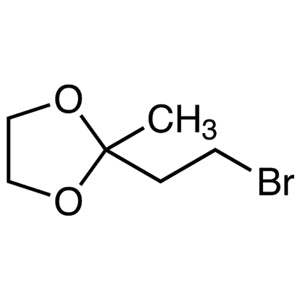
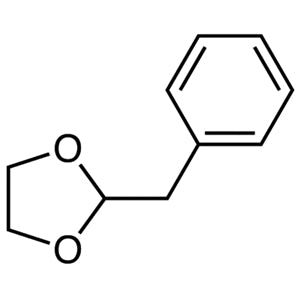
2-(4-Bromobutyl)-1,3-dioxolane is a chemical compound widely used in organic synthesis reactions within laboratory settings. As a building block in the field of chemistry, it plays a crucial role in the development of more complex organic molecules. This compound is particularly valued for its structural versatility, allowing it to participate in various types of chemical reactions. Its presence in the laboratory is essential for researchers aiming to create new compounds or modify existing ones through synthetic pathways. Due to its chemical stability and controlled reactivity, it is a reliable choice for both academic and industrial research.
The compound's unique chemical properties, including its bromo group on the butyl chain and the 1,3-dioxolane ring structure, contribute to its effectiveness in organic synthesis. These features provide a balance between reactivity and stability, making it suitable for reactions that require moderate chemical activity. Its solubility in organic solvents further enhances its usability, as it simplifies handling and purification processes. These characteristics make it a preferred material for chemists working on complex molecular structures.
In Indonesian laboratories, this compound is commonly used in organic chemistry research, particularly in academic institutions. It is a key component in the synthesis of various organic compounds, supporting both teaching and research activities. Its availability and reliability make it an essential reagent for students and researchers alike, facilitating the exploration of chemical reactions and molecular design.
Related TCI products
- TCI B2802 60789-54-0 Benzyl 4-Bromobutyl Ether
- TCI T2575 1193-11-9 2,2,4-Trimethyl-1,3-dioxolane
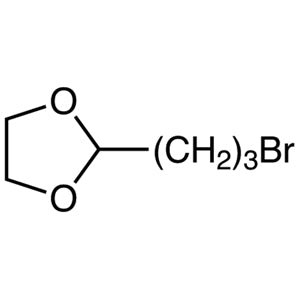
- TCI B3463 62563-07-9 2-(3-Bromopropyl)-1,3-dioxolane
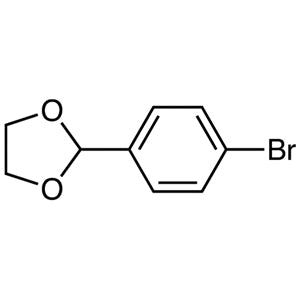
- TCI B2100 10602-01-4 2-(4-Bromophenyl)-1,3-dioxolane
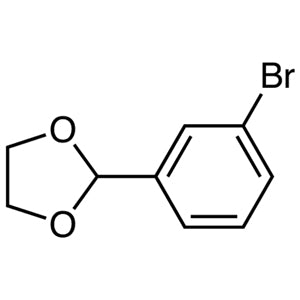
- TCI B2098 17789-14-9 2-(3-Bromophenyl)-1,3-dioxolane
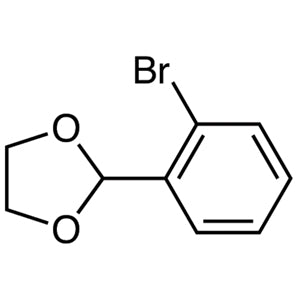
- TCI B2084 34824-58-3 2-(2-Bromophenyl)-1,3-dioxolane
- Organic synthesis reactions benefit from this compound's controlled reactivity and structural versatility, enabling the creation of complex molecules.
- It is ideal for substitution reactions due to its bromo group, which can be easily replaced in synthetic pathways.
- In coupling reactions, its 1,3-dioxolane structure provides stability while allowing for functional group modifications.
- It supports addition reactions by offering a stable yet reactive platform for chemical transformations.
- Its solubility in organic solvents makes it suitable for purification and separation processes in laboratory settings.
| Brand | TCI |
|---|---|
| CAS number | 87227-41-6 |
| Molecular formula | — |
| Purity | — |
| Category | Chemistry > Building Blocks > Non-Heterocyclic Building Blocks |
| Pack sizes | Available in various sizes as per standard laboratory supply |
| Physical form | Liquid |
| Storage | Store in a cool, dry place away from light and incompatible materials |
This compound should be stored in a cool, dry environment, away from direct sunlight and sources of heat. It is recommended to keep it in a tightly sealed container to prevent contamination and evaporation. Due to its chemical nature, it should be stored separately from incompatible substances such as strong oxidizers or acids. Always ensure proper ventilation in the laboratory when handling this material. Personal protective equipment, including gloves and safety goggles, should be worn to minimize exposure. Regular inspection of storage conditions is advised to maintain the integrity and safety of the compound.
—
Produk Terkait
-
Benzyl4-BromobutylEther TCI B2802
Regular price From Rp 3.683.400,00Regular priceRp 2.575.650,00Sale price From Rp 3.683.400,00 -
2,2,4-Trimethyl-1,3-dioxolane TCI T2575
Regular price Rp 1.856.400,00Regular priceRp 1.313.550,00Sale price Rp 1.856.400,00 -
2-(3-Bromopropyl)-1,3-dioxolane TCI B3463
Regular price From Rp 1.908.900,00Regular priceRp 1.350.300,00Sale price From Rp 1.908.900,00 -
2-(4-Bromophenyl)-1,3-dioxolane TCI B2100
Regular price From Rp 5.460.000,00Regular priceRp 3.833.550,00Sale price From Rp 5.460.000,00 -
2-(3-Bromophenyl)-1,3-dioxolane TCI B2098
Regular price From Rp 1.087.800,00Regular priceRp 775.950,00Sale price From Rp 1.087.800,00 -
2-(2-Bromophenyl)-1,3-dioxolane TCI B2084
Regular price From Rp 1.140.300,00Regular priceRp 812.700,00Sale price From Rp 1.140.300,00 -
2-(2-Bromoethyl)-2-methyl-1,3-dioxolane TCI B1598
Regular price From Rp 5.460.000,00Regular priceRp 3.833.550,00Sale price From Rp 5.460.000,00 -
2-Benzyl-1,3-dioxolane TCI B1404
Regular price Rp 1.749.300,00Regular priceRp 1.239.000,00Sale price Rp 1.749.300,00