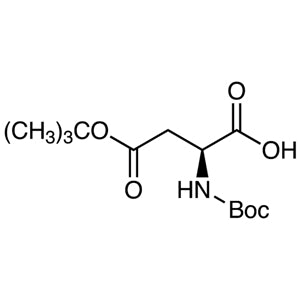
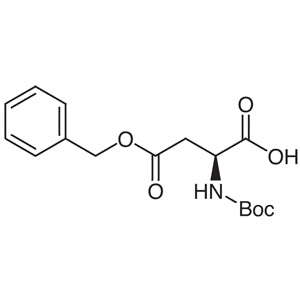
1-Benzyl N-(tert-Butoxycarbonyl)-L-aspartate is a chemical compound widely used in organic chemistry and biochemical research, particularly in peptide synthesis. This compound plays a critical role in the protection of amino acid functional groups during complex molecular reactions. Its unique structure allows it to be a key component in the synthesis of protected amino acids, which are essential in various biochemical and pharmaceutical applications. In laboratory settings, it is commonly used to facilitate the controlled modification of amino acid side chains, ensuring the integrity of the final product during multi-step synthesis processes.
The compound is valued for its stability under controlled laboratory conditions and its ability to participate in specific chemical reactions such as deprotection and coupling reactions. Its molecular structure provides the necessary reactivity for use in advanced synthetic pathways, making it a reliable reagent for researchers working on peptide and protein-based compounds. The solid form of this compound allows for easy storage and handling, which enhances its practicality in both academic and industrial research environments.
In Indonesian laboratories, this compound is extensively used by researchers and educational institutions focused on organic chemistry, biochemistry, and pharmacology. Its application in the synthesis of protected amino acids supports the development of new drugs and bioactive compounds. The compound’s versatility and reliability make it a preferred choice for scientists engaged in complex chemical synthesis and functional group manipulation.
TCI brochures (PDF)
- Amino Acids and Peptide Synthesis Reagents 2025-08-14 · p. 13
Related TCI products
- TCI B4303 34404-30-3 1-Benzyl N-(tert-Butoxycarbonyl)-D-glutamate
- TCI A2894 144120-53-6 1-Allyl N-[(9H-Fluoren-9-ylmethoxy)carbonyl]-L-aspartate
- TCI M2707 4668-42-2 1-Methyl N-Benzyloxycarbonyl-L-aspartate
- TCI F0503 129460-09-9 1-tert-Butyl N-[(9H-Fluoren-9-ylmethoxy)carbonyl]-L-aspartate
- TCI B3935 1676-90-0 4-tert-Butyl N-(tert-Butoxycarbonyl)-L-aspartate
- TCI B3903 3479-47-8 4-Benzyl N-Carbobenzoxy-L-aspartate
- Peptide Synthesis: This compound is ideal for peptide synthesis due to its ability to protect amino acid side chains, ensuring the accuracy of the final product.
- Biochemical Research: It supports the development of bioactive compounds by enabling controlled functional group modifications in complex molecules.
- Pharmaceutical Development: Its use in protected amino acid synthesis is crucial for the creation of drug molecules with specific structural requirements.
- Organic Chemistry Studies: It facilitates the study of molecular reactivity and functional group behavior in synthetic pathways.
- Academic Research: It is widely used in educational institutions for teaching and research in advanced chemical synthesis techniques.
| Brand | TCI |
|---|---|
| CAS number | 30925-18-9 |
| Molecular formula | — |
| Purity | — |
| Category | Chemistry > Chemical Biology > Peptide Chemistry |
| Pack sizes | Available in various quantities as per supplier specifications |
| Physical form | Solid |
| Storage | Store in a cool, dry place away from moisture and direct light |
This compound should be stored in a cool, dry environment to maintain its stability and prevent degradation. It is recommended to use airtight containers to protect it from moisture and contaminants. Due to its chemical nature, it should be handled with appropriate personal protective equipment, such as gloves and safety goggles, to ensure laboratory safety. The compound is typically stored in a well-ventilated area to minimize exposure to airborne particles. Proper labeling of containers is essential to prevent accidental misuse. Regular inspection of storage conditions ensures the compound remains in optimal condition for use in research applications.
—
Product Categories
Produk Terkait
-
1-BenzylN-(tert-Butoxycarbonyl)-D-glutamate TCI B4303
Regular price From Rp 1.246.350,00Regular priceRp 887.250,00Sale price From Rp 1.246.350,00 -
1-AllylN-[(9H-Fluoren-9-ylmethoxy)carbonyl]-L-aspartate TCI A2894
Regular price From Rp 1.881.600,00Regular priceRp 1.331.400,00Sale price From Rp 1.881.600,00 -
1-MethylN-Benzyloxycarbonyl-L-aspartate TCI M2707
Regular price Rp 1.696.800,00Regular priceRp 1.202.250,00Sale price Rp 1.696.800,00 -
1-tert-ButylN-[(9H-Fluoren-9-ylmethoxy)carbonyl]-L-aspartate TCI F0503
Regular price From Rp 1.378.650,00Regular priceRp 979.650,00Sale price From Rp 1.378.650,00 -
4-tert-ButylN-(tert-Butoxycarbonyl)-L-aspartate TCI B3935
Regular price From Rp 1.378.650,00Regular priceRp 979.650,00Sale price From Rp 1.378.650,00 -
4-BenzylN-Carbobenzoxy-L-aspartate TCI B3903
Regular price From Rp 1.246.350,00Regular priceRp 887.250,00Sale price From Rp 1.246.350,00 -
4-BenzylN-[(9H-Fluoren-9-ylmethoxy)carbonyl]-L-aspartate TCI B3887
Regular price From Rp 1.510.950,00Regular priceRp 1.072.050,00Sale price From Rp 1.510.950,00 -
4-BenzylN-(tert-Butoxycarbonyl)-L-aspartate TCI B1628
Regular price From Rp 769.650,00Regular priceRp 553.350,00Sale price From Rp 769.650,00