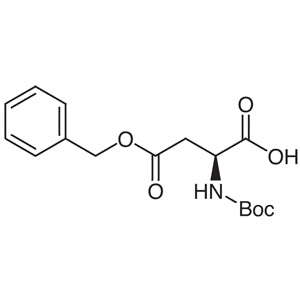
4-Benzyl N-Carbobenzoxy-L-aspartate is a chemical compound widely used in laboratory settings for biochemical and chemical research. It belongs to the category of peptide chemistry and plays a crucial role in the study of molecular interactions and enzymatic reactions. This compound is particularly valuable in experiments involving protein synthesis and receptor binding due to its ability to interact with biological systems. Its structural complexity makes it a versatile tool for researchers aiming to understand biological mechanisms at the molecular level.
One of the key reasons this compound is preferred is its stability under controlled conditions, which ensures reliable results in experimental settings. Its chemical properties allow it to be used as a substrate in enzymatic reactions, making it essential for biochemical assays. Additionally, its solid form facilitates easy handling and storage, reducing the risk of contamination and ensuring consistency in research outcomes. These characteristics make it a reliable choice for both academic and industrial laboratories.
In Indonesian laboratories, 4-Benzyl N-Carbobenzoxy-L-aspartate is commonly used in biochemical and pharmacological research. It is a key component in studies related to molecular interactions, drug development, and the synthesis of active compounds. Its application is widespread across research institutions and universities, contributing to advancements in biotechnology and pharmaceutical sciences.
TCI brochures (PDF)
- Amino Acids and Peptide Synthesis Reagents 2025-08-14 · p. 17
Related TCI products
- TCI B3887 86060-84-6 4-Benzyl N-[(9H-Fluoren-9-ylmethoxy)carbonyl]-L-aspartate
- TCI B2408 30925-18-9 1-Benzyl N-(tert-Butoxycarbonyl)-L-aspartate
- TCI B1628 7536-58-5 4-Benzyl N-(tert-Butoxycarbonyl)-L-aspartate
- TCI B4619 112883-39-3 4-tert-Butyl N-[(9H-Fluoren-9-ylmethoxy)carbonyl]-D-aspartate
- TCI B3935 1676-90-0 4-tert-Butyl N-(tert-Butoxycarbonyl)-L-aspartate
- TCI B3150 71989-14-5 4-tert-Butyl N-[(9H-Fluoren-9-ylmethoxy)carbonyl]-L-aspartate
- Enzymatic Reaction Studies – This compound serves as a substrate for enzymatic reactions, allowing researchers to study enzyme activity and substrate specificity in controlled environments.
- Peptide Synthesis – Its structural complexity makes it suitable for the synthesis of complex peptides and proteins, aiding in the development of bioactive compounds.
- Receptor Binding Analysis – The compound’s ability to interact with biological receptors makes it valuable in studying molecular recognition and signaling pathways.
- Drug Development Research – It is used in the early stages of drug discovery to investigate the biochemical interactions of potential therapeutic agents.
- Molecular Interaction Studies – Its role in facilitating molecular interactions supports research into protein-protein and protein-ligand interactions.
| Brand | — |
|---|---|
| CAS number | — |
| Molecular formula | — |
| Purity | — |
| Category | — |
| Pack sizes | — |
| Physical form | — |
| Storage | — |
- Brand – TCI
- CAS Number – 3479-47-8
- Category – Chemistry > Chemical Biology > Peptide Chemistry
- Pack Sizes – Available in various quantities as per supplier specifications
- Physical Form – Solid
- Storage Note – Requires protection from moisture and air exposure
This compound should be stored in a cool, dry place away from moisture and direct exposure to air. It is recommended to keep it in a sealed container to prevent degradation and contamination. Due to its sensitivity, it should be handled with care to avoid exposure to humidity or prolonged air contact. Laboratory personnel should use appropriate protective equipment when handling the compound. Proper storage conditions ensure the compound remains chemically stable and suitable for use in experimental procedures. Maintaining these conditions is essential for preserving the integrity and effectiveness of the compound in research applications.
—
Product Categories
Produk Terkait
-
4-BenzylN-[(9H-Fluoren-9-ylmethoxy)carbonyl]-L-aspartate TCI B3887
Regular price From Rp 1.510.950,00Regular priceRp 1.072.050,00Sale price From Rp 1.510.950,00 -
1-BenzylN-(tert-Butoxycarbonyl)-L-aspartate TCI B2408
Regular price From Rp 1.008.000,00Regular priceRp 720.300,00Sale price From Rp 1.008.000,00 -
4-BenzylN-(tert-Butoxycarbonyl)-L-aspartate TCI B1628
Regular price From Rp 769.650,00Regular priceRp 553.350,00Sale price From Rp 769.650,00 -
4-tert-ButylN-[(9H-Fluoren-9-ylmethoxy)carbonyl]-D-aspartate TCI B4619
Regular price From Rp 557.550,00Regular priceRp 405.300,00Sale price From Rp 557.550,00 -
4-tert-ButylN-(tert-Butoxycarbonyl)-L-aspartate TCI B3935
Regular price From Rp 1.378.650,00Regular priceRp 979.650,00Sale price From Rp 1.378.650,00 -
4-tert-ButylN-[(9H-Fluoren-9-ylmethoxy)carbonyl]-L-aspartate TCI B3150
Regular price From Rp 875.700,00Regular priceRp 627.900,00Sale price From Rp 875.700,00 -
1-AllylN-[(9H-Fluoren-9-ylmethoxy)carbonyl]-L-aspartate TCI A2894
Regular price From Rp 1.881.600,00Regular priceRp 1.331.400,00Sale price From Rp 1.881.600,00 -
1-MethylN-Benzyloxycarbonyl-L-aspartate TCI M2707
Regular price Rp 1.696.800,00Regular priceRp 1.202.250,00Sale price Rp 1.696.800,00