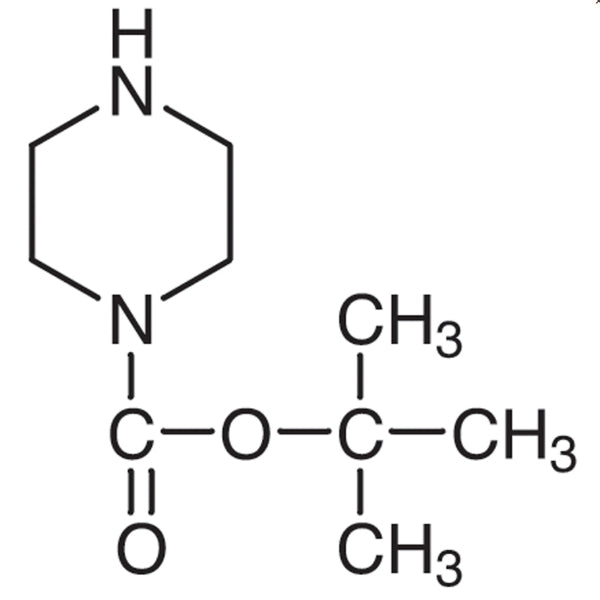
1-(tert-Butoxycarbonyl)piperazine is a chemical compound widely used as a building block in the synthesis of heterocyclic compounds. This material plays a crucial role in organic chemistry laboratories, particularly in protecting amino groups or other reactive functionalities during complex synthetic processes. Its presence allows chemists to manipulate molecular structures with precision, facilitating the creation of more intricate chemical entities. As a key component in the development of pharmaceutical and organic compounds, this reagent supports a wide range of research activities in both academic and industrial settings.
The compound's chemical stability and controlled reactivity make it a preferred choice for laboratory applications. It maintains its integrity under various reaction conditions, ensuring consistent results without unwanted side reactions. The tert-butoxycarbonyl (Boc) group provides a reliable method for protecting functional groups, which is essential in multi-step syntheses. Its ability to participate in substitution, reduction, and bond-forming reactions further enhances its utility in synthetic chemistry. These properties make it an essential tool for researchers working on complex molecular transformations.
In Indonesian laboratories, 1-(tert-Butoxycarbonyl)piperazine is commonly used in organic chemistry research, especially in the development of bioactive compounds. It is frequently employed in pharmaceutical research programs aimed at synthesizing pharmacological agents, including drug candidates. Its versatility and reliability make it a valuable resource for scientists engaged in the discovery and synthesis of new chemical entities with potential therapeutic applications.
- Organic synthesis of heterocyclic compounds due to its role in protecting amino groups and enabling controlled chemical transformations.
- Development of pharmaceutical compounds where the Boc group is essential for functional group protection during complex molecular synthesis.
- Research in medicinal chemistry focused on the creation of bioactive molecules with potential therapeutic applications.
- Synthesis of complex organic molecules requiring precise manipulation of reactive functionalities through controlled reactivity.
- Support for academic and industrial research in the field of organic chemistry, particularly in the design of novel chemical structures.
| Brand | TCI |
|---|---|
| CAS number | 57260-71-6 |
| Molecular formula | — |
| Purity | — |
| Category | Chemistry > Building Blocks > Heterocyclic Building Blocks |
| Pack sizes | Available in various quantities as per supplier specifications |
| Physical form | Solid (as per standard product description) |
| Storage | Store in a cool, dry place away from moisture and direct sunlight |
This compound should be stored in a cool, dry environment to maintain its chemical stability. It is recommended to keep it in a sealed container to prevent exposure to moisture and air, which may affect its integrity. Suitable storage containers include glass or high-density polyethylene (HDPE) bottles with airtight closures. General laboratory precautions include handling with care to avoid contamination and ensuring proper ventilation when working with the material. Due to its chemical nature, it should be stored away from incompatible substances such as strong acids or bases. Proper labeling and storage conditions are essential to ensure safety and maintain the compound's effectiveness in laboratory applications.
—
Produk Terkait
-
N-(2-Aminoethyl)piperazine TCI A0304
Regular price From Rp 557.550,00Regular priceRp 405.300,00Sale price From Rp 557.550,00 -
1-(o-Tolyl)piperazine TCI T3404
Regular price From Rp 1.723.050,00Regular priceRp 1.220.100,00Sale price From Rp 1.723.050,00 -
1-(2-Thiazolyl)piperazine TCI T3273
Regular price Rp 1.378.650,00Regular priceRp 979.650,00Sale price Rp 1.378.650,00 -
1-(p-Tolyl)piperazine TCI T2956
Regular price From Rp 1.351.350,00Regular priceRp 960.750,00Sale price From Rp 1.351.350,00 -
1-(Tetrahydro-2-furoyl)piperazine TCI T2617
Regular price From Rp 822.150,00Regular priceRp 590.100,00Sale price From Rp 822.150,00 -
1-(m-Tolyl)piperazine TCI T2260
Regular price From Rp 1.483.650,00Regular priceRp 1.053.150,00Sale price From Rp 1.483.650,00 -
1,4-Bis(2-hydroxyethyl)piperazine TCI B4903
Regular price From Rp 900.900,00Regular priceRp 645.750,00Sale price From Rp 900.900,00 -
1-Acetyl-4-(4-hydroxyphenyl)piperazine TCI A1845
Regular price From Rp 955.500,00Regular priceRp 683.550,00Sale price From Rp 955.500,00