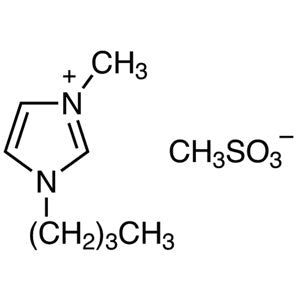
1-Butyl-3-methylimidazolium Tetrachloroferrate is an ionic liquid widely used in specialized chemical reactions within laboratory settings. As a member of the ionic liquid family, it plays a crucial role in organic and inorganic chemistry due to its unique molecular structure, which consists of an imidazolium cation and a tetrachloroferrate anion. This compound is particularly valuable for its non-volatile nature and high boiling point, making it a stable medium for chemical processes that require prolonged reaction times or high-temperature conditions. Its versatility allows it to be applied in various research fields, including material science and electrochemistry.
The properties of 1-Butyl-3-methylimidazolium Tetrachloroferrate make it a preferred choice for laboratory applications. Its high dielectric constant facilitates electrochemical reactions and electron transfer processes, which are essential in advanced chemical research. Additionally, its non-volatile nature ensures that it remains stable under prolonged heating or in closed systems, reducing the risk of evaporation and contamination. The compound’s ability to stabilize complex chemical reactions also makes it an ideal catalyst or reaction medium in synthetic chemistry. These characteristics contribute to its widespread use in both academic and industrial research environments.
In Indonesian laboratories, 1-Butyl-3-methylimidazolium Tetrachloroferrate is commonly used in organic chemistry, material science, and electrochemical studies. Researchers in universities and research institutions rely on this compound for its stability and effectiveness in various synthesis processes. Its application in these fields supports the development of new materials and chemical technologies, making it a valuable resource for scientific innovation in Indonesia.
Advantages (TCI brochure)
- Highly stable and non-volatile liquid at room temperature
- Responds to a magnetic field by a neodymium magnet
- Not very soluble in water
TCI brochures (PDF)
- Magnetic Ionic Liquids 2024-05-24 · p. 1
- Ionic Liquids 2026-06-08 · p. 7
Related TCI products
- TCI E0706 850331-04-3 1-Ethyl-3-methylimidazolium Tetrachloroferrate
- TCI B5487 878027-73-7 1-Butyl-3-methylimidazolium Tricyanomethanide
- TCI B5447 448245-52-1 1-Butyl-3-methylimidazolium Dicyanamide
- TCI B4091 344790-87-0 1-Butyl-3-methylimidazolium Thiocyanate
- TCI B3596 820965-08-0 1-Butyl-3-methylimidazolium Tribromide
- TCI B3542 741677-68-9 1-Butyl-3-methylimidazolium Trifluoro(trifluoromethyl)borate
- Organic chemistry synthesis where stable and non-volatile reaction media are required for complex chemical transformations.
- Electrochemical research due to its high dielectric constant, which supports electron transfer and electrochemical reactions.
- Material science experiments involving the development of new polymers and nanomaterials through controlled chemical processes.
- Catalytic applications in reactions that benefit from the unique ionic structure and stability of the compound.
- Advanced chemical synthesis where the non-volatile nature of the ionic liquid prevents evaporation and maintains reaction consistency.
From the TCI brochure
- Demonstration of magnetic response to a neodymium magnet in the presence of water
| Brand | TCI |
|---|---|
| CAS number | 359845-21-9 |
| Molecular formula | — |
| Purity | — |
| Category | Chemistry > Specialty Synthesis > Ionic Liquids |
| Pack sizes | Available in various quantities as per supplier specifications |
| Physical form | Liquid |
| Storage | Store in a cool, dry place away from moisture and direct sunlight |
Data from the TCI brochure
| Kemasan | 5 g / 25 g |
|---|---|
| Kekuatan magnet neodymium | 0.55 T (Magnet neodymium yang digunakan pada demonstrasi) |
Source: TCI brochure FF055 (2024-05-24)
This ionic liquid should be stored in a cool, dry environment to maintain its stability and prevent degradation. It is recommended to use airtight containers made of glass or high-density polyethylene to avoid contamination and evaporation. Due to its non-volatile nature, it does not require refrigeration but should be protected from moisture and direct light. In laboratory settings, proper personal protective equipment should be worn when handling the compound to ensure safety. Regular monitoring of storage conditions is advised to maintain the integrity of the material for long-term use.
—
Product Categories
Produk Terkait
-
1-Ethyl-3-methylimidazoliumTetrachloroferrate TCI E0706
Regular price Rp 3.735.900,00Regular priceRp 2.628.150,00Sale price Rp 3.735.900,00 -
1-Butyl-3-methylimidazoliumTricyanomethanide TCI B5487
Regular price From Rp 1.856.400,00Regular priceRp 1.313.550,00Sale price From Rp 1.856.400,00 -
1-Butyl-3-methylimidazoliumDicyanamide TCI B5447
Regular price From Rp 1.749.300,00Regular priceRp 1.239.000,00Sale price From Rp 1.749.300,00 -
1-Butyl-3-methylimidazoliumThiocyanate TCI B4091
Regular price From Rp 1.167.600,00Regular priceRp 831.600,00Sale price From Rp 1.167.600,00 -
1-Butyl-3-methylimidazoliumTribromide TCI B3596
Regular price Rp 3.922.800,00Regular priceRp 2.758.350,00Sale price Rp 3.922.800,00 -
1-Butyl-3-methylimidazoliumTrifluoro(trifluoromethyl)borate TCI B3542
Regular price Rp 3.312.750,00Regular priceRp 2.332.050,00Sale price Rp 3.312.750,00 -
1-Butyl-3-methylimidazoliumMethanesulfonate TCI B3231
Regular price From Rp 848.400,00Regular priceRp 609.000,00Sale price From Rp 848.400,00 -
1-Butyl-3-methylimidazoliumIodide TCI B2708
Regular price From Rp 1.590.750,00Regular priceRp 1.127.700,00Sale price From Rp 1.590.750,00