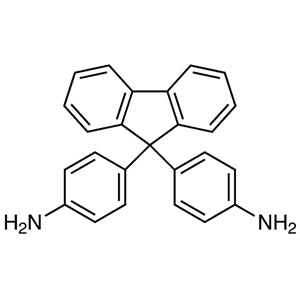
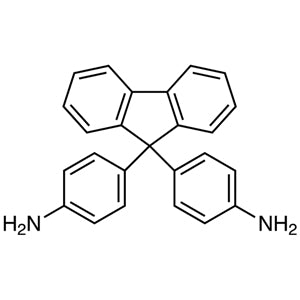
9,9-Bis(4-amino-3-chlorophenyl)fluorene is a chemical compound widely used in scientific and industrial applications, particularly in the fields of materials science and polymer chemistry. This compound serves as a key monomer in the synthesis of complex organic molecules and polymers. Its unique molecular structure allows it to participate in various chemical reactions, making it a versatile reagent for laboratory use. In research settings, it is often employed to create polymers with specific properties, such as conductivity or mechanical strength. Its role in polymerization processes is critical for the development of advanced materials.
The compound is valued for its stable chemical properties and moderate reactivity, which make it a preferred choice for synthetic applications. Its ability to form strong chemical bonds contributes to the creation of durable and high-performance materials. The presence of amino and chloro groups in its structure enhances its reactivity, allowing for further functionalization and modification. These characteristics make it suitable for a wide range of chemical transformations, including cross-linking and chain extension. Its versatility supports its use in both academic and industrial research environments.
In Indonesian laboratories, 9,9-Bis(4-amino-3-chlorophenyl)fluorene is commonly used in material science and polymer chemistry research. Scientists and researchers utilize this compound to develop new materials, such as conductive polymers and composite materials. Its application extends to the study of polymer synthesis and modification, contributing to advancements in material science. The compound is also used in the development of specialized chemical products that require specific structural and functional properties. Its presence in Indonesian research institutions highlights its importance in modern chemical research.
TCI brochures (PDF)
- Raw Materials for Polyimide Synthesis 2026-05-11 · p. 5
- Fluorenes and Fluorenones 2026-04-15 · p. 5
- Monomers 2025-05-28 · p. 30
Related TCI products
- TCI B2693 107934-60-1 9,9-Bis(4-amino-3-methylphenyl)fluorene
- TCI B2691 127926-65-2 9,9-Bis(4-amino-3-fluorophenyl)fluorene
- TCI B2654 15499-84-0 9,9-Bis(4-aminophenyl)fluorene (purified by sublimation)
- TCI B1549 15499-84-0 9,9-Bis(4-aminophenyl)fluorene
- TCI T3239 368-53-6 5-Trifluoromethyl-1,3-phenylenediamine
- TCI T3098 84-67-3 m-Tolidine
- Polymer synthesis and modification where strong chemical bonds and structural complexity are required.
- Development of conductive polymers and composite materials due to its reactivity and functional group versatility.
- Research in organic chemistry for the synthesis of complex molecules with specific structural features.
- Material science studies focused on creating high-performance and durable materials through chemical reactions.
- Investigation of chemical reactivity and stability in various synthetic and industrial processes.
| Brand | TCI |
|---|---|
| CAS number | 107934-68-9 |
| Molecular formula | — |
| Purity | — |
| Category | Materials Science > Polymer/Macromolecule Reagents > Monomers |
| Pack sizes | As available from supplier |
| Physical form | Solid (as per standard product description) |
| Storage | Store in a cool, dry place away from light and moisture |
This compound should be stored in a cool, dry environment, away from direct sunlight and moisture. It is recommended to keep it in a sealed container to prevent exposure to air and humidity. Proper ventilation should be maintained in the laboratory to ensure safe handling. Avoid contact with skin and eyes, and use appropriate personal protective equipment when working with the material. Due to its chemical nature, it should be handled in a fume hood if possible. Always follow standard laboratory safety protocols to minimize risks associated with chemical exposure.
—
Produk Terkait
-
9,9-Bis(4-amino-3-methylphenyl)fluorene TCI B2693
Regular price From Rp 1.060.500,00Regular priceRp 757.050,00Sale price From Rp 1.060.500,00 -
9,9-Bis(4-amino-3-fluorophenyl)fluorene TCI B2691
Regular price Rp 8.983.800,00Regular priceRp 6.297.900,00Sale price Rp 8.983.800,00 -
9,9-Bis(4-aminophenyl)fluorene(purifiedbysublimation) TCI B2654
Regular price Rp 2.650.200,00Regular priceRp 1.869.000,00Sale price Rp 2.650.200,00 -
9,9-Bis(4-aminophenyl)fluorene TCI B1549
Regular price From Rp 3.365.250,00Regular priceRp 2.368.800,00Sale price From Rp 3.365.250,00 -
5-Trifluoromethyl-1,3-phenylenediamine TCI T3239
Regular price Rp 1.326.150,00Regular priceRp 942.900,00Sale price Rp 1.326.150,00 -
m-Tolidine TCI T3098
Regular price Rp 2.439.150,00Regular priceRp 1.720.950,00Sale price Rp 2.439.150,00 -
2-(Trifluoromethyl)-1,4-phenylenediamine TCI T2969
Regular price Rp 1.829.100,00Regular priceRp 1.278.900,00Sale price Rp 1.829.100,00 -
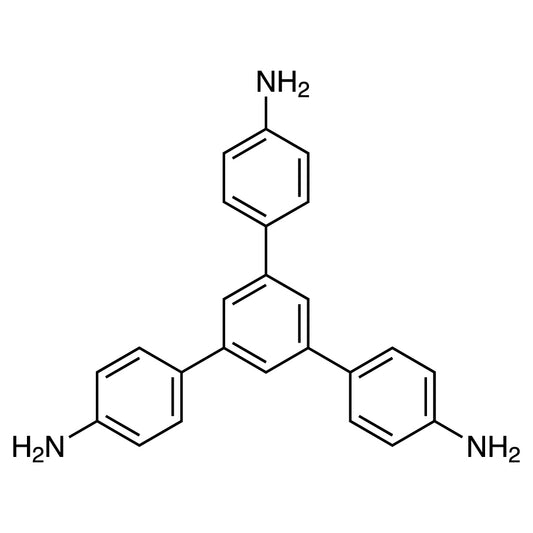
1,3,5-Tris(4-aminophenyl)benzene TCI T2728
Regular price From Rp 6.465.900,00Regular priceRp 4.537.050,00Sale price From Rp 6.465.900,00