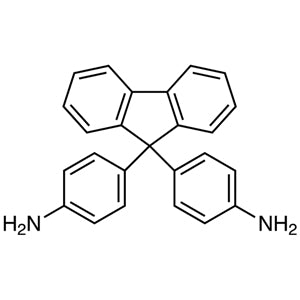
9,9-Bis(4-aminophenyl)fluorene is a chemical compound widely used in organic reactions for the synthesis of complex molecules. As a building block in chemical research, it plays a crucial role in constructing molecular structures with high precision. This compound is commonly found in industrial chemical manufacturing processes, including the production of electronic materials and polymers. Its versatility makes it an essential component in various laboratory applications where structural complexity and functional group compatibility are required.
The compound's stability and ability to form bonds with a variety of functional groups make it a preferred choice for researchers. Its high purity, achieved through sublimation, ensures consistent results in experimental settings. This level of purity is particularly important in applications that demand accuracy and reproducibility. The compound's chemical inertness and predictable reactivity further enhance its reliability in laboratory environments.
In Indonesian laboratories, 9,9-Bis(4-aminophenyl)fluorene is frequently utilized in organic chemistry research, especially in academic and research institutions. It is a key material in the development of new compounds and the testing of industrial material properties. Its role in polymer synthesis and electronic material production highlights its importance in both academic and industrial research contexts.
TCI brochures (PDF)
- Chemical Compounds Purified by Sublimation 2025-05-07 · p. 3
- Raw Materials for Polyimide Synthesis 2026-05-11 · p. 5
- Fluorenes and Fluorenones 2026-04-15 · p. 5
- Monomers 2025-05-28 · p. 30
Related TCI products
- TCI B1549 15499-84-0 9,9-Bis(4-aminophenyl)fluorene
- TCI D5689 2243-62-1 1,5-Diaminonaphthalene (purified by sublimation)
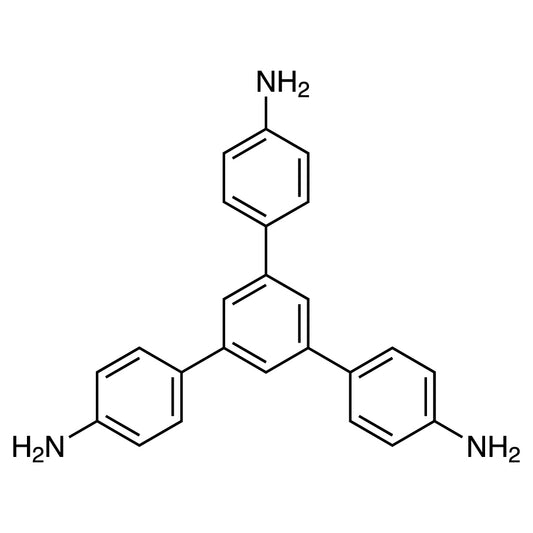
- TCI T2728 118727-34-7 1,3,5-Tris(4-aminophenyl)benzene
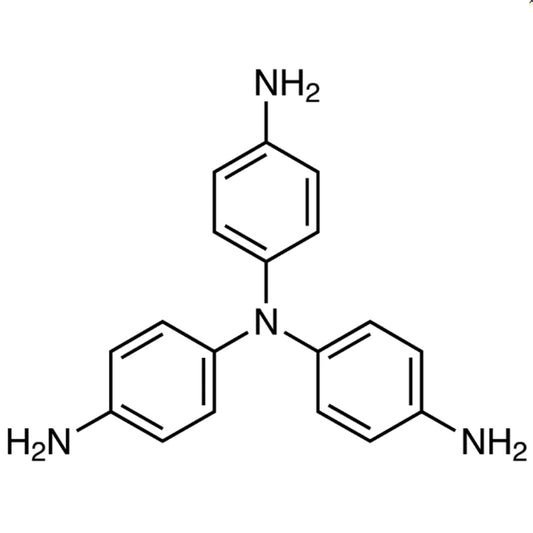
- TCI T2332 5981-09-9 Tris(4-aminophenyl)amine
- TCI B3853 2687-27-6 1,3-Bis[2-(4-aminophenyl)-2-propyl]benzene
- TCI B2076 3282-99-3 1,1-Bis(4-aminophenyl)cyclohexane
- Organic synthesis of complex molecules due to its stable structure and functional group compatibility.
- Development of new polymers for electronic applications as it facilitates the formation of conjugated systems.
- Research in polymer science for creating advanced materials with specific electrical or optical properties.
- Testing of industrial chemical properties in material science studies for quality control and innovation.
- Educational use in chemistry laboratories for teaching synthetic methods and molecular structure building.
| Brand | TCI |
|---|---|
| CAS number | 15499-84-0 |
| Molecular formula | — |
| Purity | — |
| Category | Chemistry > Building Blocks > Non-Heterocyclic Building Blocks |
| Pack sizes | Available in standard laboratory quantities as per supplier specifications |
| Physical form | Solid |
| Storage | Store in a cool, dry place away from light and moisture |
This compound should be stored in a cool, dry environment, away from direct light and moisture to maintain its stability and purity. It is recommended to use airtight containers to prevent contamination and exposure to air. As a solid, it should be handled with care to avoid mechanical damage. Laboratory personnel should wear appropriate personal protective equipment when handling the material. The compound is generally non-hazardous under normal conditions but should be kept in a secure location to prevent accidental exposure. Regular monitoring of storage conditions ensures the material remains suitable for use in research applications.
—
Product Categories
Produk Terkait
-
9,9-Bis(4-aminophenyl)fluorene TCI B1549
Regular price From Rp 3.365.250,00Regular priceRp 2.368.800,00Sale price From Rp 3.365.250,00 -
1,5-Diaminonaphthalene(purifiedbysublimation) TCI D5689
Regular price From Rp 1.881.600,00Regular priceRp 1.331.400,00Sale price From Rp 1.881.600,00 -
1,3,5-Tris(4-aminophenyl)benzene TCI T2728
Regular price From Rp 6.465.900,00Regular priceRp 4.537.050,00Sale price From Rp 6.465.900,00 -
Tris(4-aminophenyl)amine TCI T2332
Regular price From Rp 3.127.950,00Regular priceRp 2.202.900,00Sale price From Rp 3.127.950,00 -
1,3-Bis[2-(4-aminophenyl)-2-propyl]benzene TCI B3853
Regular price Rp 1.192.800,00Regular priceRp 849.450,00Sale price Rp 1.192.800,00 -
1,1-Bis(4-aminophenyl)cyclohexane TCI B2076
Regular price From Rp 4.001.550,00Regular priceRp 2.814.000,00Sale price From Rp 4.001.550,00 -
alpha,alpha'-Bis(4-aminophenyl)-1,4-diisopropylbenzene TCI B1562
Regular price From Rp 1.326.150,00Regular priceRp 942.900,00Sale price From Rp 1.326.150,00 -
2,2-Bis(4-aminophenyl)hexafluoropropane TCI B1400
Regular price From Rp 1.563.450,00Regular priceRp 1.108.800,00Sale price From Rp 1.563.450,00