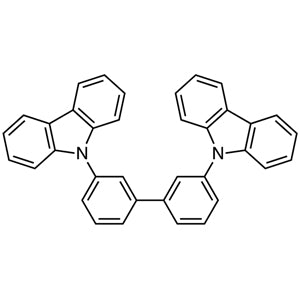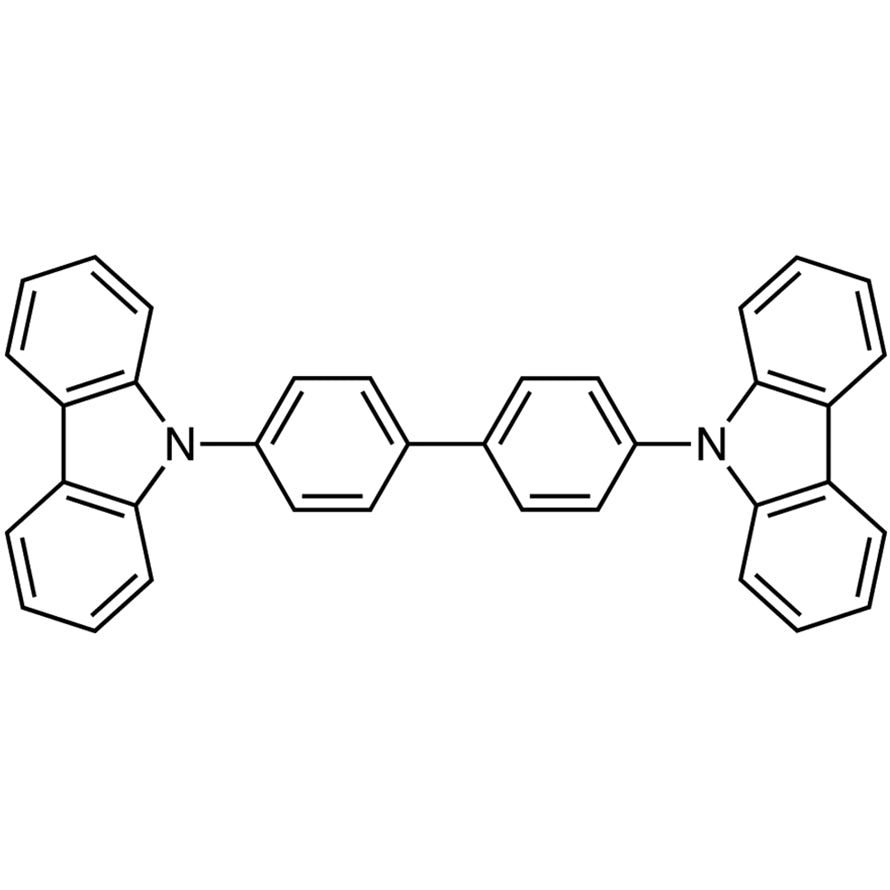
4,4'-Bis(9H-carbazol-9-yl)biphenyl is an organic compound widely used in laboratory research focused on electroluminescent materials. This compound plays a crucial role in the development of Organic Light-Emitting Diode (OLED) technologies, where it serves as a key component in the emission layer. Its molecular structure enables efficient electron transport, making it essential for creating light-emitting devices with high performance. In Indonesian laboratories, this material is frequently utilized for advancing research in organic electronics and display technologies.
The compound’s unique properties, including its complex molecular structure and excellent electron conductivity, make it a preferred choice for OLED applications. These characteristics allow for enhanced light emission efficiency and stability under various operating conditions. Additionally, its high chemical stability ensures that it remains effective even when exposed to different laboratory environments. This combination of structural complexity and functional performance positions it as a valuable material for researchers working on next-generation display technologies.
In Indonesian laboratories, 4,4'-Bis(9H-carbazol-9-yl)biphenyl is commonly used in the development of organic light-emitting devices and related materials. Its role in OLED research has made it a standard component in many experimental setups. Researchers rely on this compound to explore new ways to improve the efficiency, longevity, and performance of organic electronic devices. Its consistent availability and well-documented properties make it a reliable choice for both academic and industrial research settings.
TCI brochures (PDF)
- Organic Light-Emitting Diode (OLED) Materials 2026-08-18 · p. 3
- Carbazoles 2025-06-27 · p. 6
Related TCI products
- TCI B5435 1242056-42-3 N-[[1,1'-Biphenyl]-4-yl]-9,9-dimethyl-N-[4-(9-phenyl-9H-carbazol-3-yl)phenyl]-9H-fluoren-2-amine
- TCI B4219 58328-31-7 4,4'-Bis(9H-carbazol-9-yl)biphenyl (purified by sublimation)
- TCI D5594 342638-54-4 3,3'-Di(9H-carbazol-9-yl)-1,1'-biphenyl (purified by sublimation)
- TCI D4772 342638-54-4 3,3'-Di(9H-carbazol-9-yl)-1,1'-biphenyl
- TCI T1934 148044-07-9 1,3,5-Tri(9H-carbazol-9-yl)benzene (purified by sublimation)
- TCI B4942 913738-04-2 2,8-Bis(9H-carbazol-9-yl)dibenzothiophene
- OLED material development for high-efficiency light-emitting devices due to its excellent electron transport properties.
- Organic electronics research to explore new materials with enhanced conductivity and stability in laboratory settings.
- Display technology innovation for creating advanced and energy-efficient organic light-emitting diodes.
- Material characterization studies to analyze the physical and chemical properties of complex organic compounds.
- Semiconductor research for developing new types of organic semiconductors with improved performance in electronic applications.
| Brand | TCI |
|---|---|
| CAS number | 58328-31-7 |
| Molecular formula | — |
| Purity | — |
| Category | Materials Science > Electronic Materials > Organic Light-Emitting Diode (OLED) Materials |
| Pack sizes | Available in various quantities as per standard laboratory supply options |
| Physical form | Solid, typically in crystalline or powder form |
| Storage | Store in a cool, dry place away from direct sunlight and moisture |
This compound should be stored in a cool, dry environment to maintain its chemical stability and prevent degradation. It is recommended to use airtight containers to protect it from moisture and air exposure. Due to its organic nature, it should be handled in a well-ventilated area to minimize inhalation risks. Proper personal protective equipment, such as gloves and safety goggles, should be worn when handling the material. It is important to keep the compound away from heat sources and incompatible materials to ensure safe storage and usage in laboratory settings. Always follow standard laboratory safety protocols when working with this compound to maintain a safe and controlled environment.
—
Produk Terkait
-
N-[[1,1'-Biphenyl]-4-yl]-9,9-dimethyl-N-[4-(9-phenyl-9H-carbazol-3-yl)phenyl]-9H-fluoren-2-amine TCI B5435
Regular price From Rp 2.121.000,00Regular priceRp 1.498.350,00Sale price From Rp 2.121.000,00 -
4,4'-Bis(9H-carbazol-9-yl)biphenyl(purifiedbysublimation) TCI B4219
Regular price Rp 3.922.800,00Regular priceRp 2.758.350,00Sale price Rp 3.922.800,00 -
3,3'-Di(9H-carbazol-9-yl)-1,1'-biphenyl(purifiedbysublimation) TCI D5594
Regular price From Rp 2.702.700,00Regular priceRp 1.905.750,00Sale price From Rp 2.702.700,00 -
3,3'-Di(9H-carbazol-9-yl)-1,1'-biphenyl TCI D4772
Regular price Rp 2.571.450,00Regular priceRp 1.813.350,00Sale price Rp 2.571.450,00 -
1,3,5-Tri(9H-carbazol-9-yl)benzene(purifiedbysublimation) TCI T1934
Regular price Rp 5.062.050,00Regular priceRp 3.555.300,00Sale price Rp 5.062.050,00 -
2,8-Bis(9H-carbazol-9-yl)dibenzothiophene TCI B4942
Regular price From Rp 1.326.150,00Regular priceRp 942.900,00Sale price From Rp 1.326.150,00 -
4,4'-Bis(9H-carbazol-9-yl)-2,2'-dimethylbiphenyl TCI B4910
Regular price Rp 4.240.950,00Regular priceRp 2.980.950,00Sale price Rp 4.240.950,00 -
2,7-Di(9H-carbazol-9-yl)-9,9'-spirobi[9H-fluorene] TCI D5442
Regular price Rp 4.054.050,00Regular priceRp 2.850.750,00Sale price Rp 4.054.050,00