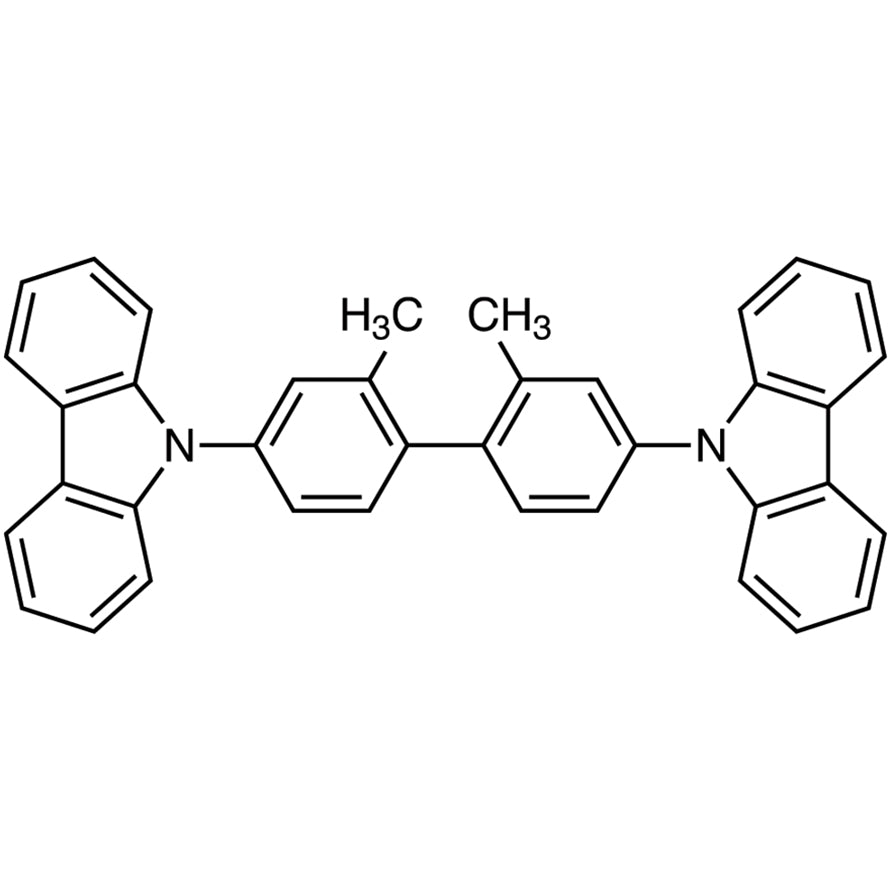
4,4'-Bis(9H-carbazol-9-yl)-2,2'-dimethylbiphenyl is an organic compound widely used in laboratory research for optoelectronic applications, particularly in the development of Organic Light-Emitting Diodes (OLEDs). This material plays a crucial role in the fabrication of OLED devices, where it serves as an emissive layer or a host material. Its molecular structure is designed to facilitate efficient and stable light emission, making it a key component in the pursuit of high-performance optical devices. In the context of material science, this compound is essential for advancing the field of organic electronics.
The compound’s unique molecular architecture, featuring two carbazole units and two methyl groups on the biphenyl core, contributes to its favorable electrical and thermal properties. These characteristics allow it to maintain stability under operational conditions, ensuring long-term performance in OLED applications. Additionally, its ability to absorb and emit light within specific spectral ranges enhances its utility in creating devices with tailored optical properties. This combination of efficiency, stability, and tunable emission makes it a preferred choice for researchers working on next-generation display technologies.
In Indonesian laboratories, this compound is commonly used in research and development projects focused on organic light-emitting technologies. It is particularly valuable in academic and industrial settings where the development of high-performance OLEDs is a priority. Researchers across various institutions utilize this material to explore new applications in electronic materials, contributing to the growth of the optoelectronics sector in the region.
TCI brochures (PDF)
- Organic Light-Emitting Diode (OLED) Materials 2026-08-18 · p. 3
- Carbazoles 2025-06-27 · p. 6
Related TCI products
- TCI T1934 148044-07-9 1,3,5-Tri(9H-carbazol-9-yl)benzene (purified by sublimation)
- TCI B5435 1242056-42-3 N-[[1,1'-Biphenyl]-4-yl]-9,9-dimethyl-N-[4-(9-phenyl-9H-carbazol-3-yl)phenyl]-9H-fluoren-2-amine
- TCI B4942 913738-04-2 2,8-Bis(9H-carbazol-9-yl)dibenzothiophene
- TCI B4219 58328-31-7 4,4'-Bis(9H-carbazol-9-yl)biphenyl (purified by sublimation)
- TCI B2713 58328-31-7 4,4'-Bis(9H-carbazol-9-yl)biphenyl
- TCI D5594 342638-54-4 3,3'-Di(9H-carbazol-9-yl)-1,1'-biphenyl (purified by sublimation)
- OLED Device Fabrication: This compound is ideal for creating emissive layers in OLEDs due to its efficient light emission and stability under operational conditions.
- Organic Electronic Material Research: Its unique molecular structure makes it a key material for studying the properties of organic semiconductors and their applications.
- Light-Emitting Diode Development: It is used in the development of OLEDs with specific color outputs, enabling the creation of high-quality displays and lighting solutions.
- Material Stability Testing: Its thermal and electrical stability make it suitable for testing the performance of organic materials under various environmental conditions.
- Spectral Tuning Applications: The compound’s ability to emit light in specific wavelengths makes it valuable for applications requiring precise optical control.
| Brand | TCI |
|---|---|
| CAS number | 604785-54-8 |
| Molecular formula | — |
| Purity | — |
| Category | Materials Science > Electronic Materials > Organic Light-Emitting Diode (OLED) Materials |
| Pack sizes | Available in various quantities as per standard laboratory supply |
| Physical form | Solid, crystalline appearance |
| Storage | Store in a cool, dry place away from light and moisture |
This compound should be stored in a cool, dry environment, away from direct light and moisture to maintain its chemical integrity. It is recommended to use airtight containers made of materials such as glass or high-density polyethylene to prevent contamination and degradation. Due to its organic nature, it is important to handle it with appropriate personal protective equipment, including gloves and safety goggles, to ensure laboratory safety. The compound is generally stable under standard storage conditions but should be kept in a secure location to prevent accidental exposure. Proper labeling and storage practices are essential to maintain the material’s effectiveness and ensure safe handling in a laboratory setting.
—
Produk Terkait
-
1,3,5-Tri(9H-carbazol-9-yl)benzene(purifiedbysublimation) TCI T1934
Regular price Rp 5.062.050,00Regular priceRp 3.555.300,00Sale price Rp 5.062.050,00 -
N-[[1,1'-Biphenyl]-4-yl]-9,9-dimethyl-N-[4-(9-phenyl-9H-carbazol-3-yl)phenyl]-9H-fluoren-2-amine TCI B5435
Regular price From Rp 2.121.000,00Regular priceRp 1.498.350,00Sale price From Rp 2.121.000,00 -
2,8-Bis(9H-carbazol-9-yl)dibenzothiophene TCI B4942
Regular price From Rp 1.326.150,00Regular priceRp 942.900,00Sale price From Rp 1.326.150,00 -
4,4'-Bis(9H-carbazol-9-yl)biphenyl(purifiedbysublimation) TCI B4219
Regular price Rp 3.922.800,00Regular priceRp 2.758.350,00Sale price Rp 3.922.800,00 -
4,4'-Bis(9H-carbazol-9-yl)biphenyl TCI B2713
Regular price From Rp 1.881.600,00Regular priceRp 1.331.400,00Sale price From Rp 1.881.600,00 -
3,3'-Di(9H-carbazol-9-yl)-1,1'-biphenyl(purifiedbysublimation) TCI D5594
Regular price From Rp 2.702.700,00Regular priceRp 1.905.750,00Sale price From Rp 2.702.700,00 -
2,7-Di(9H-carbazol-9-yl)-9,9'-spirobi[9H-fluorene] TCI D5442
Regular price Rp 4.054.050,00Regular priceRp 2.850.750,00Sale price Rp 4.054.050,00 -
3,3'-Di(9H-carbazol-9-yl)-1,1'-biphenyl TCI D4772
Regular price Rp 2.571.450,00Regular priceRp 1.813.350,00Sale price Rp 2.571.450,00