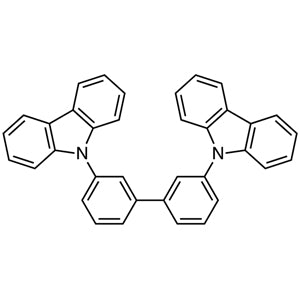
2,8-Bis(9H-carbazol-9-yl)dibenzothiophene is an organic compound widely used in electronic materials research, particularly in the development of OLED (Organic Light-Emitting Diode) devices. This compound plays a crucial role in laboratory settings where researchers are working on advanced display technologies and optoelectronic applications. Its complex molecular structure, composed of two carbazole units connected to a dibenzothiophene framework, makes it an essential component in the fabrication of high-performance OLEDs. Due to its unique chemical properties, it is frequently employed in the synthesis of materials that emit light efficiently and reliably.
The compound is preferred for its chemical stability and resistance to environmental changes, which are critical for long-term performance in electronic devices. Its molecular structure facilitates efficient electron transfer, a key factor in the operation of OLEDs. Additionally, the compound exhibits the ability to emit light at specific wavelengths, making it highly suitable for applications in optoelectronics. These properties ensure that it remains a reliable and effective material for researchers aiming to develop next-generation display technologies.
In Indonesian laboratories, this compound is commonly used in the development of OLED-based devices that are energy-efficient and environmentally friendly. It supports research initiatives focused on creating sustainable and high-performance materials for modern display technologies. Its application in local research settings highlights its importance in advancing the field of electronic materials in Southeast Asia.
TCI brochures (PDF)
- Organic Light-Emitting Diode (OLED) Materials 2026-08-18 · p. 4
- Carbazoles 2025-06-27 · p. 6
- Thiophenes 2026-06-29 · p. 12
Related TCI products
- TCI D5473 1128045-14-6 3,3'-Di(dibenzothiophen-4-yl)-1,1'-biphenyl
- TCI T1934 148044-07-9 1,3,5-Tri(9H-carbazol-9-yl)benzene (purified by sublimation)
- TCI B5435 1242056-42-3 N-[[1,1'-Biphenyl]-4-yl]-9,9-dimethyl-N-[4-(9-phenyl-9H-carbazol-3-yl)phenyl]-9H-fluoren-2-amine
- TCI B4910 604785-54-8 4,4'-Bis(9H-carbazol-9-yl)-2,2'-dimethylbiphenyl
- TCI B4219 58328-31-7 4,4'-Bis(9H-carbazol-9-yl)biphenyl (purified by sublimation)
- TCI B2713 58328-31-7 4,4'-Bis(9H-carbazol-9-yl)biphenyl
- OLED material synthesis for high-efficiency light-emitting devices due to its stable molecular structure and efficient electron transfer properties.
- Development of optoelectronic components requiring precise light emission wavelengths for advanced display technologies.
- Research in organic semiconductor materials for use in flexible and transparent electronic devices.
- Investigation of chemical stability under varying environmental conditions to ensure long-term device performance.
- Fabrication of next-generation display panels with improved brightness and color accuracy through optimized material integration.
| Brand | TCI |
|---|---|
| CAS number | 913738-04-2 |
| Molecular formula | — |
| Purity | — |
| Category | Materials Science > Electronic Materials > Organic Light-Emitting Diode (OLED) Materials |
| Pack sizes | Available in standard laboratory quantities as per supplier specifications |
| Physical form | Solid, typically in crystalline or powder form |
| Storage | Store in a cool, dry place away from light and moisture |
This compound should be stored in a cool, dry environment, away from direct light and moisture to maintain its chemical stability. It is recommended to use airtight containers made of glass or high-density polyethylene to prevent contamination and degradation. Due to its organic nature, it should be handled with care in a well-ventilated laboratory setting. Avoid exposure to strong oxidizing agents or reactive chemicals to prevent unwanted reactions. Standard laboratory safety protocols should be followed when handling and storing this material to ensure the safety of personnel and the integrity of the compound.
—
Produk Terkait
-
3,3'-Di(dibenzothiophen-4-yl)-1,1'-biphenyl TCI D5473
Regular price Rp 5.246.850,00Regular priceRp 3.684.450,00Sale price Rp 5.246.850,00 -
1,3,5-Tri(9H-carbazol-9-yl)benzene(purifiedbysublimation) TCI T1934
Regular price Rp 5.062.050,00Regular priceRp 3.555.300,00Sale price Rp 5.062.050,00 -
N-[[1,1'-Biphenyl]-4-yl]-9,9-dimethyl-N-[4-(9-phenyl-9H-carbazol-3-yl)phenyl]-9H-fluoren-2-amine TCI B5435
Regular price From Rp 2.121.000,00Regular priceRp 1.498.350,00Sale price From Rp 2.121.000,00 -
4,4'-Bis(9H-carbazol-9-yl)-2,2'-dimethylbiphenyl TCI B4910
Regular price Rp 4.240.950,00Regular priceRp 2.980.950,00Sale price Rp 4.240.950,00 -
4,4'-Bis(9H-carbazol-9-yl)biphenyl(purifiedbysublimation) TCI B4219
Regular price Rp 3.922.800,00Regular priceRp 2.758.350,00Sale price Rp 3.922.800,00 -
4,4'-Bis(9H-carbazol-9-yl)biphenyl TCI B2713
Regular price From Rp 1.881.600,00Regular priceRp 1.331.400,00Sale price From Rp 1.881.600,00 -
3,3'-Di(9H-carbazol-9-yl)-1,1'-biphenyl(purifiedbysublimation) TCI D5594
Regular price From Rp 2.702.700,00Regular priceRp 1.905.750,00Sale price From Rp 2.702.700,00 -
2,7-Di(9H-carbazol-9-yl)-9,9'-spirobi[9H-fluorene] TCI D5442
Regular price Rp 4.054.050,00Regular priceRp 2.850.750,00Sale price Rp 4.054.050,00