

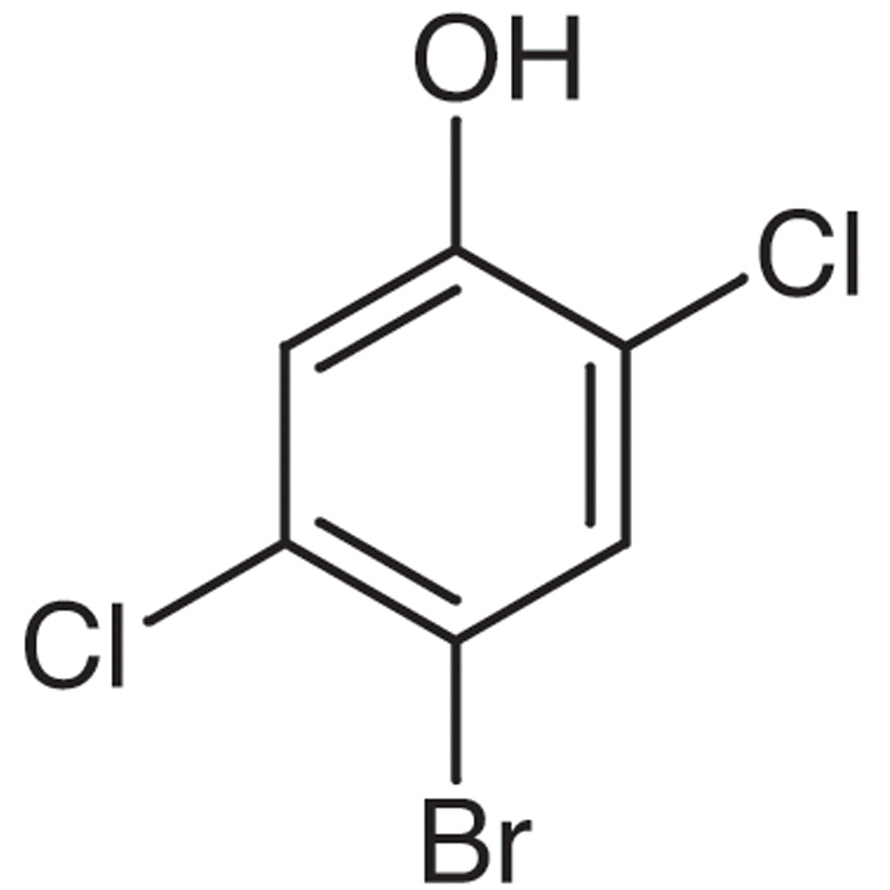
4-Bromo-2,5-dichlorophenol is a chemical compound widely used in organic synthesis reactions within laboratory settings. As a building block in chemical research, it serves as a fundamental component for the development of more complex molecular structures. Its versatility makes it an essential reagent in various synthetic pathways, particularly in the creation of aromatic and heterocyclic compounds. This compound plays a crucial role in the advancement of chemical research, especially in the fields of medicinal chemistry and materials science. Due to its stability and reactivity, it is frequently chosen for its ability to participate in multiple reaction types, including substitution and electrophilic reactions.
The unique chemical properties of 4-Bromo-2,5-dichlorophenol, such as the presence of bromo and chloro groups, contribute to its distinct reactivity and polarity. These functional groups provide specific sites for chemical modification, enhancing its utility in synthetic applications. The compound is soluble in various organic solvents, including ethyl acetate and dimethyl sulfoxide, which facilitates its use in a wide range of experimental conditions. Its solubility and reactivity make it a preferred choice for researchers seeking to explore diverse chemical transformations.
In Indonesian laboratories, 4-Bromo-2,5-dichlorophenol is extensively used in chemical research, particularly in the synthesis of organic compounds and pharmaceutical development. It is commonly found in academic and industrial research settings, where it supports the creation of new compounds and the testing of chemical hypotheses. Its reliability and effectiveness in laboratory applications make it a valuable resource for scientists and researchers in Indonesia.
- Organic synthesis reactions benefit from this compound's reactivity and structural versatility, enabling the creation of complex aromatic and heterocyclic molecules.
- Medicinal chemistry research utilizes its functional groups for the development of new pharmaceutical compounds with targeted biological activities.
- Materials science experiments leverage its chemical stability and solubility to synthesize advanced polymers and functional materials.
- Analytical chemistry applications take advantage of its distinct spectroscopic properties for identification and quantification in complex mixtures.
- Environmental studies incorporate its reactivity to model degradation processes and assess the fate of organic pollutants in natural systems.
| Brand | TCI |
|---|---|
| CAS number | 1940-42-7 |
| Molecular formula | — |
| Purity | — |
| Category | Chemistry > Building Blocks > Non-Heterocyclic Building Blocks |
| Pack sizes | Available in standard laboratory quantities |
| Physical form | Solid crystalline |
| Storage | Store in a cool, dry place away from light and moisture |
This compound should be stored in a cool, dry environment, away from direct sunlight and moisture to maintain its chemical integrity. It is recommended to use airtight containers made of glass or high-density polyethylene to prevent contamination and degradation. Due to its bromo and chloro substituents, it may exhibit reactivity with certain materials, so it should be handled with care in a well-ventilated laboratory setting. Proper personal protective equipment, including gloves and safety goggles, should be worn during handling to ensure safety. Regular monitoring of storage conditions is advised to maintain the compound's stability and usability in laboratory applications.
—
Produk Terkait
-
4-Bromo-2,6-dichlorophenol TCI B5034
Regular price From Rp 3.419.850,00Regular priceRp 2.390.850,00Sale price From Rp 3.419.850,00 -
2,4-Dichlorophenol[forBiochemicalResearch] TCI D3865
Regular price From Rp 505.050,00Regular priceRp 352.800,00Sale price From Rp 505.050,00 -
3,4-Dichlorophenol TCI D0395
Regular price Rp 2.306.850,00Regular priceRp 1.612.800,00Sale price Rp 2.306.850,00 -
2,6-Dichlorophenol TCI D0394
Regular price From Rp 1.298.850,00Regular priceRp 908.250,00Sale price From Rp 1.298.850,00 -
2,5-Dichlorophenol TCI D0393
Regular price Rp 610.050,00Regular priceRp 426.300,00Sale price Rp 610.050,00 -
2,4-Dichlorophenol TCI D0392
Regular price From Rp 584.850,00Regular priceRp 408.450,00Sale price From Rp 584.850,00 -
2,3-Dichlorophenol TCI D0391
Regular price Rp 1.115.100,00Regular priceRp 779.100,00Sale price Rp 1.115.100,00 -
3,5-Dichlorophenol TCI D0365
Regular price Rp 2.704.800,00Regular priceRp 1.891.050,00Sale price Rp 2.704.800,00


