

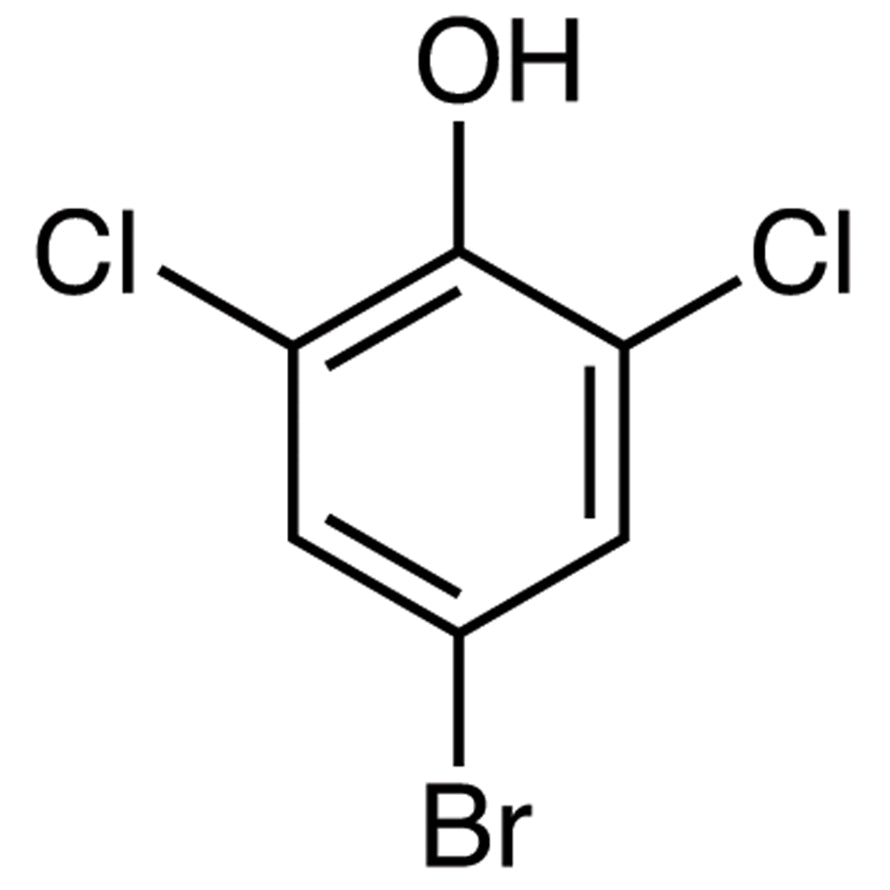
4-Bromo-2,6-dichlorophenol is a chemical compound widely used in organic synthesis reactions within laboratory settings. It serves as a key building block for the development of complex aromatic compounds, making it essential in both academic and industrial research. This compound is commonly found in chemical laboratories as a raw material for the preparation of various functionalized derivatives. Its versatility and reliability make it a preferred choice for chemists working on diverse synthetic pathways.
The compound’s chemical properties, including its stable nature and controlled reactivity, contribute to its widespread use. The presence of bromine and chlorine atoms at specific positions on the phenolic ring enhances its reactivity in substitution and oxidation reactions. It is a liquid at room temperature and dissolves well in organic solvents such as ethyl acetate and chloroform. These characteristics simplify its handling and application in various chemical processes. Additionally, its stability under normal conditions ensures minimal degradation during storage and use.
In Indonesian laboratories, 4-Bromo-2,6-dichlorophenol is extensively used by chemists and researchers for both applied and academic studies. It is a common component in drug development, material synthesis, and environmental chemistry projects. Its availability and chemical properties make it a reliable resource for laboratories seeking to conduct advanced chemical experiments and research.
- Organic synthesis reactions benefit from this compound’s reactivity and structural versatility, enabling the creation of complex aromatic derivatives.
- It is ideal for halogen substitution reactions due to the presence of bromine and chlorine atoms, which facilitate targeted chemical modifications.
- Oxidation processes often utilize this compound as a starting material, leveraging its stability and controlled reactivity in synthetic pathways.
- Environmental chemistry studies employ it to analyze the behavior of halogenated phenolic compounds in various ecosystems.
- It is commonly used in the development of pharmaceutical intermediates, supporting the synthesis of bioactive molecules with specific functional groups.
| Brand | TCI |
|---|---|
| CAS number | 3217-15-0 |
| Molecular formula | — |
| Purity | — |
| Category | Chemistry > Building Blocks > Non-Heterocyclic Building Blocks |
| Pack sizes | Available in various quantities as per standard laboratory supply |
| Physical form | Liquid |
| Storage | Store in a cool, dry place away from direct sunlight and incompatible materials |
This compound should be stored in a cool, dry environment, away from direct sunlight and sources of heat. It is recommended to use airtight containers made of glass or high-density polyethylene to prevent contamination and evaporation. Due to its chemical nature, it should be kept away from incompatible substances such as strong oxidizers and bases. Proper labeling of containers is essential for safety and identification. Laboratory personnel should always wear appropriate personal protective equipment, including gloves and safety goggles, when handling this material. Regular inspection of storage conditions ensures the compound remains stable and safe for use in chemical experiments.
—
Produk Terkait
-
4-Bromo-2,5-dichlorophenol TCI B2822
Regular price From Rp 610.050,00Regular priceRp 426.300,00Sale price From Rp 610.050,00 -
2,4-Dichlorophenol[forBiochemicalResearch] TCI D3865
Regular price From Rp 505.050,00Regular priceRp 352.800,00Sale price From Rp 505.050,00 -
3,4-Dichlorophenol TCI D0395
Regular price Rp 2.306.850,00Regular priceRp 1.612.800,00Sale price Rp 2.306.850,00 -
2,6-Dichlorophenol TCI D0394
Regular price From Rp 1.298.850,00Regular priceRp 908.250,00Sale price From Rp 1.298.850,00 -
2,5-Dichlorophenol TCI D0393
Regular price Rp 610.050,00Regular priceRp 426.300,00Sale price Rp 610.050,00 -
2,4-Dichlorophenol TCI D0392
Regular price From Rp 584.850,00Regular priceRp 408.450,00Sale price From Rp 584.850,00 -
2,3-Dichlorophenol TCI D0391
Regular price Rp 1.115.100,00Regular priceRp 779.100,00Sale price Rp 1.115.100,00 -
3,5-Dichlorophenol TCI D0365
Regular price Rp 2.704.800,00Regular priceRp 1.891.050,00Sale price Rp 2.704.800,00


