


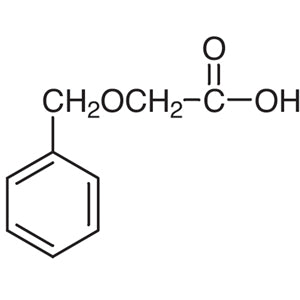
Benzyloxyacetic Acid (BCAA), with the CAS number 30379-55-6, is a key chemical compound widely used in organic synthesis as a building block. It serves as a versatile reagent in the creation of complex organic molecules, particularly in reactions involving heterocyclic structures and carbon chain formations. This compound is essential in various synthetic pathways, contributing to the development of new compounds and the modification of existing ones. Its role in substitution reactions and bond formation makes it a critical component in organic chemistry research.
The stability and reactivity of BCAA make it a preferred choice for laboratory use. It exhibits good solubility in organic solvents, which simplifies mixing and reaction processes. Its molecular structure allows it to participate effectively in a range of chemical transformations under controlled conditions. These properties ensure consistent results and reliability in experimental settings, making it a valuable tool for chemists. Additionally, its chemical and physical characteristics support its use across different experimental scales, from small-scale research to larger industrial applications.
In Indonesian laboratories, BCAA is commonly used in organic chemistry research, including the synthesis of new compounds and the modification of existing ones. It plays a vital role in pharmaceutical development, industrial chemical production, and material science research. Its availability and performance make it a standard reagent in both academic and industrial settings, supporting innovation and discovery in various scientific fields.
- Organic synthesis for creating complex molecules and heterocyclic compounds due to its versatile reactivity and structural compatibility.
- Pharmaceutical research for the development of new drugs and medicinal compounds through its role in bond formation and substitution reactions.
- Industrial chemical production as a building block for the synthesis of various organic materials and functional compounds.
- Material science experiments for the modification of existing compounds and the creation of new materials with specific properties.
- Academic research in chemistry departments for teaching and experimental purposes, supporting both undergraduate and graduate studies.
| Brand | TCI |
|---|---|
| CAS number | 30379-55-6 |
| Molecular formula | — |
| Purity | — |
| Category | Chemistry > Building Blocks > Non-Heterocyclic Building Blocks |
| Pack sizes | Available in various quantities as per standard laboratory supply |
| Physical form | Solid or crystalline, depending on the specific product variant |
| Storage | Store in a cool, dry place away from direct sunlight and moisture |
Benzyloxyacetic Acid should be stored in a cool, dry environment to maintain its chemical stability and prevent degradation. It is recommended to keep it in airtight containers to avoid exposure to moisture and air, which could affect its reactivity. Laboratory personnel should handle the compound with care, using appropriate personal protective equipment such as gloves and safety goggles to ensure safety. It should be stored away from incompatible substances to prevent any potential chemical reactions. Regular inspection of storage conditions is advised to ensure the integrity of the material remains intact for use in experiments.
—
Produk Terkait
-
3'-Benzyloxyacetophenone TCI B4705
Regular price From Rp 928.200,00Regular priceRp 664.650,00Sale price From Rp 928.200,00 -
4'-Benzyloxyacetophenone TCI B3365
Regular price From Rp 530.250,00Regular priceRp 386.400,00Sale price From Rp 530.250,00 -
1-NaphthyloxyaceticAcid TCI N0046
Regular price Rp 4.213.650,00Regular priceRp 2.962.050,00Sale price Rp 4.213.650,00 -
2-NaphthyloxyaceticAcid TCI N0045
Regular price From Rp 900.900,00Regular priceRp 645.750,00Sale price From Rp 900.900,00 -
3',5'-Dibenzyloxyacetophenone TCI D2085
Regular price Rp 1.723.050,00Regular priceRp 1.220.100,00Sale price Rp 1.723.050,00 -
ButoxyaceticAcid TCI B1467
Regular price From Rp 2.702.700,00Regular priceRp 1.905.750,00Sale price From Rp 2.702.700,00 -
EthoxyaceticAcid TCI E0377
Regular price From Rp 1.458.450,00Regular priceRp 1.035.300,00Sale price From Rp 1.458.450,00 -
2-(2-Chlorophenyl)-2-hydroxyaceticAcid TCI C3937
Regular price From Rp 1.510.950,00Regular priceRp 1.072.050,00Sale price From Rp 1.510.950,00


