Benzyltrimethylammonium Bromide (BTMAB) is a chemical compound widely used as a phase transfer catalyst in various laboratory applications. It plays a crucial role in facilitating reactions that require interaction between immiscible phases, such as aqueous and organic solvents. Its ionic structure enables it to act as a mediator, promoting efficient mass transfer and reaction kinetics. In synthetic chemistry, BTMAB is essential for reactions involving electron or ion transfer, where it enhances the rate and yield of desired products.
The chemical properties of BTMAB make it a preferred choice for laboratory use. It exhibits high reactivity and chemical stability, allowing it to maintain its catalytic activity under a range of reaction conditions. Its cationic structure enables effective interaction with diverse substrates, including aromatic and heterocyclic compounds. This versatility makes it suitable for a wide array of synthetic processes. Additionally, its resistance to degradation ensures consistent performance in repeated use, making it a reliable reagent for both research and industrial applications.
In Indonesian laboratories, BTMAB is extensively utilized in organic chemistry research, particularly in the synthesis of complex compounds and phase transfer reactions. Its ability to bridge polar and non-polar phases has made it a staple in both academic and industrial settings. Researchers rely on BTMAB for its efficiency and reliability in catalyzing reactions that would otherwise be challenging to achieve. Its widespread use underscores its importance in modern chemical synthesis practices.
TCI brochures (PDF)
- Quaternary Ammonium Salts 2025-11-10 · p. 6
Related TCI products
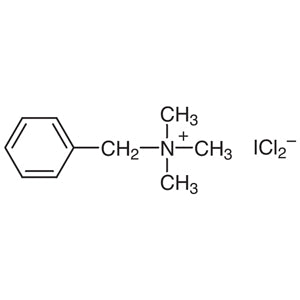
- TCI B1604 114971-52-7 Benzyltrimethylammonium Dichloroiodate
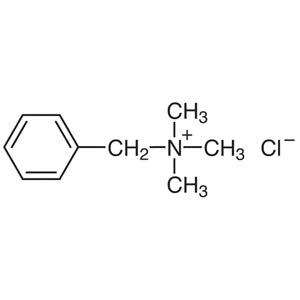
- TCI B0447 56-93-9 Benzyltrimethylammonium Chloride
- TCI T2762 2650-50-2 Trimethylpropylammonium Bromide
- TCI T2734 1943-11-9 Trimethylnonylammonium Bromide
- TCI T1603 14866-33-2 Tetra-n-octylammonium Bromide
- TCI T1602 4368-51-8 Tetraheptylammonium Bromide
- Organic synthesis reactions benefit from BTMAB's ability to enhance reaction rates by bridging immiscible phases, improving yield and efficiency.
- Phase transfer catalysis applications utilize BTMAB to facilitate reactions between aqueous and organic solvents, reducing the need for extensive purification steps.
- Heterocyclic compound synthesis leverages BTMAB's cationic structure to promote effective interaction with aromatic substrates, enhancing reaction pathways.
- Electrochemical reactions utilize BTMAB's stability and reactivity to support ion transfer processes, enabling controlled redox reactions.
- Industrial chemical processes rely on BTMAB for its consistent performance in large-scale reactions, ensuring reliable results in production environments.
| Brand | TCI |
|---|---|
| CAS number | 5350-41-4 |
| Molecular formula | — |
| Purity | — |
| Category | Chemistry > Synthetic Reagents > Phase Transfer Catalysts |
| Pack sizes | Available in various quantities as per standard laboratory reagent packaging |
| Physical form | Solid powder |
| Storage | Store in a cool, dry place away from moisture and direct sunlight |
BTMAB should be stored in a cool, dry environment to maintain its chemical stability and catalytic activity. It is recommended to keep it in airtight containers to prevent exposure to moisture, which could potentially affect its performance. The compound is generally non-hazardous under normal conditions but should be handled with care to avoid direct contact with skin or inhalation of dust. In laboratory settings, it is advisable to use appropriate personal protective equipment such as gloves and safety goggles when handling or transferring the material. Proper labeling of storage containers is essential to ensure safe handling and prevent accidental use in unsuitable applications.
—
Produk Terkait
-
BenzyltrimethylammoniumDichloroiodate TCI B1604
Regular price From Rp 1.192.800,00Regular priceRp 849.450,00Sale price From Rp 1.192.800,00 -
BenzyltrimethylammoniumChloride TCI B0447
Regular price From Rp 610.050,00Regular priceRp 442.050,00Sale price From Rp 610.050,00 -
TrimethylpropylammoniumBromide TCI T2762
Regular price Rp 6.704.250,00Regular priceRp 4.704.000,00Sale price Rp 6.704.250,00 -
TrimethylnonylammoniumBromide TCI T2734
Regular price Rp 1.801.800,00Regular priceRp 1.275.750,00Sale price Rp 1.801.800,00 -
Tetra-n-octylammoniumBromide TCI T1603
Regular price From Rp 1.618.050,00Regular priceRp 1.146.600,00Sale price From Rp 1.618.050,00 -
TetraheptylammoniumBromide TCI T1602
Regular price From Rp 1.298.850,00Regular priceRp 924.000,00Sale price From Rp 1.298.850,00 -
TetrahexylammoniumBromide TCI T1599
Regular price Rp 2.889.600,00Regular priceRp 2.035.950,00Sale price Rp 2.889.600,00 -
TetraamylammoniumBromide TCI T1432
Regular price From Rp 1.326.150,00Regular priceRp 942.900,00Sale price From Rp 1.326.150,00