

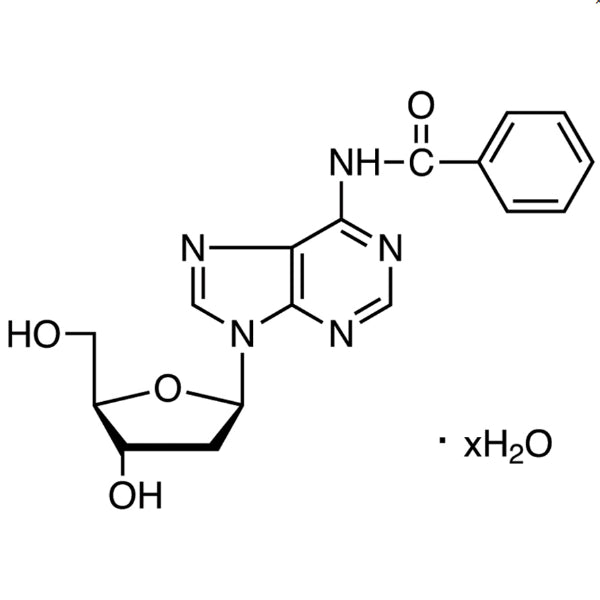
N6-Benzoyl-2'-deoxyadenosine Hydrate is a chemical compound widely used in biochemical and molecular biology experiments. It belongs to the nucleotide class of compounds and plays a crucial role in DNA and RNA synthesis. This compound is commonly utilized as a substrate or modification agent in studies related to nucleic acid replication and transcription mechanisms. Its presence in laboratory settings supports the development of advanced molecular techniques and biochemical research.
The compound’s chemical structure features a benzoyl group, which contributes to its reactivity and stability. These properties make it a preferred choice for controlled chemical reactions that require both stability and reactivity. The hydrate form of the compound simplifies weighing and handling in laboratory settings, ensuring consistent results during experiments. Its versatility allows it to be used in various research applications, from nucleotide modification to synthetic biology projects.
In Indonesian laboratories, N6-Benzoyl-2'-deoxyadenosine Hydrate is commonly used in molecular biology research, particularly in DNA and RNA analysis techniques. Researchers in academic and research institutions frequently employ this compound for experiments requiring nucleotide modification or the synthesis of biological compounds. Its reliability and chemical properties make it an essential tool for advancing scientific studies in the region.
TCI brochures (PDF)
- Oligonucleotide Synthesis Reagents 2025-07-24 · p. 2
- Nucleosides, Nucleotides, Nucleic Acids and Related Reagents 2026-03-23 · p. 5
Related TCI products
- TCI B3103 64325-78-6 N6-Benzoyl-5'-O-(4,4'-dimethoxytrityl)-2'-deoxyadenosine
- TCI B3631 69304-43-4 N4-Benzoyl-3',5'-O-(1,1,3,3-tetraisopropyl-1,3-disiloxanediyl)cytidine
- TCI B3102 4836-13-9 N4-Benzoyl-2'-deoxycytidine
- TCI B3087 67219-55-0 N4-Benzoyl-5'-O-(4,4'-dimethoxytrityl)-2'-deoxycytidine
- TCI D4137 958-09-8 2'-Deoxyadenosine Anhydrous
- TCI D0046 16373-93-6 2'-Deoxyadenosine Monohydrate
- Nucleic Acid Synthesis: This compound is ideal for synthesizing modified nucleotides, enabling the creation of custom DNA and RNA sequences for research purposes.
- Molecular Biology Research: It supports studies on DNA replication and transcription, offering a reliable substrate for biochemical investigations.
- Nucleotide Modification Studies: Its reactivity allows it to be used in experiments that require chemical modification of nucleotides for functional studies.
- Biochemical Analysis: The compound is used in analytical techniques to study the behavior of nucleic acids under various experimental conditions.
- Synthetic Biology Applications: It serves as a building block for the synthesis of complex biological molecules, aiding in the development of new therapeutic agents.
| Brand | TCI |
|---|---|
| CAS number | 206752-42-3 |
| Molecular formula | — |
| Purity | — |
| Category | Chemistry > Chemical Biology > Nucleic Acid Chemistry |
| Pack sizes | Available in various quantities as per supplier specifications |
| Physical form | Hydrate form, typically a white or off-white solid |
| Storage | Store in a cool, dry place away from light and moisture |
This compound should be stored in a cool, dry environment, away from direct sunlight and moisture to maintain its chemical integrity. It is recommended to use airtight containers to prevent exposure to humidity and contaminants. Due to its chemical nature, it should be handled with care, using appropriate personal protective equipment such as gloves and safety goggles. It is important to ensure that the compound is stored in a secure location, away from incompatible substances. Proper labeling of storage containers is essential to avoid mix-ups and ensure safe handling in the laboratory. Regular monitoring of storage conditions will help maintain the compound’s stability and effectiveness for research applications.
—
Product Categories
Produk Terkait
-
N6-Benzoyl-5'-O-(4,4'-dimethoxytrityl)-2'-deoxyadenosine TCI B3103
Regular price From Rp 1.881.600,00Regular priceRp 1.331.400,00Sale price From Rp 1.881.600,00 -
N4-Benzoyl-3',5'-O-(1,1,3,3-tetraisopropyl-1,3-disiloxanediyl)cytidine TCI B3631
Regular price From Rp 2.491.650,00Regular priceRp 1.757.700,00Sale price From Rp 2.491.650,00 -
N4-Benzoyl-2'-deoxycytidine TCI B3102
Regular price From Rp 505.050,00Regular priceRp 368.550,00Sale price From Rp 505.050,00 -
N4-Benzoyl-5'-O-(4,4'-dimethoxytrityl)-2'-deoxycytidine TCI B3087
Regular price From Rp 2.068.500,00Regular priceRp 1.461.600,00Sale price From Rp 2.068.500,00 -
2'-DeoxyadenosineAnhydrous TCI D4137
Regular price Rp 4.133.850,00Regular priceRp 2.906.400,00Sale price Rp 4.133.850,00 -
2'-DeoxyadenosineMonohydrate TCI D0046
Regular price From Rp 2.889.600,00Regular priceRp 2.035.950,00Sale price From Rp 2.889.600,00 -
2',3'-Dideoxyadenosine TCI D3065
Regular price Rp 12.533.850,00Regular priceRp 8.780.100,00Sale price Rp 12.533.850,00 -
N6-Dibenzoyladenosine2',3'-Dibenzoate TCI B3460
Regular price From Rp 1.881.600,00Regular priceRp 1.331.400,00Sale price From Rp 1.881.600,00


