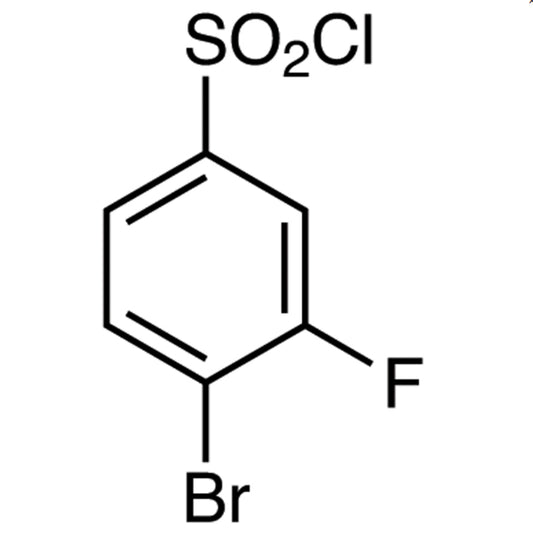
4-Bromo-2-fluorobenzenesulfonyl Chloride is a versatile organic compound widely used in laboratory settings for its reactivity and structural complexity. This compound contains bromo, fluoro, and sulfonate groups, making it a valuable building block in the synthesis of heterocyclic compounds and sulfonate derivatives. Its unique molecular structure enables it to participate in various organic reactions, such as nucleophilic substitution and coupling reactions, where high reactivity is required. In research and development, it plays a critical role in the creation of bioactive molecules and pharmaceutical intermediates.
The compound is known for its solubility in organic solvents such as ethyl acetate and dimethyl sulfoxide, which facilitates its use in a wide range of synthetic procedures. Its reactivity allows it to interact with nucleophiles like amines, alcohols, and hydrazines, making it an essential reagent in functional group transformations. Additionally, it exhibits stability under controlled conditions, although it is sensitive to moisture and air exposure, which requires careful handling during storage and use.
In Indonesian laboratories, 4-Bromo-2-fluorobenzenesulfonyl Chloride is commonly used in pure and applied chemistry research, particularly in the fields of pharmaceuticals and industrial chemicals. Researchers rely on this compound for its ability to contribute to the development of new drugs and chemical materials. Its presence in laboratory workflows highlights its importance in advancing scientific innovation in the region.
TCI brochures (PDF)
- Fluorination Reagents, Fluorinated Building Blocks 2026-03-18 · p. 21
Related TCI products
- TCI B3835 351003-51-5 4-Bromo-3-fluorobenzenesulfonyl Chloride
- TCI F0795 2905-21-7 2-Fluorobenzenesulfonyl Chloride
- TCI F0790 701-27-9 3-Fluorobenzenesulfonyl Chloride
- TCI F0202 349-88-2 4-Fluorobenzenesulfonyl Chloride
- TCI C2553 351003-48-0 3-Chloro-2-fluorobenzenesulfonyl Chloride
- TCI C1772 91170-93-3 3-Chloro-4-fluorobenzenesulfonyl Chloride
- Organic synthesis of heterocyclic compounds due to its reactive sulfonate group and fluorinated structure.
- Nucleophilic substitution reactions where it acts as an electrophilic substrate for various functional group transformations.
- Coupling reactions in pharmaceutical research to form complex molecules with biological activity.
- Development of sulfonate derivatives for use in drug discovery and chemical modification studies.
- Research in industrial chemistry for the production of specialty chemicals and intermediates.
| Brand | TCI |
|---|---|
| CAS number | 216159-03-4 |
| Molecular formula | — |
| Purity | — |
| Category | Chemistry > Building Blocks > Fluorinated Building Blocks |
| Pack sizes | Available in standard laboratory quantities as per supplier specifications |
| Physical form | Solid, crystalline appearance |
| Storage | Store in a cool, dry place away from moisture and air exposure |
This compound should be stored in a cool, dry environment to prevent degradation due to moisture and air exposure. It is recommended to use airtight containers made of glass or high-density polyethylene to minimize contact with atmospheric humidity. Due to its reactivity, it should be handled in a well-ventilated area, preferably under a fume hood, to avoid exposure to vapors. Avoid direct contact with skin and eyes, and ensure proper personal protective equipment is worn during handling. The compound is sensitive to light and should be protected from prolonged exposure to direct sunlight. Regular monitoring of storage conditions is essential to maintain its chemical integrity and ensure safe usage in laboratory settings.
—
Produk Terkait
-
4-Bromo-3-fluorobenzenesulfonylChloride TCI B3835
Regular price From Rp 2.016.000,00Regular priceRp 1.409.100,00Sale price From Rp 2.016.000,00 -
2-FluorobenzenesulfonylChloride TCI F0795
Regular price From Rp 1.485.750,00Regular priceRp 1.038.450,00Sale price From Rp 1.485.750,00 -
3-FluorobenzenesulfonylChloride TCI F0790
Regular price From Rp 1.670.550,00Regular priceRp 1.167.600,00Sale price From Rp 1.670.550,00 -
4-FluorobenzenesulfonylChloride TCI F0202
Regular price From Rp 505.050,00Regular priceRp 352.800,00Sale price From Rp 505.050,00 -
3-Chloro-2-fluorobenzenesulfonylChloride TCI C2553
Regular price Rp 717.150,00Regular priceRp 500.850,00Sale price Rp 717.150,00 -
3-Chloro-4-fluorobenzenesulfonylChloride TCI C1772
Regular price From Rp 1.008.000,00Regular priceRp 704.550,00Sale price From Rp 1.008.000,00 -
2,4,5-TrifluorobenzenesulfonylChloride TCI T3128
Regular price From Rp 1.538.250,00Regular priceRp 1.075.200,00Sale price From Rp 1.538.250,00 -
1-[Bis(trifluoromethanesulfonyl)methyl]-2,3,4,5,6-pentafluorobenzene TCI B2291
Regular price From Rp 3.763.200,00Regular priceRp 2.631.300,00Sale price From Rp 3.763.200,00