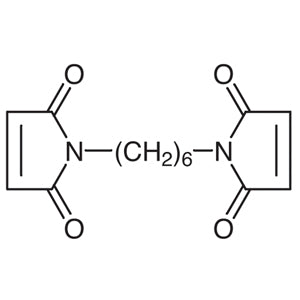
1,4-Bis(maleimido)butane is a chemical compound widely used in biochemical and organic chemistry applications. It serves as a versatile linker and crosslinker in laboratory settings, enabling the formation of covalent bonds between different molecules. This compound plays a crucial role in the construction of complex structures such as proteins, polymers, and other biomolecules. Its ability to facilitate molecular interactions makes it an essential tool for researchers working on molecular modifications and structural analysis.
The compound’s chemical properties, including its stable yet reactive nature, make it a preferred choice for various experimental processes. The maleimide groups present in its structure are capable of reacting with amino groups on target molecules, allowing for precise and controlled chemical modifications. This reactivity, combined with its specificity, ensures reliable results in applications requiring high precision. The compound’s versatility supports its use across multiple research fields, including biochemistry and pharmaceutical development.
In Indonesian laboratories, 1,4-Bis(maleimido)butane is commonly used in research related to biochemistry, pharmacology, and materials science. It is frequently found in projects involving molecular modification, drug development, and the creation of bio-based chemical compounds. Its availability in the local market ensures that researchers can access this essential reagent for their experimental needs.
TCI brochures (PDF)
- Cross-linkers 2026-04-14 · p. 2
- Bioconjugation Reagents 2026-07-07 · p. 8
- Monomers 2025-05-28 · p. 28
- Reagents for Biological Research 2025-03-11 · p. 29
Related TCI products
- TCI B1787 4856-87-5 1,6-Bis(maleimido)hexane
- TCI E0482 5132-30-9 1,2-Bis(maleimido)ethane
- TCI M2666 1263045-16-4 19-Maleimido-17-oxo-4,7,10,13-tetraoxa-16-azanonadecanoic Acid
- TCI B2935 1070-70-8 1,4-Bis(acryloyloxy)butane (stabilized with MEHQ)
- TCI B1770 17309-39-6 meso-Butane-1,2,3,4-tetracarboxylic Dianhydride
- TCI M3295 6613-65-6 4-[[2-(Methacryloyloxy)ethyl]dimethylammonio]butane-1-sulfonate
- Bioconjugation applications benefit from its ability to form stable covalent bonds with amino groups, enabling precise molecular attachment.
- Drug development projects utilize this compound for modifying drug molecules to enhance their therapeutic properties and stability.
- Polymer synthesis relies on its crosslinking capabilities to create durable and functional materials with tailored properties.
- Protein modification studies use it to link biomolecules for structural analysis and functional studies in biotechnology.
- Biomaterial research incorporates it to develop biocompatible materials for tissue engineering and medical device applications.
| Brand | TCI |
|---|---|
| CAS number | 28537-70-4 |
| Molecular formula | — |
| Purity | — |
| Category | Chemistry > Chemical Biology > Linkers and Crosslinkers |
| Pack sizes | Available in various quantities as per supplier listing |
| Physical form | Solid |
| Storage | Store in a cool, dry place away from moisture and direct sunlight |
This compound should be stored in a cool, dry environment to maintain its chemical stability and reactivity. It is recommended to keep it in a tightly sealed container to prevent exposure to moisture and air, which could affect its performance. Due to its reactive nature, it should be handled with care in a well-ventilated laboratory setting. Avoid contact with incompatible substances to ensure safety during use. Proper personal protective equipment, such as gloves and safety goggles, should be worn when handling the material. Regular monitoring of storage conditions is essential to maintain the integrity of the compound for research applications.
—
Product Categories
Produk Terkait
-
1,6-Bis(maleimido)hexane TCI B1787
Regular price Rp 4.054.050,00Regular priceRp 2.850.750,00Sale price Rp 4.054.050,00 -
1,2-Bis(maleimido)ethane TCI E0482
Regular price Rp 4.054.050,00Regular priceRp 2.850.750,00Sale price Rp 4.054.050,00 -
19-Maleimido-17-oxo-4,7,10,13-tetraoxa-16-azanonadecanoicAcid TCI M2666
Regular price From Rp 1.378.650,00Regular priceRp 979.650,00Sale price From Rp 1.378.650,00 -
1,4-Bis(acryloyloxy)butane(stabilizedwithMEHQ) TCI B2935
Regular price Rp 637.350,00Regular priceRp 445.200,00Sale price Rp 637.350,00 -
meso-Butane-1,2,3,4-tetracarboxylicDianhydride TCI B1770
Regular price From Rp 1.749.300,00Regular priceRp 1.239.000,00Sale price From Rp 1.749.300,00 -
4-[[2-(Methacryloyloxy)ethyl]dimethylammonio]butane-1-sulfonate TCI M3295
Regular price Rp 4.108.650,00Regular priceRp 2.888.550,00Sale price Rp 4.108.650,00 -
MethacrylicAnhydride[stabilizedwith1,1,3-Tris(3-tert-butyl-4-hydroxy-6-methylphenyl)butane] TCI M3139
Regular price From Rp 1.246.350,00Regular priceRp 887.250,00Sale price From Rp 1.246.350,00 -
4-(1,1,2-Trimethyl-1H-benzo[e]indol-3-ium-3-yl)butane-1-sulfonate TCI T4291
Regular price From Rp 557.550,00Regular priceRp 405.300,00Sale price From Rp 557.550,00