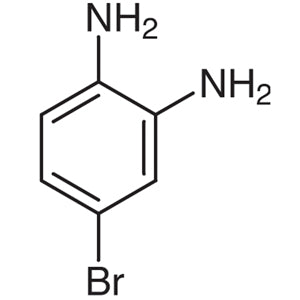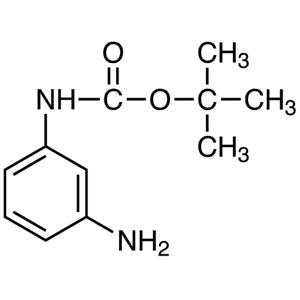
N-(tert-Butoxycarbonyl)-1,3-phenylenediamine is a chemical compound widely used in laboratory settings as a building block for the synthesis of complex molecules. This compound plays a crucial role in organic chemistry, particularly in reactions that involve structural modification or functional group transformation. Its versatility makes it an essential reagent in various synthetic pathways, enabling the creation of heterocyclic compounds, pharmaceuticals, and industrial chemicals. Due to its reactivity and stability under controlled conditions, it is a valuable tool for chemists aiming to achieve precise molecular designs.
The compound’s unique structure, featuring a tert-butoxycarbonyl group, allows for controlled cleavage or substitution reactions, making it ideal for applications requiring high specificity. Its solubility in organic solvents enhances its usability in a wide range of experimental procedures. Additionally, its chemical stability ensures consistent performance across different reaction conditions, contributing to reliable and reproducible results. These properties make it a preferred choice for researchers working on advanced synthetic projects.
In Indonesian laboratories, this compound is commonly used in organic chemistry research, drug development, and industrial chemical production. It supports academic and industrial efforts in creating new materials and compounds with specific functional properties. Its presence in research institutions and laboratories across the country underscores its importance in advancing chemical innovation and scientific discovery.
Related TCI products
- TCI B4238 146651-75-4 N-(tert-Butoxycarbonyl)-1,2-phenylenediamine
- TCI B4081 71026-66-9 N-(tert-Butoxycarbonyl)-1,4-phenylenediamine
- TCI T3770 485831-34-3 N,N,N',N'-Tetrakis[4-(diisobutylamino)phenyl]-1,4-phenylenediamine
- TCI T3239 368-53-6 5-Trifluoromethyl-1,3-phenylenediamine
- TCI T1457 3102-87-2 2,3,5,6-Tetramethyl-1,4-phenylenediamine
- TCI T1275 3102-70-3 2,4,6-Trimethyl-1,3-phenylenediamine
- Organic synthesis for the creation of complex molecules and pharmaceutical intermediates due to its reactivity and structural versatility.
- Development of heterocyclic compounds as it facilitates controlled functional group modifications and structural transformations.
- Pharmaceutical research where precise molecular design is essential for drug molecule synthesis and optimization.
- Industrial chemical production for the manufacture of specialty chemicals and materials requiring specific functional groups.
- Academic research in chemical laboratories focusing on synthetic methodologies and molecular engineering applications.
| Brand | TCI |
|---|---|
| CAS number | 68621-88-5 |
| Molecular formula | — |
| Purity | — |
| Category | Chemistry > Building Blocks > Non-Heterocyclic Building Blocks |
| Pack sizes | Available in various quantities as per standard laboratory supply specifications |
| Physical form | Solid, typically in powder or crystalline form |
| Storage | Store in a cool, dry place away from moisture and direct sunlight |
This compound should be stored in a cool, dry environment to maintain its chemical stability and prevent degradation. It is recommended to keep it in airtight containers to minimize exposure to moisture and air, which can affect its reactivity. Due to its potential chemical reactivity, it should be handled in a well-ventilated laboratory setting, preferably with appropriate personal protective equipment. Avoid contact with incompatible substances to ensure safety during storage and use. Regular monitoring of storage conditions is advised to maintain optimal performance and safety standards in the laboratory.
—
Produk Terkait
-
N-(tert-Butoxycarbonyl)-1,2-phenylenediamine TCI B4238
Regular price From Rp 2.252.250,00Regular priceRp 1.590.750,00Sale price From Rp 2.252.250,00 -
N-(tert-Butoxycarbonyl)-1,4-phenylenediamine TCI B4081
Regular price From Rp 2.199.750,00Regular priceRp 1.554.000,00Sale price From Rp 2.199.750,00 -
N,N,N',N'-Tetrakis[4-(diisobutylamino)phenyl]-1,4-phenylenediamine TCI T3770
Regular price From Rp 2.147.250,00Regular priceRp 1.517.250,00Sale price From Rp 2.147.250,00 -
5-Trifluoromethyl-1,3-phenylenediamine TCI T3239
Regular price Rp 1.326.150,00Regular priceRp 942.900,00Sale price Rp 1.326.150,00 -
2,3,5,6-Tetramethyl-1,4-phenylenediamine TCI T1457
Regular price From Rp 1.934.100,00Regular priceRp 1.368.150,00Sale price From Rp 1.934.100,00 -
2,4,6-Trimethyl-1,3-phenylenediamine TCI T1275
Regular price From Rp 3.658.200,00Regular priceRp 2.573.550,00Sale price From Rp 3.658.200,00 -
4-Bromo-1,2-phenylenediamine TCI B3181
Regular price From Rp 1.724.100,00Regular priceRp 1.205.400,00Sale price From Rp 1.724.100,00 -
N,N,N',N'-Tetramethyl-1,4-phenylenediamineDihydrochloride TCI T0151
Regular price From Rp 584.850,00Regular priceRp 408.450,00Sale price From Rp 584.850,00