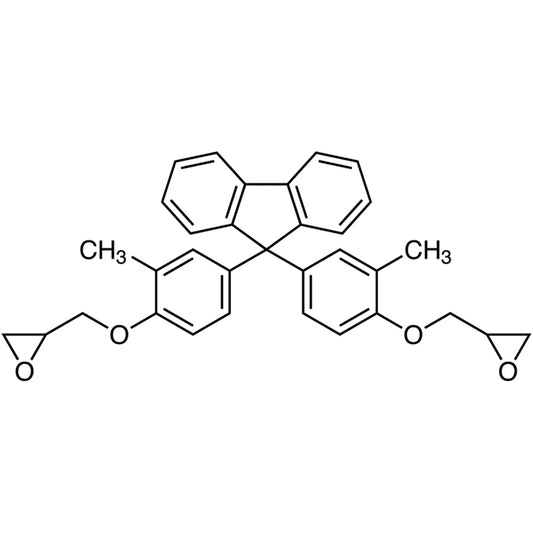
9,9-Bis(4-glycidyloxyphenyl)fluorene is a chemical compound widely used in laboratory settings for the synthesis of complex organic molecules. This compound features a fluorene core with epoxy groups attached at both ends, enabling highly specific chemical reactions. Its unique structure makes it a valuable tool in organic chemistry for creating polymers, resins, and composite materials. Due to its reactivity and structural versatility, it is a key component in advanced chemical research and development.
The compound's high reactivity and stability under controlled conditions make it a preferred choice for precise chemical synthesis. The presence of epoxy groups allows it to react with various functional groups such as amines, carboxylic acids, and hydroxyls. This reactivity expands its applications in the creation of diverse organic compounds. Its molecular complexity and functional versatility make it a sought-after material in both academic and industrial research environments.
In Indonesian laboratories, 9,9-Bis(4-glycidyloxyphenyl)fluorene is commonly used in organic chemistry research, material development, and epoxy resin production. It is a key reagent in the synthesis of new materials and is widely utilized by research institutions and universities. Its role in chemical innovation and material science makes it an essential compound for advanced laboratory work in Indonesia.
TCI brochures (PDF)
- Epoxide Monomers 2025-09-19 · p. 2
- Fluorenes and Fluorenones 2026-04-15 · p. 6
- Monomers 2025-05-28 · p. 20
Related TCI products
- Organic synthesis applications benefit from this compound's reactivity and structural versatility, enabling the creation of complex molecules.
- Epoxy resin development relies on its epoxy groups, which allow for cross-linking and polymerization in resin formulations.
- Composite material research utilizes its ability to bond with various functional groups, enhancing the properties of composite structures.
- Polymer science applications leverage its fluorene core for creating high-performance polymers with tailored properties.
- Material innovation projects use it as a building block for designing new materials with specific chemical and physical characteristics.
| Brand | TCI |
|---|---|
| CAS number | 47758-37-2 |
| Molecular formula | — |
| Purity | — |
| Category | Chemistry > Building Blocks > Heterocyclic Building Blocks |
| Pack sizes | Available in standard laboratory quantities |
| Physical form | Solid |
| Storage | Store in a cool, dry place away from light and moisture |
This compound should be stored in a cool, dry environment, away from direct light and moisture to maintain its chemical integrity. It is recommended to use airtight containers made of materials that are chemically inert, such as glass or high-density polyethylene, to prevent contamination and degradation. Due to its reactivity, it should be handled with care, using appropriate personal protective equipment when necessary. Proper labeling and storage conditions are essential to ensure safety and maintain the compound's effectiveness in laboratory applications. Always follow standard laboratory safety protocols when working with reactive chemicals.
—
Produk Terkait
-
2,2-Bis(4-glycidyloxyphenyl)propane TCI B1796
Regular price From Rp 1.115.100,00Regular priceRp 779.100,00Sale price From Rp 1.115.100,00 -
9,9-Bis(4-glycidyloxy-3-methylphenyl)fluorene TCI B4666
Regular price From Rp 2.518.950,00Regular priceRp 1.760.850,00Sale price From Rp 2.518.950,00 -
4-Glycidyloxycarbazole TCI G0296
Regular price From Rp 1.696.800,00Regular priceRp 1.202.250,00Sale price From Rp 1.696.800,00 -
NeopentylGlycolDiglycidylEther TCI N0448
Regular price From Rp 955.500,00Regular priceRp 667.800,00Sale price From Rp 955.500,00 -
BenzylGlycidylEther TCI B2108
Regular price From Rp 1.510.950,00Regular priceRp 1.056.300,00Sale price From Rp 1.510.950,00 -
AllylGlycidylEther TCI A0221
Regular price From Rp 477.750,00Regular priceRp 333.900,00Sale price From Rp 477.750,00 -
3-(Oxiran-2-yl)-7-oxabicyclo[410]heptane(mixtureofisomers) TCI V0195
Regular price From Rp 3.870.300,00Regular priceRp 2.705.850,00Sale price From Rp 3.870.300,00 -
4-tert-ButylphenylGlycidylEther TCI B4831
Regular price From Rp 2.279.550,00Regular priceRp 1.593.900,00Sale price From Rp 2.279.550,00