


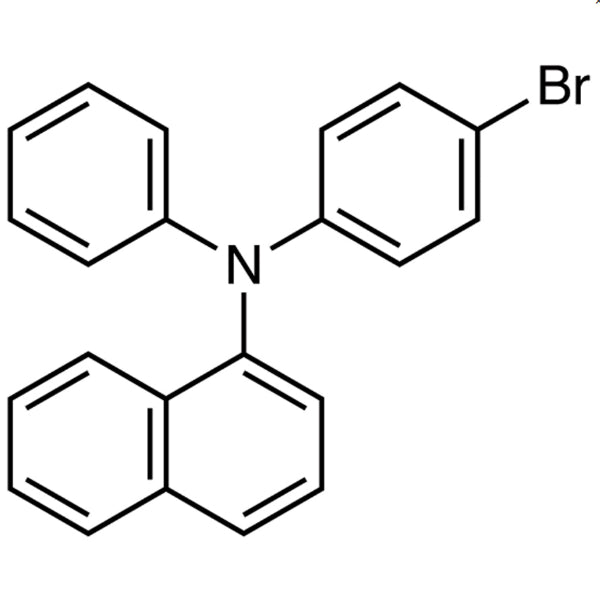
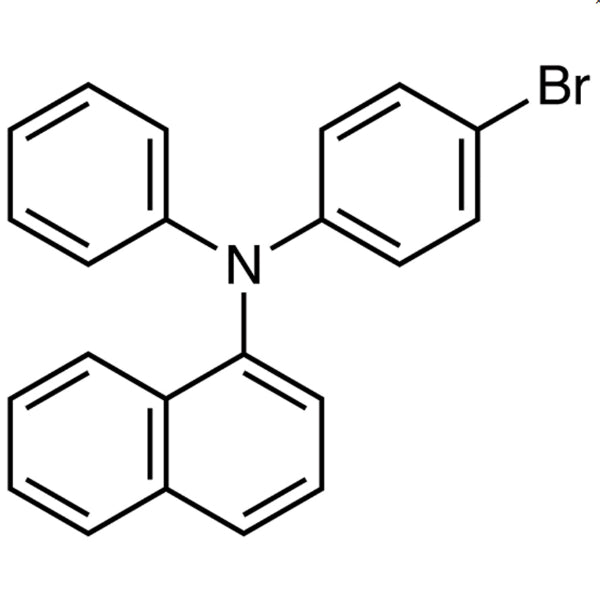
N-(4-Bromophenyl)-N-phenyl-1-naphthylamine is an organic compound widely utilized in semiconductor material research and materials science laboratories. This compound plays a crucial role in the development of advanced materials with unique optical and electronic properties. Its complex structure, composed of aromatic groups and amine functionalities, makes it a key building block for synthesizing novel materials. Due to its chemical versatility, it is frequently employed in the creation of optoelectronic devices and other advanced material systems.
The compound’s chemical structure and reactivity make it a preferred choice for researchers. Its ability to form stable chemical bonds with various functional groups enables its use in the synthesis of complex molecules and material modifications. Additionally, its chemical stability under specific conditions simplifies handling and storage in laboratory settings. These characteristics make it an essential component in the development of next-generation electronic and optical materials.
In Indonesian laboratories, this compound is commonly used in the synthesis and characterization of new materials. Researchers in semiconductor and materials science fields rely on it for creating compounds with tailored optical and electronic properties. Its presence in laboratory workflows supports the advancement of optoelectronic technologies, such as LEDs and photodetectors. The compound’s reliability and performance in controlled environments make it a valuable tool for scientific innovation.
TCI brochures (PDF)
- Building Blocks for Organic Semiconductor 2026-03-24 · p. 31
Related TCI products
- TCI B4660 850153-24-1 N,N-Bis(4-bromophenyl)-4-(4,4,5,5-tetramethyl-1,3,2-dioxaborolan-2-yl)aniline
- TCI T2201 634-43-5 N-(p-Tolyl)-1-naphthylamine
- TCI T2065 644-16-6 N-(p-Tolyl)-2-naphthylamine
- TCI B5047 446242-37-1 N-(4-Biphenylyl)-1-naphthylamine
- TCI P0197 90-30-2 N-Phenyl-1-naphthylamine
- TCI N0052 134-32-7 1-Naphthylamine
- Used in semiconductor material synthesis due to its ability to form stable chemical bonds with various functional groups.
- Applied in optoelectronic device development because of its interaction with light and electron behavior.
- Employed in material characterization studies for its unique optical and electronic properties.
- Utilized in sensor development for its sensitivity to environmental changes and chemical interactions.
- Integrated into research on advanced electronic materials due to its structural versatility and chemical stability.
| Brand | TCI |
|---|---|
| CAS number | 138310-84-6 |
| Molecular formula | — |
| Purity | — |
| Category | Materials Science > Material Building Blocks > Small Molecule Semiconductor Building Blocks |
| Pack sizes | Available in various quantities as per standard laboratory supply standards |
| Physical form | Solid, crystalline or powder depending on production batch |
| Storage | Store in a cool, dry place away from light and moisture |
This compound should be stored in a cool, dry environment, away from direct sunlight and moisture. It is recommended to use airtight containers to prevent exposure to air and humidity. Proper ventilation should be maintained in the laboratory to ensure safe handling. Due to its chemical nature, it should be handled with appropriate personal protective equipment, such as gloves and safety goggles. Storage conditions should be controlled to maintain its stability and prevent degradation. Regular monitoring of storage conditions is advised to ensure the compound remains in optimal condition for research applications.
—
Produk Terkait
-
N,N-Bis(4-bromophenyl)-4-(4,4,5,5-tetramethyl-1,3,2-dioxaborolan-2-yl)aniline TCI B4660
Regular price From Rp 3.790.500,00Regular priceRp 2.665.950,00Sale price From Rp 3.790.500,00 -
N-(p-Tolyl)-1-naphthylamine TCI T2201
Regular price Rp 4.426.800,00Regular priceRp 3.095.400,00Sale price Rp 4.426.800,00 -
N-(p-Tolyl)-2-naphthylamine TCI T2065
Regular price Rp 2.359.350,00Regular priceRp 1.649.550,00Sale price Rp 2.359.350,00 -
N-(4-Biphenylyl)-1-naphthylamine TCI B5047
Regular price From Rp 1.670.550,00Regular priceRp 1.167.600,00Sale price From Rp 1.670.550,00 -
N-Phenyl-1-naphthylamine TCI P0197
Regular price From Rp 452.550,00Regular priceRp 316.050,00Sale price From Rp 452.550,00 -
1-Naphthylamine TCI N0052
Regular price From Rp 1.590.750,00Regular priceRp 1.111.950,00Sale price From Rp 1.590.750,00 -
Trimethylamine(ca.8%inToluene,ca.1mol/L) TCI T3614
Regular price Rp 1.087.800,00Regular priceRp 760.200,00Sale price Rp 1.087.800,00 -
Trimethylamine(ca.25%inIsopropylAlcohol,ca.3mol/L) TCI T2893
Regular price From Rp 717.150,00Regular priceRp 500.850,00Sale price From Rp 717.150,00


