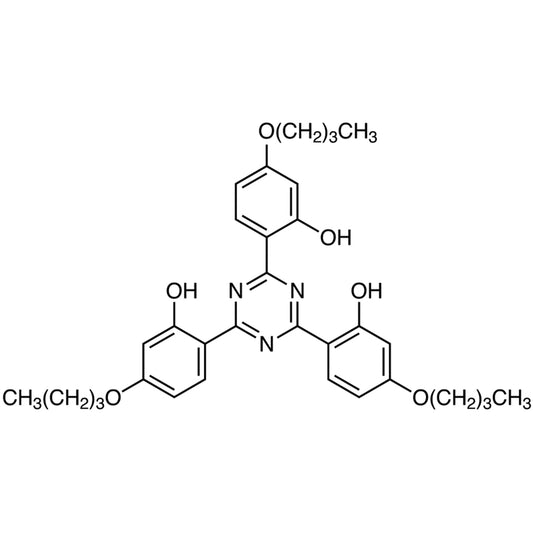
TCI B4399, with the CAS number 2725-22-6, is a complex chemical compound classified under the triazine family. This material is widely used in scientific laboratories for polymer modification and chemical reactions that require the adjustment of specific material properties. Its molecular structure allows for versatile interactions with various polymers, making it a valuable tool in material science research. As a polymer additive, it plays a crucial role in enhancing the performance of synthetic materials by altering their mechanical, thermal, or optical characteristics.
The compound's chemical stability and ability to form bonds with other molecules make it a preferred choice for researchers. Its non-toxic nature also contributes to its safety profile, ensuring it can be used in controlled laboratory environments without significant health risks. These properties enable it to function as a binder, protector, or modifier in different chemical processes. Its compatibility with a wide range of polymers further expands its applicability in both academic and industrial research settings.
In Indonesian laboratories, this compound is commonly used in material science and polymer research. It supports studies aimed at developing new materials with enhanced properties, such as improved durability or thermal resistance. Its role in modifying polymer behavior makes it an essential component in experiments related to polymer synthesis and functional material development. Researchers in Indonesia rely on this compound for its reliability and effectiveness in achieving desired material outcomes.
TCI brochures (PDF)
- Triazines Useful as Electron Transport Materials for OLEDs and as UV Absorbers 2025-03-31 · p. 2
- Polymer Additives 2026-04-16 · p. 7
Related TCI products
- TCI D4527 1668-53-7 2-(2,4-Dihydroxyphenyl)-4,6-bis(2,4-dimethylphenyl)-1,3,5-triazine
- TCI H1531 106556-36-9 2-(2-Hydroxy-4-methoxyphenyl)-4,6-diphenyl-1,3,5-triazine
- TCI B6601 137658-79-8 2-[4,6-Bis(2,4-dimethylphenyl)-1,3,5-triazin-2-yl]-5-[3-[(2-ethylhexyl)oxy]-2-hydroxypropoxy]phenol
- TCI T3870 3135-19-1 2,4,6-Tris(4-butoxy-2-hydroxyphenyl)-1,3,5-triazine
- TCI T3869 2125-23-7 2,4,6-Tris(2,4-dihydroxyphenyl)-1,3,5-triazine
- TCI T3240 82504-70-9 N,N',N''-Tri(m-tolyl)-1,3,5-triazine-2,4,6-triamine
- Polymer modification in synthetic material development due to its ability to alter mechanical and thermal properties.
- Chemical reaction optimization for creating functionalized polymers with enhanced performance characteristics.
- Research in material science for developing advanced composites with improved optical and structural properties.
- Formulation of polymer-based coatings and adhesives requiring controlled cross-linking and stability.
- Testing of polymer additives in industrial applications to improve product durability and processability.
| Brand | TCI |
|---|---|
| CAS number | 2725-22-6 |
| Molecular formula | — |
| Purity | — |
| Category | Materials Science > Polymer/Macromolecule Reagents > Polymer Additives |
| Pack sizes | Available in standard laboratory quantities as per supplier specifications |
| Physical form | Solid, as per standard product description |
| Storage | Store in a cool, dry place away from direct sunlight and moisture |
This compound should be stored in a cool, dry environment to maintain its chemical stability. It is recommended to use airtight containers to prevent moisture absorption and contamination. Due to its non-toxic nature, it does not require special handling beyond standard laboratory safety protocols. Avoid exposure to high temperatures and direct light to preserve its integrity. Always ensure proper ventilation when handling the material to maintain a safe working environment. Regularly check storage conditions to ensure optimal preservation of the compound's properties.
—
Produk Terkait
-
2-(2,4-Dihydroxyphenyl)-4,6-bis(2,4-dimethylphenyl)-1,3,5-triazine TCI D4527
Regular price From Rp 2.677.500,00Regular priceRp 1.887.900,00Sale price From Rp 2.677.500,00 -
2-(2-Hydroxy-4-methoxyphenyl)-4,6-diphenyl-1,3,5-triazine TCI H1531
Regular price From Rp 1.908.900,00Regular priceRp 1.350.300,00Sale price From Rp 1.908.900,00 -
2-[4,6-Bis(2,4-dimethylphenyl)-1,3,5-triazin-2-yl]-5-[3-[(2-ethylhexyl)oxy]-2-hydroxypropoxy]phenol TCI B6601
Regular price From Rp 1.961.400,00Regular priceRp 1.387.050,00Sale price From Rp 1.961.400,00 -
2,4,6-Tris(4-butoxy-2-hydroxyphenyl)-1,3,5-triazine TCI T3870
Regular price From Rp 2.041.200,00Regular priceRp 1.442.700,00Sale price From Rp 2.041.200,00 -
2,4,6-Tris(2,4-dihydroxyphenyl)-1,3,5-triazine TCI T3869
Regular price Rp 5.935.650,00Regular priceRp 4.166.400,00Sale price Rp 5.935.650,00 -
N,N',N''-Tri(m-tolyl)-1,3,5-triazine-2,4,6-triamine TCI T3240
Regular price From Rp 2.518.950,00Regular priceRp 1.776.600,00Sale price From Rp 2.518.950,00 -
2-(2,4-Dihydroxyphenyl)-4,6-diphenyl-1,3,5-triazine TCI D4819
Regular price From Rp 1.881.600,00Regular priceRp 1.331.400,00Sale price From Rp 1.881.600,00 -
2,4,8,10-Tetraoxaspiro[5.5]undecane-3,9-diylbis(2-methylpropane-2,1-diyl)Bis[3-[3-(tert-butyl)-4-hydroxy-5-methylphenyl]propanoate] TCI T3804
Regular price From Rp 875.700,00Regular priceRp 627.900,00Sale price From Rp 875.700,00