

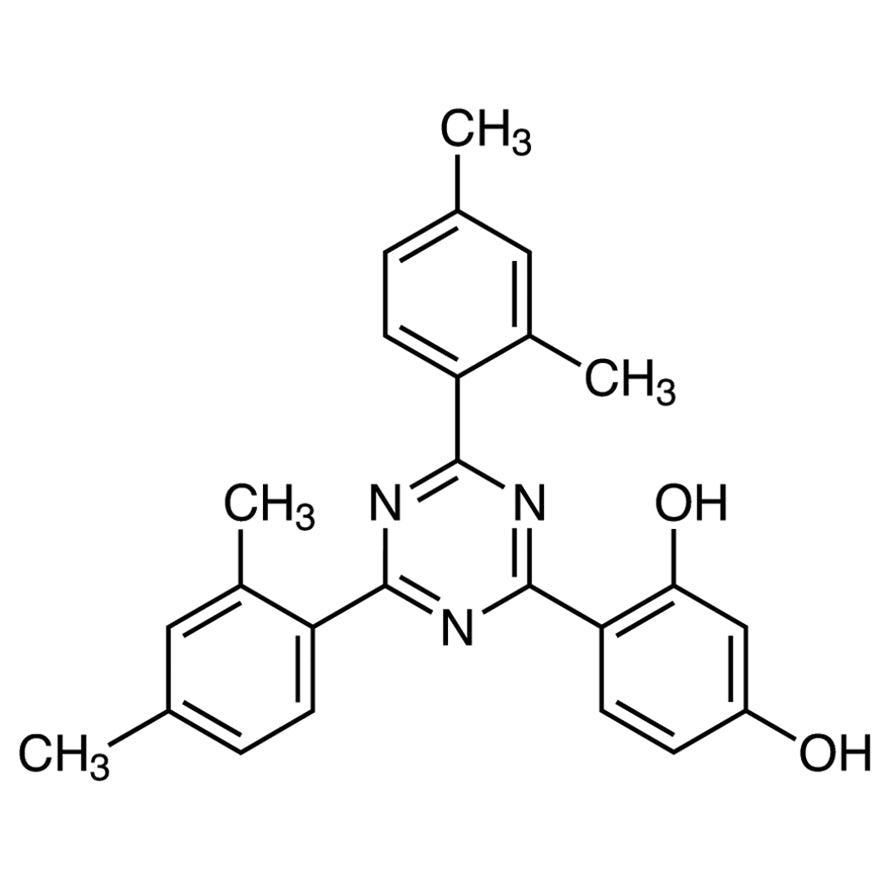
2-(2,4-Dihydroxyphenyl)-4,6-bis(2,4-dimethylphenyl)-1,3,5-triazine is a chemical compound widely used in scientific and industrial applications, particularly in the field of materials science and polymer chemistry. This compound serves as a key reagent or additive in laboratory settings, where it is employed in the synthesis of organic compounds and the development of polymers with specific properties. Its complex molecular structure, consisting of a triazine core linked to phenyl and alkyl groups, makes it a versatile material for chemical reactions.
The compound’s chemical stability and controlled reactivity make it a preferred choice for researchers seeking precision and consistency in their experiments. Its ability to participate in various chemical reactions, including polymer modification and radical scavenging, enhances its utility in both academic and industrial research. The molecular structure also allows for tailored applications in the creation of advanced materials with desired functional properties.
In Indonesian laboratories, this compound is commonly used by researchers in educational and research institutions across disciplines such as chemistry, materials science, and engineering. It plays a crucial role in applied research focused on the development of new materials or chemical processes. Its presence in laboratory workflows underscores its importance in advancing scientific innovation and technological development.
- Polymer modification research utilizes this compound to enhance the properties of synthetic polymers, offering improved thermal and mechanical stability.
- Radical scavenging studies benefit from its ability to neutralize free radicals, making it valuable in antioxidant research and material durability testing.
- Organic synthesis projects often incorporate this compound as a reagent due to its reactivity and compatibility with various chemical environments.
- Advanced material development leverages its molecular structure to create complex chemical compounds with tailored functional properties.
- Industrial chemical process optimization uses this compound to improve the efficiency and performance of polymer-based products in manufacturing.
| Brand | TCI |
|---|---|
| CAS number | 1668-53-7 |
| Molecular formula | — |
| Purity | — |
| Category | Materials Science > Polymer/Macromolecule Reagents > Polymer Additives |
| Pack sizes | Available in various quantities as per supplier specifications |
| Physical form | Solid (exact form may vary based on supplier) |
| Storage | Store in a cool, dry place away from direct sunlight and moisture |
This compound should be stored in a cool, dry environment, away from direct sunlight and sources of moisture. It is recommended to use airtight containers to prevent exposure to air and humidity, which could affect its chemical stability. When handling, ensure proper personal protective equipment is worn, including gloves and safety goggles, to avoid direct contact with skin or eyes. Due to its chemical nature, it should be kept away from incompatible substances such as strong acids or bases. Regular inspection of storage conditions is advised to maintain the integrity of the material and ensure safe laboratory practices.
—
Produk Terkait
-
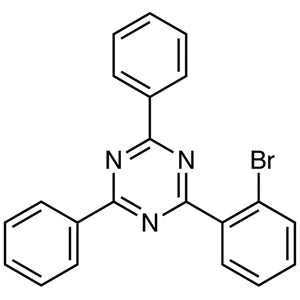
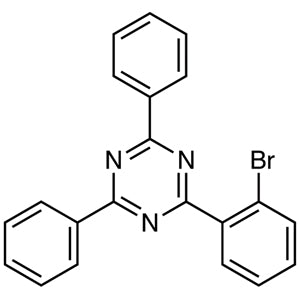
2-(2-Bromophenyl)-4,6-diphenyl-1,3,5-triazine TCI B5663
Regular price From Rp 1.856.400,00Regular price -
2-([1,1'-Biphenyl]-4-yl)-4-chloro-6-phenyl-1,3,5-triazine TCI B5792
Regular price From Rp 1.670.550,00Regular price -
2-([1,1'-Biphenyl]-3-yl)-4,6-dichloro-1,3,5-triazine TCI B5796
Regular price Rp 2.704.800,00Regular price -
2-([1,1'-Biphenyl]-3-yl)-4-chloro-6-phenyl-1,3,5-triazine TCI B5803
Regular price From Rp 717.150,00Regular price -
2,4-Bis[4-(tert-butyl)phenyl]-6-chloro-1,3,5-triazine TCI B5804
Regular price From Rp 2.279.550,00Regular price -
2-[3'-Bromo[1,1'-biphenyl]-3-yl]-4,6-diphenyl-1,3,5-triazine TCI B5895
Regular price From Rp 2.809.800,00Regular price -
4-[[4,6-Bis(n-octylthio)-1,3,5-triazin-2-yl]amino]-2,6-di-tert-butylphenol TCI B5977
Regular price From Rp 1.565.550,00Regular price -
Bemotrizinol TCI B6145
Regular price From Rp 1.431.150,00Regular price
![2-([1,1'-Biphenyl]-3-yl)-4,6-dichloro-1,3,5-triazine (CAS 1402225-89-1) - TCI B5796 - AMI Scientific](http://amiscientific.com/cdn/shop/files/TCI2510B5796.jpg?v=1768815898&width=533)
![2-([1,1'-Biphenyl]-3-yl)-4-chloro-6-phenyl-1,3,5-triazine (CAS 1689576-03-1) - TCI B5803 - AMI Scientific](http://amiscientific.com/cdn/shop/files/TCI2510B5803_dbb6d0f3-4eff-4744-81be-d259549ad9cd.jpg?v=1767863399&width=533)
![2,4-Bis[4-(tert-butyl)phenyl]-6-chloro-1,3,5-triazine (CAS 253158-13-3) - TCI B5804 - AMI Scientific](http://amiscientific.com/cdn/shop/files/TCI2510B5804.jpg?v=1769180232&width=533)
![2-[3'-Bromo[1,1'-biphenyl]-3-yl]-4,6-diphenyl-1,3,5-triazine (CAS 1606981-69-4) - TCI B5895 - AMI Scientific](http://amiscientific.com/cdn/shop/files/TCI2510B5895_c69d52a5-fe12-40ac-bc68-6adcf4ff2e0f.jpg?v=1767863771&width=533)
![2-[3'-Bromo[1,1'-biphenyl]-3-yl]-4,6-diphenyl-1,3,5-triazine (CAS 1606981-69-4) - TCI B5895 - AMI Scientific](http://amiscientific.com/cdn/shop/files/TCI2510B5895.jpg?v=1768815919&width=533)
![4-[[4,6-Bis(n-octylthio)-1,3,5-triazin-2-yl]amino]-2,6-di-tert-butylphenol (CAS 991-84-4) - TCI B5977 - AMI Scientific](http://amiscientific.com/cdn/shop/files/TCI2510B5977.jpg?v=1768815943&width=533)
